
Aveanna Healthcare in Late 2026: Home Health Scale, Acquisition-Led Expansion, and the Realities of Reimbursement Risk
Aveanna Healthcare’s home care platform shows positive net income and liquidity above short-term obligations, bolstered by an August 2026 equity raise. The company leans on acquisition-driven growth and sector demand tailwinds, but faces ongoing regulatory and reimbursement headwinds that could reshape its economics.
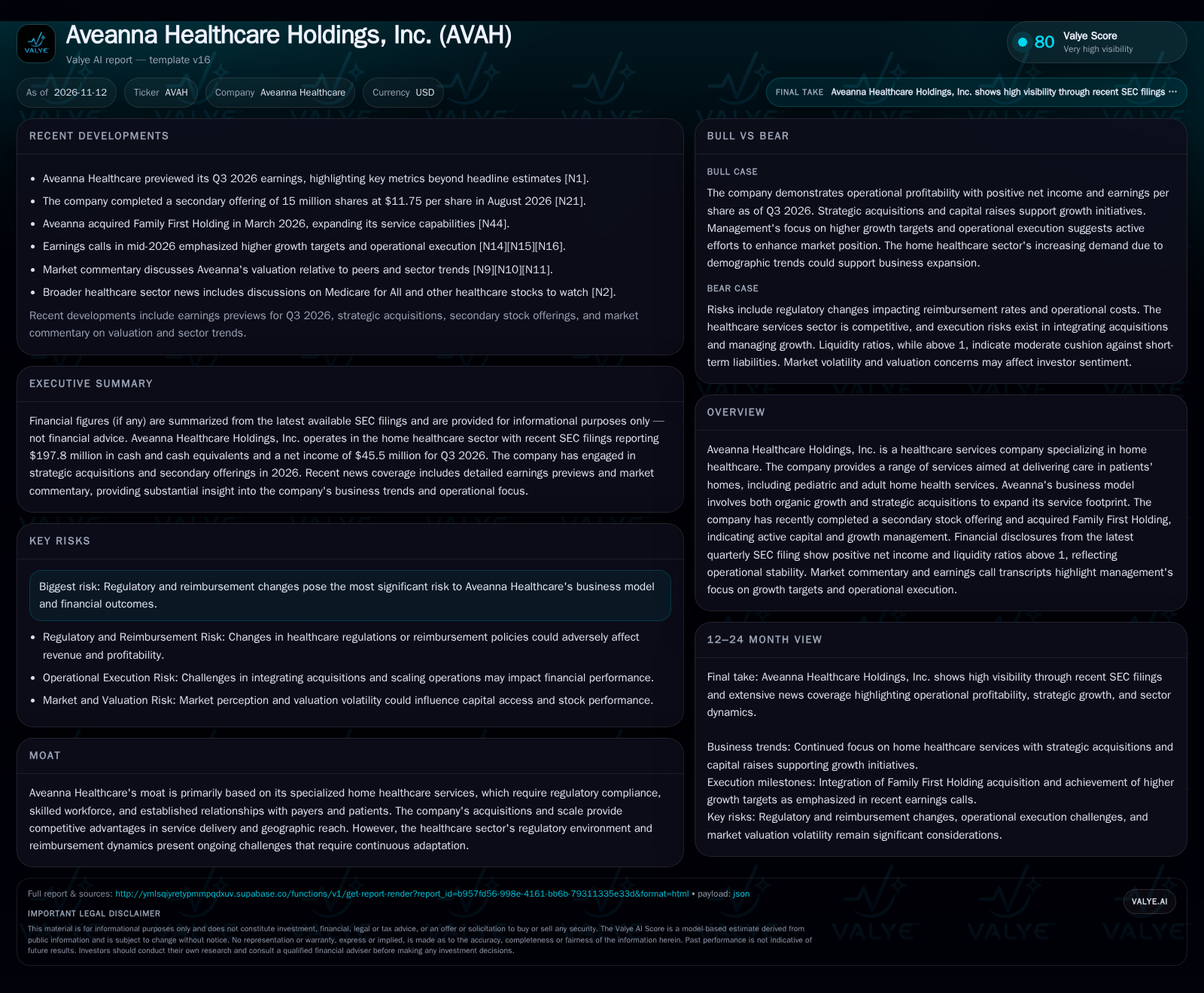
Aveanna Healthcare Holdings, Inc. reported $45.5 million in net income for Q3 2026, reported liquidity-ratio trends of 1.23, and completed a 15 million share secondary offering at $11.75/share in August 2026. The company continues to expand through acquisitions and organic growth in home healthcare services, but regulatory and reimbursement risk remains a defining challenge for its long-term business model. [S2]
Aveanna Healthcare Holdings enters late 2026 with a positive operating snapshot, reporting meaningful net income and maintaining liquidity above near-term obligations. The company’s strategic expansion—via acquisitions and organic growth—positions it to capture demographic-driven demand in the home healthcare sector. However, reimbursement and regulatory uncertainty continue to shape the durability of its economics, and the integration of recent capital raises underscores the need for scale and operational leverage in a competitive, margin-sensitive space.
Recent Earnings, Capital Raise, and Balance Sheet: What Changed in 2026
Aveanna Healthcare reported a net income of $45.5 million for the quarter ending October 3, 2026, with diluted earnings per share of $0.20. This marks continued operational profitability and suggests some success in managing cost and scale in a labor-intensive sector. [S2]
The company completed a secondary offering of 15 million shares at $11.75 per share in August 2026, increasing its cash reserves and providing additional growth capital. This move likely reflects both a response to growth opportunities and a desire to strengthen the balance sheet amid sector volatility.
As of October 3, 2026, cash and cash equivalents were $197.8 million, with current assets of $565.9 million and current liabilities of $460.3 million, yielding a current ratio of 1.23. The company reported cash and liquidity metrics for the period; these figures do not by themselves establish operating runway, investment capacity, financial flexibility, or financing capacity. [S2]
How Home Healthcare Economics Drive Aveanna’s Results and Constraints
Aveanna’s core business involves providing skilled and unskilled nursing, therapy, and related services to patients in their homes. The economics of this model are shaped by a mix of fee-for-service and managed care reimbursement, with revenue per visit or per hour determined largely by payer contracts and government rates.
Scale matters: fixed costs include regional management, compliance, and clinical oversight, while variable costs are driven by labor (nurses, therapists, aides). Margins can be sensitive to wage inflation and shifts in reimbursement rates. Acquisitions allow Aveanna to expand its referral base and geographic footprint, but integration brings risks of redundancy, system harmonization, and retention.
The capital structure, bolstered by the recent equity raise, supports further expansion. However, funding needs remain ongoing due to the working capital intensity of the sector, where collections lag service delivery and payers may delay or dispute claims. Sustainable operating leverage depends on maintaining high clinician utilization and minimizing unbillable downtime. If wage growth outpaces reimbursement or regulatory changes squeeze rates, margin compression could follow.
An additional layer affecting Aveanna’s economics is the variability in payer mix composition. The proportion of revenue derived from government programs such as Medicare and Medicaid versus commercial insurers can materially influence reimbursement stability and growth potential. Government payers often impose stricter regulatory requirements and slower payment cycles, which can increase administrative costs and working capital needs. Conversely, commercial contracts may offer higher rates but tend to be more volatile, subject to renegotiation and competitive pressures. Monitoring shifts in payer mix is therefore critical, as a growing reliance on government payers could exacerbate margin pressures, while a balanced or commercial-leaning mix might provide more pricing flexibility.
Competitive Advantages and Sector Pressures in Home Healthcare
Aveanna’s competitive edge is rooted in its scale, acquisition-driven growth, and regulatory know-how. Large providers can negotiate more favorable payer contracts and offer broader service lines, which can improve referral relationships with hospitals and health systems.
However, the sector is highly fragmented, with local agencies and specialized providers competing on service quality, flexibility, and community ties. Technology-enabled entrants and vertically integrated payers represent long-term substitution threats, especially if value-based care models gain traction and shift more risk onto providers.
Switching costs for payers are moderate: while relationships and compliance history matter, contracts are periodically rebid, and providers must demonstrate both quality and cost-effectiveness. Aveanna’s moat is reinforced by its compliance infrastructure and ability to absorb acquisitions, but success depends on ongoing adaptation to regulatory and reimbursement dynamics.
The competitive landscape also involves the strategic use of technology and data analytics to improve care coordination and operational efficiency. Providers that successfully leverage electronic health records, telehealth capabilities, and predictive analytics can reduce costs and enhance patient outcomes, potentially differentiating themselves in a fragmented market. Aveanna’s ability to integrate such technologies across acquired entities and standardize best practices could be a pivotal factor in sustaining competitive advantage. However, the capital investment and change management required to implement these systems at scale introduce execution risk, particularly if acquisitions bring disparate legacy platforms and varying levels of technological maturity.
What Could Unlock Accelerated Earnings: Scale, Integration, and Demographic Demand
A favorable scenario emerges if Aveanna successfully integrates recent acquisitions, achieves higher clinician utilization rates, and leverages its scale to negotiate better payer contracts. If demographic trends—such as aging populations and increased preference for home-based care—translate into sustained volume growth, the company could see both top-line expansion and operating leverage.
Upside would be confirmed by evidence of rising revenue per visit, stable or improving gross margins despite wage inflation, and consistent net income growth. Additional proof would come from lower days sales outstanding (DSO) and improved cash conversion, suggesting tighter working capital management and payer discipline.
A shift toward value-based contracts, if Aveanna can manage risk and demonstrate outcomes, could also lift margins if coupled with efficient care coordination.
In scenarios where Aveanna capitalizes on demographic tailwinds, the company could also benefit from increased payer willingness to support home-based care as a cost containment strategy. If insurers and government programs intensify efforts to shift care from expensive inpatient settings to home environments, reimbursement models may evolve to reward providers demonstrating quality and efficiency. This could include bundled payments or shared savings arrangements that incentivize reduced hospital readmissions and improved chronic disease management. Success in this arena would require Aveanna to develop robust care coordination capabilities and outcome measurement frameworks, enabling it to participate in value-based contracts that align financial incentives with patient health improvements.
Sustaining Growth in a Regulatory-Driven, Margin-Sensitive Sector
The most plausible trajectory for Aveanna is continued expansion through a mix of organic growth and targeted acquisitions, with moderate improvements in scale efficiency offset by ongoing reimbursement and wage pressures. The company is likely to post stable to slightly rising revenues, with margins fluctuating within a narrow band as sector dynamics evolve.
Disconfirming evidence would be sustained margin compression, rising bad debt, or a spike in regulatory challenges that reduce reimbursement rates or increase compliance costs.
The company's ability to manage integration and retain clinical staff will be critical, as will its agility in adapting to payer mix shifts and regulatory changes.
Reimbursement Cuts and Wage Inflation: The Route to Margin Compression
A negative outcome could result if regulatory changes or political pressures lead to lower reimbursement rates from Medicare, Medicaid, or private payers. If wage inflation accelerates faster than Aveanna can pass through costs or renegotiate contracts, gross margins could contract sharply.
Integration missteps from recent acquisitions—manifesting as high turnover, service disruption, or loss of referral sources—could further erode profitability. A liquidity crunch could emerge if working capital needs spike or capital markets tighten, especially if investor sentiment shifts due to sector volatility.
Downside evidence would include declining net income, a drop in the current ratio below 1, increasing days sales outstanding, and growing regulatory or legal costs tied to compliance or billing disputes.
Benchmarks to Assess Aveanna’s Expansion, Profitability, and Regulatory Exposure
Quarterly gross margin trends, especially in relation to wage inflation and reimbursement adjustments, will help gauge operating leverage.
Clinician turnover and retention rates, if disclosed, would provide insight into labor cost pressures and the sustainability of service quality.
Integration progress and realized synergies from recent acquisitions—measured by operating expense ratios or margin improvement—would test Aveanna’s ability to scale effectively.
Days sales outstanding and cash conversion cycle metrics would reveal how efficiently Aveanna is managing working capital and collections.
Changes in payer mix and the proportion of revenue from government sources versus commercial contracts would clarify exposure to regulatory risk.
Any announced or pending regulatory or reimbursement policy changes that could immediately affect home healthcare rates.
Evidence of successful entry into value-based care models or new service lines, indicating potential for margin expansion or business model adaptation.
Disclaimer: This is research-only, informational analysis and not investment advice. It may include AI-generated interpretation and general industry context. Always verify important details using primary sources.

Comments