
Avalanche Treasury Corp Q2 2026: Digital Asset Holdings Face Market Price and Custodian Risks with Internal Control Weaknesses
Avalanche Treasury Corp's Q2 2026 results highlight operating losses driven by AVAX price volatility and reveal material internal control weaknesses amid Nasdaq listing risks.
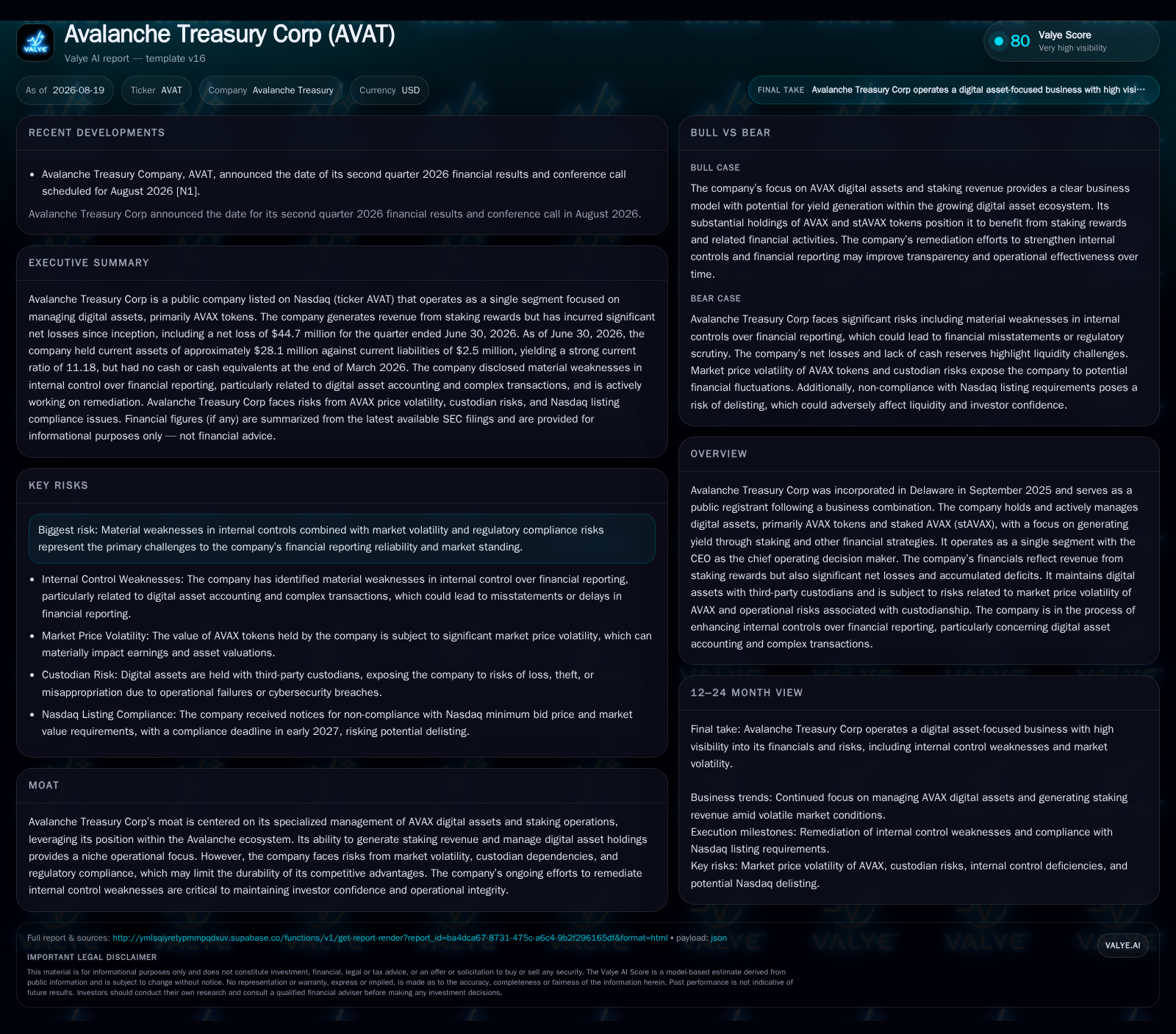
Avalanche Treasury Corp reported net losses in Q2 2026 primarily due to fluctuations in the market price of its AVAX digital assets, which are accounted for at fair value through earnings. The company disclosed material weaknesses in its internal controls over financial reporting, particularly related to digital asset accounting complexities. Additionally, Avalanche Treasury Corp received a Nasdaq minimum bid price deficiency letter in August 2026, posing potential risks to its continued listing. These developments underscore the structural challenges of managing digital asset volatility and operational risks within the digital asset treasury management sector.
Q2 2026 Operating and Financial Performance
Avalanche Treasury Corp reported operating losses for the quarter ended June 30, 2026, driven by volatility in the market price of its AVAX digital assets, which are measured at fair value and impact earnings through gains or losses on digital assets. Additionally, the company disclosed a deficiency related to Nasdaq's minimum bid price requirement, although this has not yet affected the listing status of its Class A Common Stock. These developments are significant as they contribute to earnings volatility, affect the reliability of financial reporting, and pose risks to the company's continued listing on Nasdaq, thereby influencing investor confidence and operational viability (S2, S3).
Nasdaq Listing Compliance and Market Risks
In August 2026, Avalanche Treasury Corp received a minimum bid price deficiency letter from Nasdaq, indicating that its Class A Common Stock had fallen below the minimum bid price required for continued listing on the Nasdaq Capital Market [S3]. While this deficiency letter does not have an immediate effect on the company's listing status, it signals a regulatory risk that could lead to delisting if the issue is not resolved within the prescribed timeframe.
This listing risk compounds the financial volatility stemming from AVAX price fluctuations, as sustained declines in market price could further pressure the company’s stock price and complicate compliance efforts. Maintaining Nasdaq listing compliance is critical for investor confidence and access to capital markets.
Internal Controls and Operational Risks
Avalanche Treasury Corp's management evaluated its disclosure controls and procedures as of June 30, 2026, and concluded they were not effective due to material weaknesses related to the accounting for digital assets and complex transactions [S2]. These deficiencies represent a significant operational risk, as they may impair the reliability and timeliness of financial reporting.
The complexity of accounting for digital assets, including fair value measurements and staking-related transactions, poses challenges for internal control frameworks [S2]. Material weaknesses in this area could lead to errors or misstatements in financial disclosures, potentially affecting investor trust and regulatory scrutiny. The company’s reliance on third-party custodians for AVAX and stAVAX holdings further introduces custodian risk, encompassing potential loss, theft, or misappropriation due to operational failures or cybersecurity breaches.
Balance Sheet and Liquidity Position
As of June 30, 2026, Avalanche Treasury Corp reported current assets of approximately $28.1 million, reflecting its holdings of digital assets and cash equivalents [F1]
Capital allocation during the quarter focused on acquiring and staking AVAX assets to generate yield, with no disclosed capital expenditures or debt repayments [S2]. The balance sheet thus primarily reflects digital asset holdings subject to market price volatility, without evidence of significant leverage or debt obligations.
Business Economics and Sector Context
Avalanche Treasury Corp operates within the digital asset treasury management industry, which involves holding and actively managing cryptocurrency assets to generate returns through mechanisms such as staking rewards. In this sector, key performance drivers include digital asset market price volatility, staking yield rates, custodian security, and regulatory compliance.
The company’s earnings and asset valuations are structurally exposed to AVAX price fluctuations, which cause cyclical and sometimes sharp short-term swings in financial results. Staking rewards provide a revenue stream that can partially offset these mark-to-market losses, but the net effect depends heavily on prevailing market conditions and staking yield rates.
Custodian risk is a critical operational consideration, as the company entrusts third-party custodians with its AVAX and stAVAX holdings. Operational failures or cybersecurity breaches at these custodians could result in asset loss, underscoring the importance of robust risk management and security protocols.
Analytical Conclusions
Avalanche Treasury Corp’s Q2 2026 net losses and accumulated deficits are directly linked to the volatility of AVAX market prices, which affect the carrying value of its digital assets and earnings through mark-to-market accounting [S2]. This structural exposure means that earnings volatility is an inherent feature of the company’s business model.
Additionally, the material weaknesses identified in internal controls over financial reporting, particularly relating to digital asset accounting, represent a significant operational risk. These deficiencies could impair the reliability of financial disclosures and undermine investor confidence if not remediated promptly [S2].
Forward-Looking Watchpoints
Key factors to monitor include subsequent quarterly filings for evidence of AVAX market price impact on earnings and asset valuations. Progress reports on remediation of internal control weaknesses will be critical to assess improvements in financial reporting reliability. Nasdaq compliance updates, especially regarding the minimum bid price requirement, should be closely watched given their implications for the company’s listing status. Finally, disclosures on staking yield rates and custodian risk management will provide insight into operational performance and risk mitigation effectiveness.
Scenario Considerations
One possible downside scenario is that continued AVAX price declines or volatility could lead to further mark-to-market losses, exacerbating net losses and weakening the balance sheet. Coupled with persistent internal control weaknesses, this could increase regulatory scrutiny and listing risks. Conversely, a base case scenario involves AVAX price stabilization or modest recovery, allowing staking rewards to partially offset losses. Effective remediation of control deficiencies and maintenance of Nasdaq compliance would support operational continuity and investor confidence.
Overall, Avalanche Treasury Corp’s Q2 2026 results reflect the structural challenges of managing digital asset volatility and operational risks inherent in the digital asset treasury management industry. The company’s future performance will depend on market conditions and its ability to strengthen internal controls and regulatory compliance.
Disclaimer: This is research-only, informational analysis and not investment advice. It may include AI-generated interpretation and general industry context. Always verify important details using primary sources.

Comments