
Microbot Medical Q2 2026: Initial LIBERTY System Commercial Launch and Revenue Growth Amid Ongoing Losses
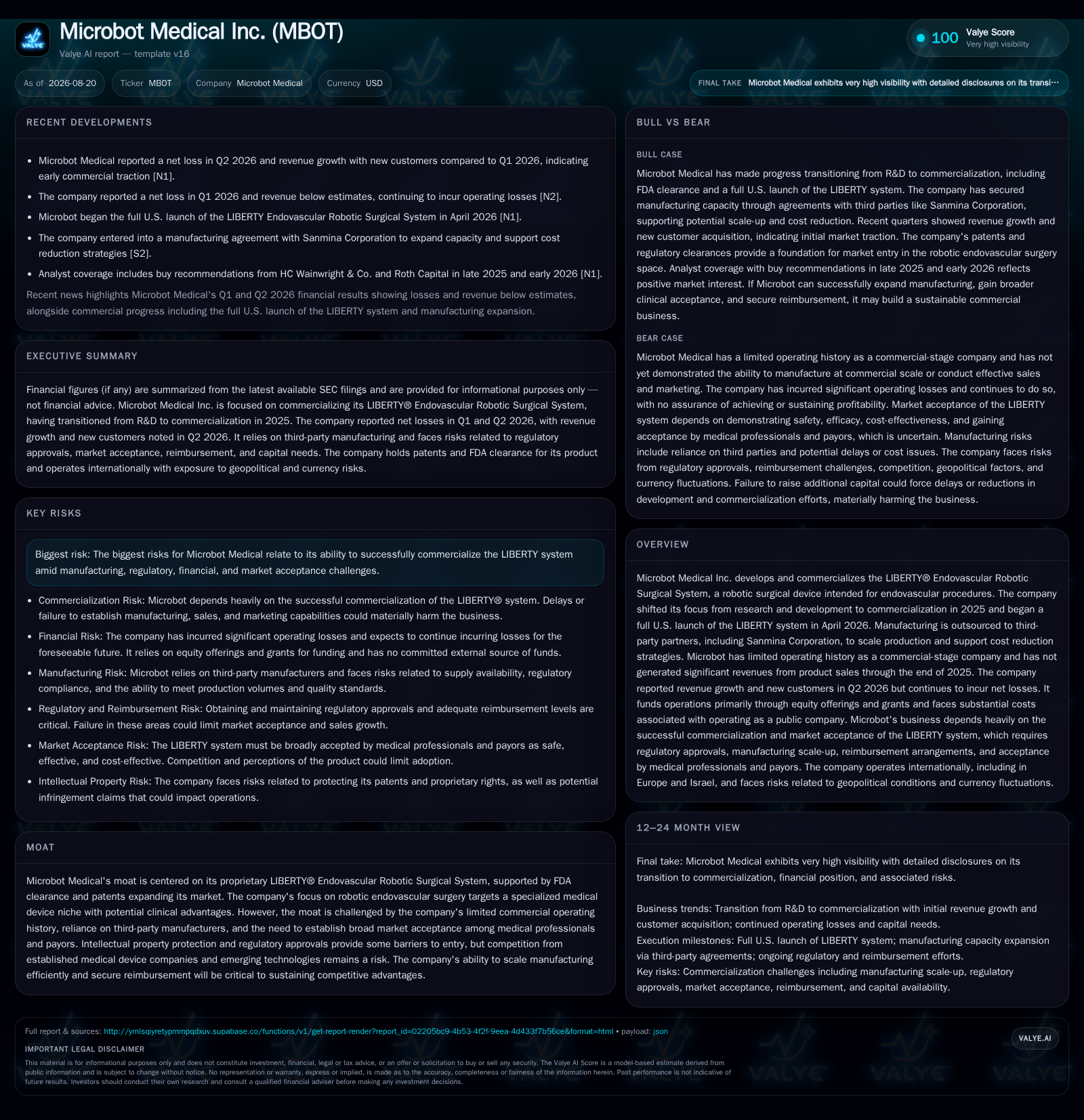
Microbot Medical commenced full U.S. commercialization of its LIBERTY® robotic surgical system in April 2026, reporting initial revenue growth and new customers in Q2 2026 while continuing to incur operating losses.
Microbot Medical transitioned from R&D to commercial-stage operations with the April 2026 U.S. launch of its LIBERTY® Endovascular Robotic Surgical System, reflected in first-quarter product revenues and customer acquisitions in Q2 2026. The company outsources manufacturing to third-party partners like Sanmina Corporation to support scaling and cost management. Despite these advances, Microbot continues to report net losses and funds operations primarily through equity offerings and grants. The key challenge remains whether Microbot can scale production, expand clinical adoption, and achieve sustained profitability amid competitive and operational risks.
Microbot Medical Inc. marked a significant milestone with the full U.S. commercial launch of its LIBERTY® Endovascular Robotic Surgical System in April 2026, reporting its first product revenues and new customer acquisitions in Q2 2026. This transition from a research and development focus to commercial-stage operations validates the strategic shift initiated in 2025 and signals the start of potential revenue growth [S2][S3]. However, this progress brings operational and financial challenges typical for early-stage medical device companies.
Manufacturing Strategy and Operational Scaling
To support anticipated demand and manage costs, Microbot Medical employs an outsourcing manufacturing strategy, partnering with third-party manufacturers such as Sanmina Corporation [S1]. This approach facilitates production scaling while controlling capital expenditures and operational complexity, aligning with industry practices for emerging medical device companies. Outsourcing allows the company to focus internal resources on product development, regulatory compliance, and commercialization. Nonetheless, reliance on third parties introduces risks related to supply chain disruptions, quality control, and cost management, which could impact the company’s ability to meet demand and maintain margins.
Financial Position and Capital Requirements
As of June 30, 2026, Microbot Medical held $3.15 million in cash and cash equivalents, with a current ratio of 18.56, reflecting $72.17 million in current assets against $3.89 million in current liabilities [F1]. Despite this liquidity, the modest cash balance underscores the need for ongoing capital raises to fund commercialization expenses, including sales, marketing, manufacturing scale-up, and regulatory activities.
Consistent with expectations for an early commercial-stage medical device company, Microbot continues to incur net losses as it invests heavily in building commercial infrastructure and expanding market presence [S2][N1]. Operating losses reflect high fixed costs and upfront investments required to launch the LIBERTY system. Funding primarily comes from equity offerings and grants, highlighting ongoing capital needs and shareholder dilution risk [S1][S2]. The balance sheet shows limited liabilities and substantial current assets, consistent with early commercialization and limited debt exposure [F1].
Business Model and Competitive Positioning
Microbot’s business model centers on selling the LIBERTY® robotic surgical system to hospitals and medical centers for minimally invasive endovascular surgeries [S1]. Revenue is expected primarily from product sales of LIBERTY units. Margins and cash conversion depend heavily on manufacturing cost efficiencies and sales scale. Currently, limited operating history and early market adoption constrain margin expansion due to fixed costs and scale-up expenses.
The LIBERTY system benefits from FDA clearance and patent protections, providing intellectual property barriers that support a competitive moat [S1]. However, competition from established medical device manufacturers with broader portfolios and longer commercial track records poses challenges. These incumbents may have advantages in sales channels, customer relationships, and reimbursement coverage, potentially slowing Microbot’s market penetration.
Hospitals must evaluate clinical benefits, cost-effectiveness, and reimbursement status before adopting the LIBERTY system. Demonstrating clinical efficacy, securing favorable reimbursement, and providing cost-competitive solutions are critical to driving adoption and revenue growth. The robotic surgical device market is driven by technological innovation and clinical adoption but remains subject to cyclical hospital capital spending, adding uncertainty to demand forecasts.
Risks and Scenario Analysis
Microbot faces execution risks in scaling manufacturing, expanding clinical adoption, and securing reimbursement coverage. Limited commercial history and reliance on third-party manufacturing introduce operational and cost uncertainties. Clinical adoption rates and payor reimbursement policies will critically influence market acceptance and revenue growth.
Three scenarios frame Microbot’s near-term outlook:
Bull Case: Successful manufacturing scale-up, broad clinical adoption, and favorable reimbursement lead to accelerating revenue growth and eventual profitability, evidenced by rising quarterly revenues, improving gross margins, and new customer contracts [S1][S2][F1]
Base Case: Modest commercial traction with gradual revenue growth, continued losses, and periodic equity financing to fund operations, supported by steady customer acquisition and manufacturing meeting demand without significant cost improvements [S2][S3][F1]
Bear Case: Challenges in manufacturing scale and market acceptance cause stagnant or declining revenues, worsening losses, and liquidity constraints, indicated by flat revenues, increasing cash burn, and negative regulatory or customer developments [S2][N1][F1]
The initial Q2 2026 revenues and customer acquisitions confirm Microbot’s transition to commercial-stage operations [S2][S3]. Nonetheless, the company remains in an early investment phase with ongoing net losses and reliance on equity financing and grants to fund commercialization [S2][N1][F1].
Investors should monitor quarterly revenue growth, customer acquisition, gross margin progression, cash burn, capital raises, regulatory or reimbursement developments, and manufacturing capacity updates. These indicators will provide insight into commercial execution and financial trajectory, informing scenario likelihood.
In summary, Microbot Medical’s commercialization of the LIBERTY® system represents a pivotal milestone. Its manufacturing outsourcing strategy and liquidity position provide a foundation for scaling operations. However, sustained net losses and capital needs highlight challenges ahead. The balance of risks and opportunities will determine whether Microbot can leverage its innovative technology to achieve profitable growth in a competitive, capital-intensive medical device market.
Disclaimer: This is research-only, informational analysis and not investment advice. It may include AI-generated interpretation and general industry context. Always verify important details using primary sources.

Comments