
Independence Power Holdings Q2 2026: Operational Management of BESS Fleet with No Revenue and Strong Liquidity
Independence Power Holdings continues managing its battery storage fleet without generating revenue in Q2 2026, maintaining a strong liquidity position.
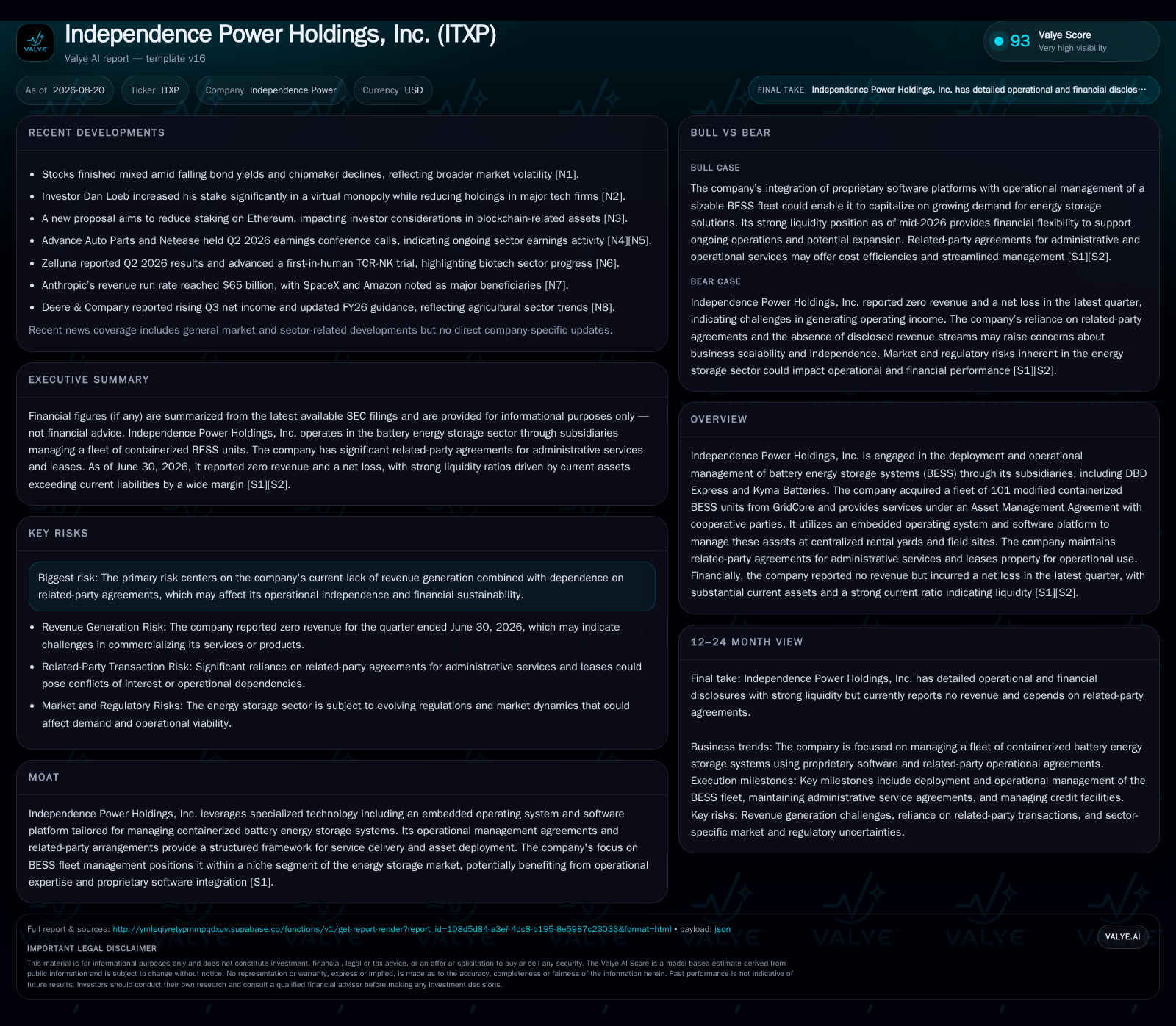
In the second quarter of 2026, Independence Power Holdings operated a fleet of 101 containerized battery energy storage systems (BESS) under asset management agreements but reported no revenue. Despite ongoing operating losses, the company sustained a robust liquidity position with a current ratio of 28.35 supported by $66.3 million in current assets. Its business model focuses on managing BESS assets and developing an embedded software platform, with future profitability hinging on scaling software and services revenues. A recent CFO resignation is underway but unrelated to financial performance.
Latest Quarterly Operating Update
Independence Power Holdings, Inc. reported no revenue in the second quarter of 2026 despite actively managing a fleet of 101 modified containerized battery energy storage system (BESS) units acquired from GridCore under an Asset Management Agreement with cooperative parties [S2][S1]. This operational management involves deploying and overseeing BESS assets at centralized rental yards and field sites using the company’s proprietary embedded operating system and software platform [S1]. The absence of revenue in Q2 2026 continues a trend from prior quarters, reflecting the company’s early commercial stage where monetization through software licenses, subscriptions, and performance-based fees has not yet commenced [S2].
Financially, Independence Power reported current assets of $66.3 million against current liabilities of $2.3 million as of June 30, 2026, resulting in a current ratio of 28.35 [F1]. This liquidity level may provide capacity to fund ongoing operations and investments in software platform development and administrative services despite the lack of revenue generation [S2][F1]. The company incurred operating losses during the quarter, driven by operating expenses related to software development and administrative functions, consistent with its early-stage business model [S2].
Business Model and Asset Management Framework
Independence Power’s core business centers on managing a sizable fleet of containerized BESS units owned and financed by rural electric cooperatives and related cooperative parties [S1]. The company provides deployment, operational management, and related services under an Asset Management Agreement, leveraging its embedded operating system and software platform to optimize asset performance and availability [S1]. These software capabilities are designed to operate across centralized battery rental yards and dispersed field sites, enabling remote monitoring and control.
Revenue generation is expected to arise primarily from software licenses, subscription fees, and performance-based contracts with cooperative customers. However, as of Q2 2026, the company has not recognized recurring revenue, reflecting the early commercial phase of its business model [S2][S1]. Related-party agreements provide administrative services and property leases, which support operational infrastructure but may limit operational independence [S1]. Capital expenditures are limited as the company does not purchase BESS equipment; instead, it focuses on software platform development and service delivery.
Financial Position and Capital Allocation
The company’s liquidity position as of June 30, 2026, remains strong, with current assets of $66.3 million substantially exceeding current liabilities of $2.3 million, yielding a current ratio of 28.35 [F1]. This liquidity buffer provides a runway to fund continued operating losses and capital allocation toward software development and administrative services [S2][F1]. Net cash used in operating activities reflects the ongoing investments in scaling the software platform and supporting infrastructure without offsetting revenue inflows [S1].
Operating losses persist due to the absence of revenue and ongoing expenses related to software development, employee costs, and administrative support. The company’s capital needs are primarily operating in nature, with no expected purchases of BESS equipment since asset ownership resides with cooperatives [S1]. The resignation is explicitly stated as unrelated to the company’s financial or operational performance or any disagreements regarding policies or practices [S3]. An external search for a CFO replacement is underway. While leadership changes may influence financial management continuity, there is no current indication of operational disruption or financial distress linked to this transition [S3].
Investment Scenarios and Risks
Independence Power’s current operating profile—managing a substantial BESS fleet without revenue—places it in an early commercial development phase. This would improve operating margins and cash flow, supported by the proprietary software platform and existing fleet under management. Confirmation of this scenario would include recognition of recurring revenue, margin improvements, and new contract announcements.
This scenario assumes ongoing software development and administrative support with no material revenue growth in the near term. Confirmation would be stable liquidity ratios and continued net losses without revenue.
This risk is heightened by dependence on related-party agreements and the absence of revenue to date. The company’s liquidity position may provide a financial runway to support ongoing software platform development and operational management. Achieving sustainable profitability could depend on converting its asset management agreements into recurring revenue through software licensing and performance-based fees.
Key watchpoints for investors include the recognition of revenue in upcoming quarterly filings, trends in operating expenses and net losses, liquidity metrics, progress in software platform development, and the impact of the CFO transition on financial oversight. Monitoring these indicators will be critical to assessing the company’s trajectory from an early-stage operational model toward a scalable, revenue-generating business.
Disclaimer: This is research-only, informational analysis and not investment advice. It may include AI-generated interpretation and general industry context. Always verify important details using primary sources.

Comments