
Avalon Holdings Harnesses Dual-Segment Synergies in Waste and Leisure
Avalon's business model uniquely combines hazardous waste management with premium golf and resort operations to deliver diversified revenue streams and strategic growth potential.
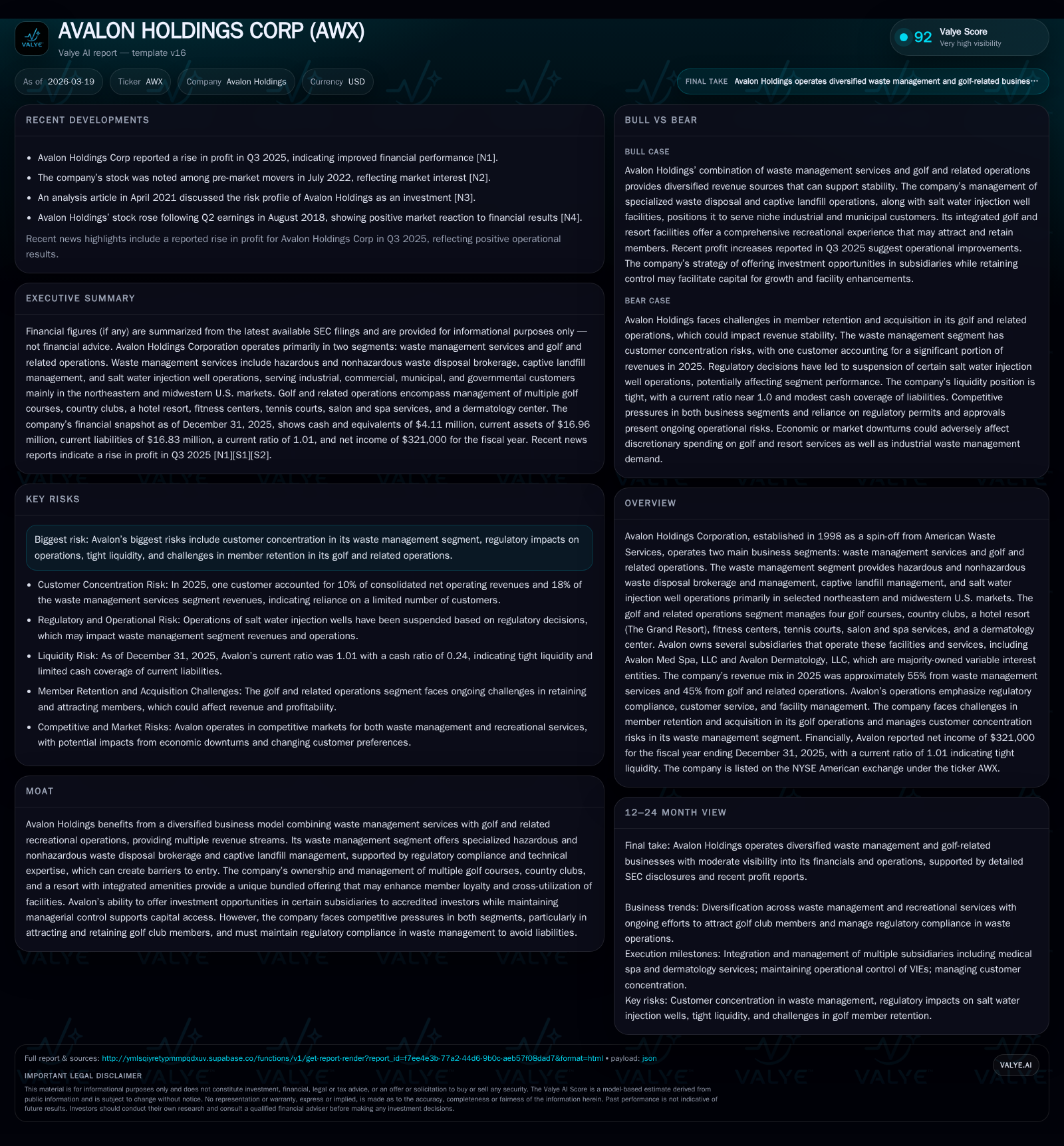
Avalon Holdings Corporation, spun off from American Waste Services in 1998, operates in two distinct sectors: specialized waste management and upscale golf and leisure services. Its revenues have shown modest growth historically, with waste management contributing about 55% of total revenues. Despite a recent decline in operating and net income, Avalon maintains positive cash flow generation. The company faces customer concentration and regulatory risks but benefits from strong insider voting control and a capital structure designed to support ongoing operations and investments without dividend payouts. Future growth depends on expanding waste service capabilities while enhancing member engagement in the recreational segment.
Evolution of Avalon’s Revenue Base and Operational Footprint
Founded in 1998 following a spin-off from American Waste Services (AWS), Avalon Holdings Corporation consolidated hazardous and nonhazardous waste disposal brokerage with real estate assets including an 18-hole golf course adjacent to its corporate headquarters [S1]. Over time, acquisitions like the Sharon Country Club (2006) and long-term leases such as Squaw Creek Country Club (2003) expanded its regional presence in golf and hospitality [S1]. The waste management segment evolved into a comprehensive service provider managing captive landfills and salt water injection wells via specialized LLCs offering private placement investment units [S1].
Financially, Avalon demonstrated modest annual revenue growth of about 3.1% between fiscal years 2012 and 2015 [F1]. By fiscal year 2025, consolidated net revenues were approximately $53 million with roughly 55% derived from waste management services and the remainder from golf-related operations [S12]. This stable dual-segment mix reflects deliberate diversification combining regulated industrial services with lifestyle offerings.
Waste Management: Specialized Services with Customer Concentration Risks
The waste management segment provides hazardous and nonhazardous waste brokerage across select northeastern and midwestern U.S. markets [S12]. Captive landfill management offers technical oversight for client-owned disposals—important given ongoing liability concerns extending from waste generation through disposal.
Strict federal and state regulations create barriers to entry but expose Avalon to environmental compliance costs and potential litigation [S11]. Robust client profiling mitigates risk prior to engagement [S1]. However, one customer accounted for about 18% of external revenues within the waste segment in 2025, indicating notable concentration risk [S12][S5]. This exposes Avalon to credit risk if major accounts face financial stress or if industry consolidation pressures pricing dynamics.
Leisure Segment: Integrated Golf, Hospitality, Wellness
Avalon's leisure operations encompass four golf courses, country clubs, a hotel resort, fitness centers, salon/spa services under Avalon Med Spa LLC, and dermatology clinics operated via majority-owned entities [S1]. Vertical integration supports bundled lifestyle offerings encouraging member loyalty through multiple recreational and wellness touchpoints.
Cross-utilization among facilities aims to smooth seasonal revenue fluctuations typical of discretionary spending categories. Nonetheless, retention challenges persist amid competitive leisure markets requiring careful balancing of operational quality against membership affordability.
Financial Performance Overview
Operating income declined sharply by approximately 34.1% year-over-year to $2.03 million for FY2025 while net income fell by about 75.6% to $321K despite steady revenues near $53 million [F1]. Margin compression likely reflects increased operational expenses or regulatory compliance costs.
Conversely, operating cash flow rose by 12.2%, reaching approximately $3.78 million—the highest recent level—indicating effective working capital management amid profit pressures [F1]. Capital expenditures decreased by over 23%, totaling around $1.73 million for FY2025, signaling disciplined investment focused on maintenance primarily within golf facilities and landfill assets [F1].
Historical performance (annual)
| FY | Net ($) | CFO ($mm) | OpInc ($mm) | Capex ($mm) | Net YoY |
|---|---|---|---|---|---|
| 2025 | 321000 | 4 | 2 | 2 | -75.6% |
| 2024 | 1318000 | 3 | 3 | 2 | +174.3% |
| 2023 | -1775000 | 2 | 0 | 4 | -204.5% |
| 2022 | -583000 | 2 | 0 | 6 |
Source: SEC companyfacts cache [F1].
Capital returns and efficiency (annual)
| FY | FCF ($mm) | ROE% |
|---|---|---|
| 2025 | 2 | 0.8 |
| 2024 | 1 | 3.5 |
| 2023 | -2 | -4.8 |
| 2022 | -4 | -1.5 |
Source: SEC companyfacts cache [F1].
Capital Structure and Liquidity
Liquidity metrics indicate a current ratio near unity at fiscal year-end with current assets around $16.96 million versus liabilities near $16.83 million [F1]. Cash and equivalents approximated $4.11 million providing operational flexibility.
Avalon carries a $5 million revolving line of credit with Premier Bank subject to borrowing base restrictions tied mainly to receivables from the waste segment; interest rates approximate Prime plus a small margin (~7.75%) as of early FY2025 [S4][S6].
No dividends are currently paid as the board prioritizes earnings retention for operational needs and selective capital investments [S1]. Voting control is concentrated among management holding Class B shares granting ten votes each representing about two-thirds of total voting power—ensuring strategic control over board composition and corporate actions [S1].
Regulatory Environment and Governance Considerations
Hazardous waste operations require compliance with evolving environmental regulations across multiple jurisdictions creating both barriers to entry and ongoing cost exposures including potential legal proceedings primarily related to environmental matters [S11][S20]. Management does not anticipate material uninsured liabilities from pending litigation.
Corporate governance incorporates anti-takeover provisions under Ohio law alongside the dual-class share structure reinforcing managerial control aimed at long-term strategic continuity without undue disruption [S1].
Outlook: Focused Growth Through Expertise and Member Engagement
Future growth will likely depend on leveraging Avalon’s technical expertise within hazardous/nonhazardous brokerage complemented by optimizing captive landfill operations where regulatory constraints limit competitors' entry [S11][S12]. Concurrently enhancing cross-selling within its integrated leisure portfolio offers avenues to expand membership base and improve resilience against cyclical trends.
Continued monitoring of operating margins amid regulatory cost pressures as well as efforts to diversify away from concentrated customers will be key metrics for stakeholders going forward.
This analysis is drawn exclusively from publicly available SEC filings dated through March 19, 2026 including detailed financials reported for fiscal year ending December 31, 2025 [F1], [S#] references cited herein without speculative projections or unverifiable assumptions.
Disclaimer: This is research-only, informational analysis and not investment advice. It may include AI-generated interpretation and general industry context. Always verify important details using primary sources.

Comments