
Autozi Internet Technology: Navigating Financial Strains Amid Rapid Revenue Shifts and Governance Concerns
Autozi’s transition to an auto parts-centric model highlights its liquidity struggles and governance challenges in a competitive Chinese automotive market.
Autozi Internet Technology (Global) Ltd. has undergone a dramatic business model shift, moving from predominantly new car sales to an almost exclusive focus on auto parts and accessories within three years. This transition coincides with deteriorating financial health, notably severe liquidity constraints and substantial net losses that threaten operational stability. Compounding these issues are material weaknesses in internal controls, attracting Nasdaq scrutiny, while a recent capital injection from the controlling shareholder offers a temporary lifeline. External pressures including fierce market competition, regulatory uncertainties, and cyclical demand further complicate recovery prospects.
From Expansion to Contraction: The Shifting Business Mix of Autozi
Autozi Internet Technology laid bare a profound transformation in its core revenue streams between fiscal years 2023 and 2025. Once dominated by new car sales constituting 65% of total revenue in FY2023, this segment collapsed to a mere 0.8% by FY2025. Meanwhile, sales of auto parts and accessories ballooned to encompass over 99% of revenues by FY2025. This precipitous shift signifies either strategic repositioning or forced retrenchment amid challenging market realities [S1].
This evolution reshaped Autozi’s revenue profile dramatically. While FY2024 showed transitional blurring—with new car sales still a significant chunk at 44.8%—the subsequent full pivot toward auto parts suggests either a throttling back of capital-intensive new vehicle inventory or responding to weakening demand dynamics. The near-vanishing insurance-related services revenue underscores potential retrenchment across other lifecycle automotive services the company once offered.
Such reliance on accessory sales typically entails lower unit economics, higher competition, and thinner margins compared to new car dealerships, placing considerable strain on profitability and cash flow.
Financial Foundations at Risk: Diagnosing Liquidity and Profitability Troubles
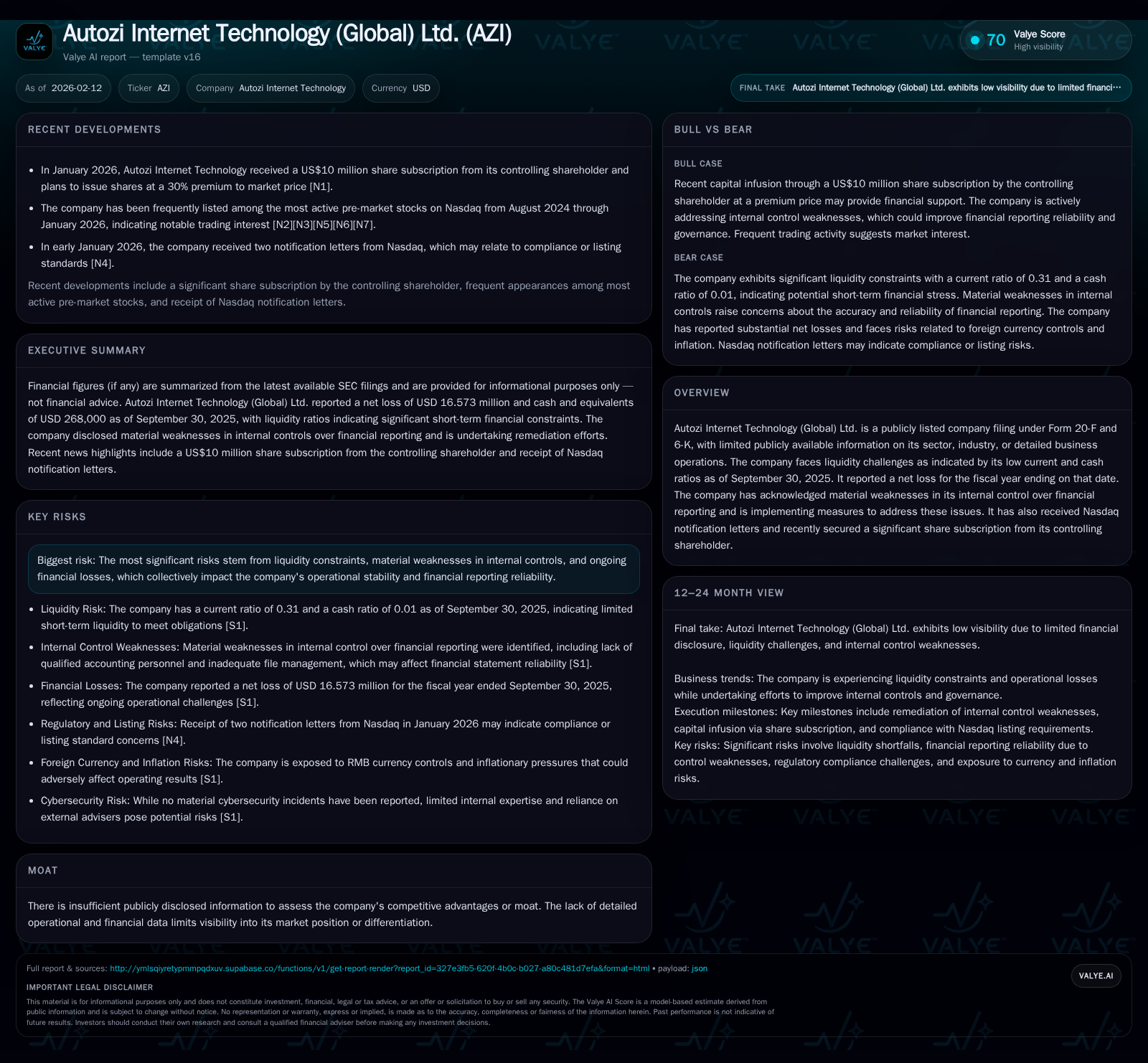
Autozi's financial footing reveals heightened vulnerability through key balance sheet ratios. At September 30, 2025, current assets totaled approximately $11.6 million against current liabilities of $37.5 million—a stark current ratio near 0.31 vividly exposing liquidity crunch conditions that leave the company struggling to meet near-term obligations [F1].
Cash on hand is bleakly insufficient at just $268,000, hardly enough cushion amid ongoing operational outflows exacerbated by their reported net loss of $16.57 million for the fiscal year ending September 30 [F1]. These figures paint a portrait of systemic financial stress that jeopardizes continued operations absent corrective measures.
Profitability has not kept pace with top-line fluctuations; instead persistent losses suggest the operational model may be underfunded or misaligned with market demands. The minimal cash reserves hint at negative working capital cycles that could throttle supply chain relationships or service commitments.
Governance Under the Microscope: Material Weaknesses and Nasdaq Oversight
Beyond financial metrics, governance gaps present additional hurdles. Autozi disclosed material weaknesses in internal control over financial reporting indicating deficiencies likely impairing accuracy or timeliness of financial statements [S1]. These weaknesses amplify risks around compliance lapses or management override potential.
The heightened scrutiny culminated in at least two official notification letters from Nasdaq addressing listing rule compliance concerns [N4]. Such letters typically signal risks regarding corporate governance standards adherence including timely disclosure obligations.
The combination of internal control lapses with regulatory pushback erodes investor confidence—particularly critical for companies navigating financial distress where transparency is essential.
Strategic Lifelines: The Controlling Shareholder’s Capital Injection
In an encouraging development amidst financial headwinds, Autozi secured a $10 million share subscription led by its controlling shareholder at a significant premium—30% above market price—as announced in January 2026 [N2].
This infusion acts as an immediate liquidity buffer providing temporary operational runway. However, considering the magnitude of net losses reported, it represents more stopgap than comprehensive solution absent structural reforms.
Reliance on insider capital increases questions about sustainable external funding access while highlighting dependency on existing ownership for survival.
Market Factors and Competitive Pressure in China’s Automotive Services
Autozi operates within China’s dynamic automotive aftermarket—a sector heavily influenced by broader economic cycles, accelerating urbanization, rising disposable incomes, and shifting consumer preferences [S1].
The company contends with intense competition not only from numerous dealership chains marketing overlapping auto brands but also from specialized suppliers offering expansive assortments of parts and custom accessories. This crowded landscape pressures margins aggressively.
Technological evolution complicates demand patterns; the rise of new energy vehicles (NEVs), autonomous driving technology, and extended part lifecycles temper replacement frequency thereby reducing accessory sales velocity.
Such external industry forces exacerbate Autozi’s internal challenges given its current heavy reliance on auto parts revenues.
Regulatory Headwinds and Their Impact on Autozi’s Operations
Government policy shifts play an outsized role in shaping Autozi’s operational terrain. For example, following implementation of stringent CHINA 6 emission standards in July 2020, parallel importation of cars was suspended—temporarily shuttering this revenue stream until prototype emission testing requirements were met in May 2021 [S1].
These oscillations underscore how deeply regulatory frameworks influence product availability and service offerings within China’s automotive retail ecosystem.
Future legislations targeting emissions reductions or foreign investment limitations remain latent risks potentially disrupting business continuity or raising compliance costs further.
Unpacking Risks: Internal Controls, Market Cyclicality, and Emerging Growth Status
Interwoven throughout Autozi's narrative is an elevated risk complexion arising from multiple sources. Deficiencies flagged in internal controls limit reliability of financial disclosures deterring investor trust at a time when transparency is paramount [S1].
Moreover, operating within cyclical industries amplifies sensitivity to macroeconomic slowdowns which could curtail vehicle purchases and downstream accessory needs alike.
Designation as an emerging growth company under U.S. SEC regulations conveys certain reporting exemptions intended to reduce burdens but simultaneously diminishes audit rigour around internal controls—potentially obscuring true operational performance [S1].
Together these factors compound questions about sustainability absent rapid remediation efforts.
The Road Ahead: Assessing Recovery Potential and Strategic Imperatives
Looking forward, Autozi faces complex crossroads balancing urgent liquidity needs against deep-rooted structural challenges. While the recent $10 million equity injection provides breathing space [N2], offsetting ongoing multi-million-dollar losses demands significant transformative actions.
Management must prioritize correcting internal control weaknesses—not solely for compliance sake but to restore credibility—and urgently seek diversification beyond near-total dependence on auto parts sales to insulate against market shifts.
Securing stable financing avenues beyond controlling shareholder support remains fundamental as does refining competitive positioning amidst fierce pricing pressures.
Rebuilding investor trust will require transparent communication grounded in measurable progress against these strategic imperatives. How effectively Autozi navigates these intertwined complexities will dictate whether it can stabilize operations or continue its downward trajectory amid intensifying sectoral battlegrounds.
Disclaimer: This analysis is for informational purposes only and does not constitute investment advice or recommendations.
Disclaimer: This is research-only, informational analysis and not investment advice. It may include AI-generated interpretation and general industry context. Always verify important details using primary sources.

Comments