
Unraveling Winchester Bancorp’s Financial Strength Amidst Limited Disclosure
Winchester Bancorp presents a paradox of solid liquidity and profitability cloaked in minimal public financial transparency.
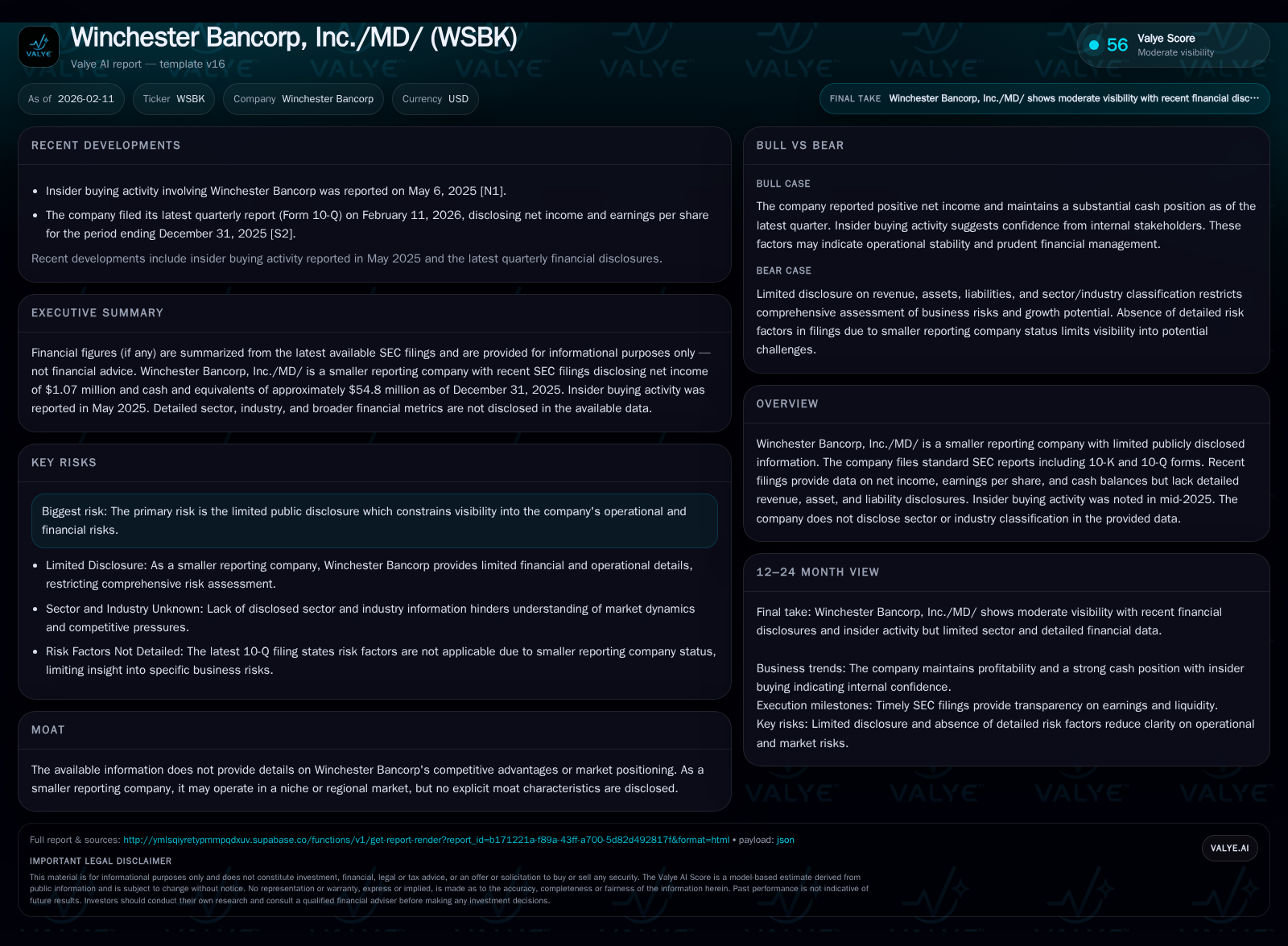
Winchester Bancorp, Inc. (WSBK) operates as a smaller reporting company with a notably sparse disclosure footprint. Despite this opacity, its most recent filings reveal a strong cash balance of approximately $54.7 million and modest net income of just over $1 million, signaling resilient core financial health. However, the lack of traditional sector classification, scarce asset and liability details, and uneven risk factor reporting complicate any thorough analytical assessment. Insider buying activity in mid-2025 offers a rare glimpse into management's confidence amidst these uncertainties.
Navigating the Fog: Winchester Bancorp’s Market Identity and Data Gaps
An immediate challenge emerges when attempting to place Winchester Bancorp within a familiar industry framework — the company does not disclose its sector or industry in either profile reports or SEC documents reviewed [S1]. This absence creates a fog through which any direct peer comparison or market positioning analysis becomes speculative at best. Typically, community banks file with clear classifications enabling analysts to benchmark ratios or operational metrics against regional peers. Here, this foundational orientation is missing.
From indirect clues — such as the bank charter designation implied by its name and typical practices observed among similarly sized entities — one can cautiously infer it may operate as a regional or niche-focused community bank serving local Maryland markets or limited geographies. Yet no specifics confirm this, leaving an initial info void that ripples across all analytical attempts.
This lack of clarity puts pressure on piecing together insights from fragmentary financial disclosures and nontraditional signals rather than conventional industry comparisons.
Strong Cash Position Against a Backdrop of Limited Disclosure
Amid this opacity, one bright spot emerges clearly: the liquidity metrics reported in the most recent quarterly filing [F1]. As of December 31, 2025, Winchester Bancorp held $54.7 million in cash and cash equivalents — a substantial stash reflecting meaningful immediate financial stability.
By contrast, other asset classes like loan portfolios or securities holdings are not delineated in the public domain. This imbalance makes it difficult to understand how this cash position fits within total assets or liabilities or how aggressive the bank’s balance sheet deployment strategies might be.
Nonetheless, holding such cash reserves suggests either conservative management fiscal policies or responses to market uncertainties requiring ample liquid buffers. Without comprehensive context on total capital structure, this figure stands as a lone yet reassuring pillar amid otherwise missing puzzle pieces.
A Closer Look at Earnings and Profitability Signals
The latest numeric disclosure also reveals modest profitability: net income for the quarter ending December 31, 2025 registered at approximately $1.07 million [F1]. While not large by broader banking standards, this baseline profit indicates the company is operating above break-even levels with some margin cushion.
This figure alone cannot speak to growth dynamics or operational efficiency because expense structures and revenue sources remain undisclosed. However, it confirms that despite limited transparency elsewhere, Winchester is generating positive bottom-line results.
This modest scale of earnings aligns plausibly with an institution of smaller size focused on steady rather than rapid expansion objectives.
Deciphering Risk Without Traditional Guides
A notable irregularity surfaces around risk factor disclosures between annual and quarterly SEC filings. The 2025 Annual Report (10-K) lists an extensive set of risk factors covering potential operational, regulatory, market, and financial vulnerabilities spanning nearly three dozen paragraphs [S1].
Curiously though, the subsequent quarterly report (10-Q) filed in February 2026 marked "Item 1A Risk Factors" as "Not applicable" explicitly citing WSBK’s smaller reporting company status [S2]. This divergence reflects regulatory provisions allowing scaled-down disclosures for certain registrants but introduces discontinuities in assessing current risks.
For investors and analysts accustomed to consistent periodic updates on evolving threats—from credit risk exposure shifts to emerging compliance challenges—this omission reduces clarity around near-term vulnerabilities. It leaves open questions about whether material changes occurred post-10-K or if less frequent updating is simply standard protocol for companies of this classification.
In essence, WSBK’s regulatory shorter leash on disclosures trades transparency for compliance efficiency but complicates ongoing risk evaluation.
Management Moves: Insider Buying as a Confidence Indicator
In an environment lacking external visibility, insider transactions become valuable signals. Mid-2025 insider buying activity was noted in public filers though absent detailed commentary [valye_report_excerpt]. Such purchases by executives or directors can often imply internal optimism about valuation levels or underlying business prospects not apparent externally.
Given WSBK’s opaque disclosure landscape, this insider commitment could be interpreted cautiously as management putting "skin in the game," reinforcing belief in future stability or even undervaluation relative to intrinsic worth.
Naturally such signals are circumstantial; without broader context on purchase size relative to holdings or timing motivations they cannot convey certainty. Still, they provide rare glimpses into executive mindset amid otherwise thin information flows.
The Implications of Smaller Reporting Company Status
Operating under the smaller reporting company category affords Winchester Bancorp tangible regulatory advantages including streamlined disclosure requirements designed to reduce compliance burdens [S2].
While this status confers cost savings and simplified filings—less frequent MD&A detail updates, reduced executive compensation disclosures—it also means fewer data points for external stakeholders seeking granular operational transparency.
This regulatory accommodation implicitly accepts that companies below certain revenue/asset thresholds present limited systemic investor impact risks; yet it creates steeper barriers for comprehensive analyst diligence given thinner public narratives.
Therefore, WSBK’s compliance benefits come at the analytical expense of sparser voluntary disclosure and periodic reporting variability—as seen starkly in risk section omissions between annual/quarterly forms.
Contextualizing Winchester Bancorp in the Broader Banking Landscape
Without firm classifications or detailed segment data, placing Winchester Bancorp alongside peers relies mostly on general knowledge about community bank profiles nationwide.
Typically, banks under $1 billion in assets focus heavily on local deposit gathering and commercial lending circuits with relationship-driven underwriting models rather than large-scale investment banking operations. They generally maintain higher liquidity ratios as buffers against regional economic fluctuations.
Given WSBK’s sizeable cash reserves coupled with modest profitability and smaller reporting company status, it seems probable it conforms broadly to such regional community bank parameters—balancing cautious fiscal management with slow-growth operating rhythms rather than aggressive expansion agendas.
Meanwhile competitive moats usually derive from entrenched local relationships and specialized service niches; however absent explicit disclosures about markets served or competitive advantages we can only acknowledge probable conceptual parallels here without measurement certainty.
Outlining the Unknowns: What We Still Need to Learn
Despite assembling fragments from available evidence several crucial unknowns persist limiting any full-fledged appraisal:
- Detailed asset composition including loan portfolio quality and concentration profiles remain undisclosed.
- Revenue segmentation by interest versus noninterest income is absent making margin analysis impossible.
- Liability structure including deposit mix and borrowings remains opaque preventing leverage/risk ratio calculation.
- Competitive positioning indicators such as market share or unique service offerings go unreported leaving potential moats speculative.
- Quarterly risk monitoring appears truncated due to regulation accommodations withholding current risk landscape evolution insights.
- Forward guidance or strategic intent commentary is lacking curtailing outlook clarity.
These enduring gaps underscore the critical need for expanded periodic transparency should stakeholders seek more confidence in evaluating fundamental business sustainability beyond surface-level indicators currently offered by WSBK filings.
In conclusion, Winchester Bancorp manifests an intriguing duality: firm financial footing evidenced by strong cash liquidity and profitable operations contrasts sharply with an information environment limited by smaller reporting company rules and self-imposed disclosure minimalism. For those navigating its story, this means embracing ambiguity while gleaning what numerical glimpses exist amid regulatory accommodations shaping both company behavior and analyst opportunity sets. The case illustrates how smaller banking institutions often balance regulatory simplicity with the market’s perennial demands for clarity—a tension increasingly relevant given today’s complex economic landscapes.
This analysis is based solely on publicly available information as of February 2026; it does not constitute investment advice.
Disclaimer: This is research-only, informational analysis and not investment advice. It may include AI-generated interpretation and general industry context. Always verify important details using primary sources.

Comments