AerCap Holdings N.V.: Commanding Scale and Strategic Insight in Aviation Leasing
AerCap’s vast portfolio, strategic acquisitions, and sophisticated capital structure underscore its leadership amid evolving market dynamics.
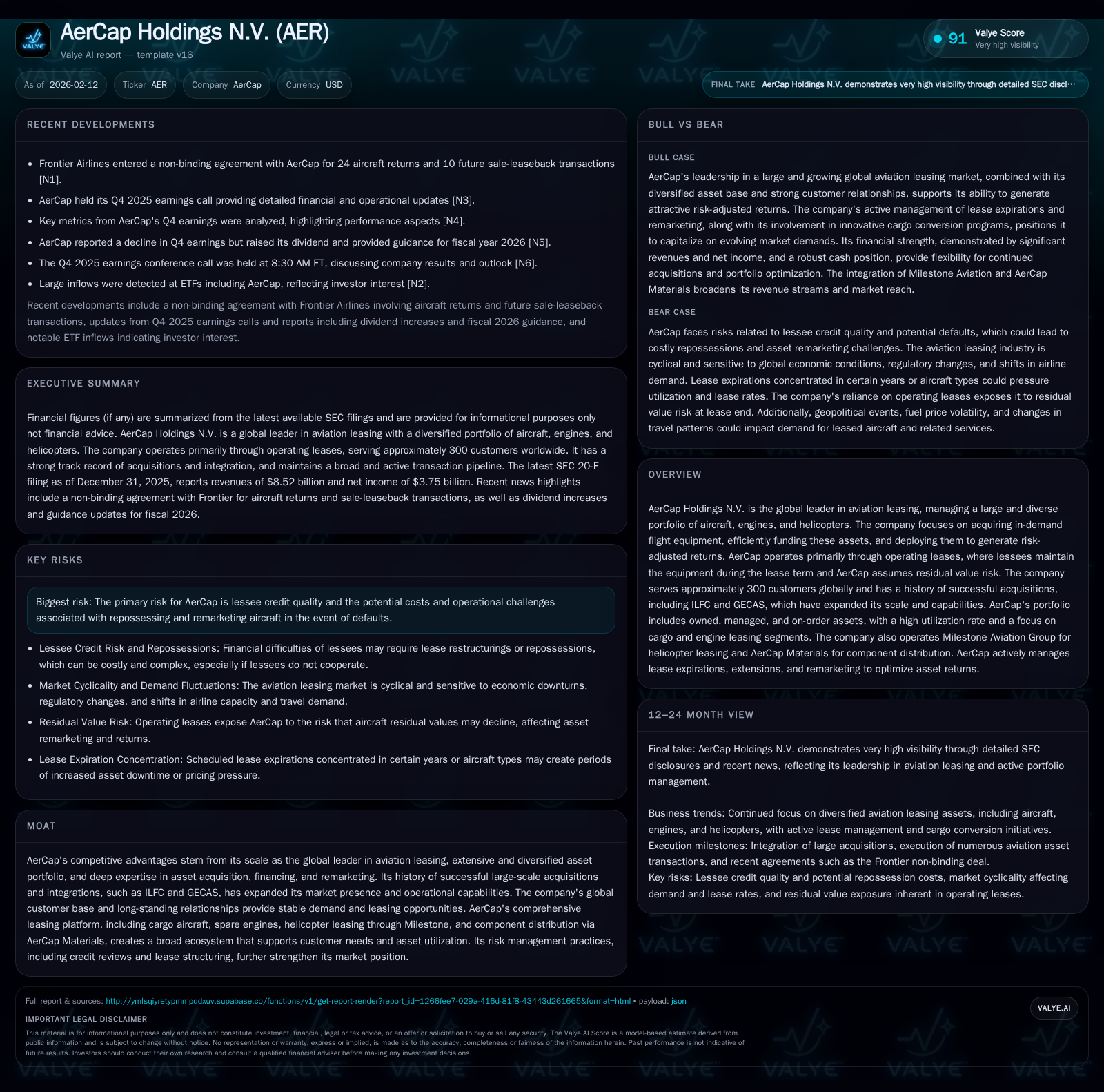
AerCap Holdings N.V. emerges as the preeminent global aviation lessor, leveraging a massive and diversified portfolio of over 3,500 owned, managed, and on-order aircraft, engines, and helicopters. Its transformative acquisitions of ILFC and GECAS have fortified its competitive moat and expanded its customer reach worldwide. Despite a slight earnings decline in Q4 2025, AerCap demonstrated resilience with high utilization rates nearing 99% and increased dividends, signaling management confidence. The company’s nuanced capital structure—including staggered debt maturities and sizable revolving credit facilities—supports liquidity while hedging interest rate exposure. Growth avenues in cargo aircraft and helicopter leasing complement the core passenger fleet business, although lessee credit quality remains a key risk that AerCap actively manages through rigorous processes.
AerCap's Unmatched Scale and Diversification: The Leverage of Leadership
AerCap Holdings N.V. occupies an unparalleled position as the world's largest aviation leasing company. As of December 31, 2025, it managed a diversified portfolio exceeding 3,500 aircraft, engines, and helicopters encompassing assets owned outright, those managed on behalf of third parties, and a substantial order book for new equipment [S1]. The owned passenger aircraft fleet totals approximately 1,501 units with an average weighted age around 7.3 years — a reflection of modernity balanced against effective lifecycle utilization. Importantly, the utilization rate across owned aircraft hovered near an impressive 99% in 2025 [S1], underscoring strong lessee engagement amid recovering air travel demand.
Beyond traditional narrowbody and widebody passenger airplanes lie significant complementary segments forming an expansive leasing ecosystem for AerCap. AerCap Cargo operates roughly 120 freighters either owned or under commitment for conversion to cargo configurations [S1]. This vertical integration addresses growing e-commerce logistics needs worldwide. Meanwhile, Milestone Aviation Group extends diversification into helicopter leasing — a niche but strategically valuable segment with distinct customer profiles primarily in offshore energy and emergency services domains. Lastly, AerCap Materials distributes components vital to maintenance cycles across fleets. Together these platforms provide revenue durability beyond cyclical fluctuations in passenger air travel.
This breadth not only stabilizes cash flows but also supports risk-adjusted returns by offering multiple avenues for asset redeployment or remarketing.
Strategic Acquisitions: How ILFC and GECAS Expanded AerCap’s Moat
Two landmark acquisitions define AerCap's ascension to industry leadership: the purchase of International Lease Finance Corporation (ILFC) in 2014 and GE Capital Aviation Services (GECAS) in 2021 [valye_report_excerpt]. Each transaction was transformational—both integrating substantial portfolios that dramatically increased scale while incorporating world-class expertise in financing structures and asset remarketing.
ILFC provided foundational expansion enabling broader geographic reach particularly across North America and Asia-Pacific markets while GECAS brought deep operational capabilities along with access to General Electric’s expansive engine leasing network. The successful integration of these entities has cemented AerCap's moat by consolidating competitive strengths such as efficient asset acquisition processes, financing acumen across capital markets channels including export credit agencies (ECA), and leveraging a global customer base exceeding around three hundred airlines [S1].
This capability to absorb sizeable portfolios without disrupting operational continuity reflects robust organizational infrastructure and seasoned management — key advantages over fragmented competitors.
Deep Dive into the 2025 Financial Results: Strengths and Headwinds
For fiscal year ended December 31st, 2025, AerCap reported revenues of $8.52 billion supplemented by net income totaling approximately $3.75 billion [F1][N2],[S1]. These figures underscore steady growth relative to prior periods despite challenges faced late in the fourth quarter that resulted in modest earnings decreases [N1],[N3]. Utilization remained exceedingly high — nearly a full-year lease occupancy measurement at ~99%, testament both to fleet desirability and creditworthy lessee relationships.
The company completed over seven hundred aviation asset transactions during the year [S1], illustrating active portfolio management encompassing acquisitions, disposals including sales of older or less economic aircraft models alongside lease renewals or extensions.
Management further signaled confidence through an elevated quarterly dividend shortly after announcing earnings results [N3], suggesting durable free cash flow generation but balanced by continued market uncertainties such as geopolitical tensions or fuel price volatility impacting airline profitability.
Capital Structure Nuances: Navigating Debt Maturities and Credit Facilities
AerCap maintains a sophisticated debt profile calibrated to support large-scale asset financing while managing refinancing risks prudently [S1]. As of end-2025, outstanding senior notes aggregated around $29 billion spread across maturities from as soon as early-2026 extending through to 2035. Interest rates are fixed between roughly 1.75% up to a ceiling near 6.45%, mitigating immediate exposure to rising benchmark rates.
Notably recent issuances include January 2025 senior notes ($750 million each at coupons near mid-4% range due '28/'31), October ’25 notes totaling $1.2 billion split evenly between '30/'35 maturities [,S1], along with $1.75 billion issued in early January ’26 featuring coupons ~4% maturing in '29/'33 [S1]. February '26 saw redemption of $500 million notes coming due within the year — reflecting proactive liability management.
Revolving credit facilities are substantial pillars within liquidity frameworks: The "Citi Revolver I" was amended late-2025 boosting capacity to $4.65 billion with maturity extended to mid-2030; "Citi Revolver II" remains at $4.35 billion post-amendment albeit reduced from prior levels but aligned covenant terms unify credit metrics [S1]. A smaller Asia revolver facility matures March ‘27 after extension from previous cycle.
Overall liquidity remains robust supported by $1.38 billion cash equivalents at year-end along with access to diverse unsecured bank lines satisfying investment-grade covenant standards [F1],[S1]. This structural flexibility is critical given aerodynamic asset depreciation horizons requiring staged capital deployment yet preserving ability to respond rapidly to market opportunities or distress scenarios.
Cargo and Helicopter Leasing: Growth Engines Beyond Passenger Aircraft
While passenger aircraft leasing represents core business volume by count and value, strategically targeted growth sectors bolster AerCap’s revenue mix against industry cyclicality [valye_report_excerpt].
The AerCap Cargo division manages a fleet of approximately one hundred twenty freight-configured aircraft including narrowbody types like converted Boeing 737s alongside widebody freighters such as converted Boeing 777s or Airbus A330s undergoing transformation programs driven by e-commerce logistics expansions globally [S1]. Cargo leasing serves a specialized clientele ranging from express delivery companies to general freight operators often requiring flexible lease terms accommodated by AerCap expertise.
Milestone Aviation Group brings helicopter leasing expertise into portfolio diversification addressing needs for short-term or long-term rotary-wing assets servicing energy extraction sites offshore or serving other emergency response domains largely insulated from commercial airline cyclicality [valye_report_excerpt].[S1]
Additionally, AerCap Materials operates component distribution channels supplying engines parts essential for ongoing maintenance & overhaul cycles thereby integrating services up the value chain supporting lessees’ operational efficiency.
Together these businesses underpin aerodynamic risk mitigation enhancing overall group profitability resiliency.
Lessee Credit Risk Management: Safeguarding Against Default
Lessee credit quality is central to AerCap’s risk profile given residual value exposure occurs mainly via operating leases where lessor retains asset ownership risk post lease expiry or default scenarios [valye_report_excerpt],[S1]. Although the company benefits from broad counterparty diversification involving approximately three hundred customers worldwide spanning major full-service airlines to low-cost carriers, careful diligence governs new lease underwriting alongside ongoing credit surveillance mechanisms.
Lease contracts incorporate tailored covenants addressing payment discipline incentives; occasional recourse is maintained for repossessing assets though these involve considerable operational strain particularly amidst sector downturns when secondary markets soften [valye_report_excerpt].
Given the volatile nature historically seen during pandemic-induced shocks or fuel-price surges affecting airline financial health, AerCap invests heavily in structured tenant evaluation processes complemented by dedicated remarketing teams skilled at rapid redeployment ensuring minimized downtime or loss severity.
Cybersecurity Oversight in a Capital-Intensive Business
Though less heralded publicly than asset metrics or financial engineering, a cybersecurity framework is vital underpinning integrity over extensive IT systems managing leases, custodial records, invoicing, and asset tracking globally. The board assumes ultimate responsibility for cybersecurity risk oversight delegating initial management scope primarily to the Audit Committee composed of members versed in cybersecurity fundamentals including credentials obtained at Carnegie Mellon University reflecting governance maturity [S1]. Annual briefings led by the CIO detail evolving threat landscapes aligned with NIST CSF standards ensuring regulatory compliance plus preparedness around incident response scenarios minimizing service disruption potential. An internal audit function alongside external auditors conducting Sarbanes-Oxley compliance reviews provides continual assessment assuring controls remain effective against intrusion or data compromise risks—imperative given reliance on cloud platforms, digital contract transmissions, and sensitive client financial data transiting corporate systems. Three cross-functional committees chaired respectively by CFO (IT Steering), Chief Compliance Officer (Data Protection & Cybersecurity), and Disclosure Committee reinforce integrated management attention ensuring comprehensive domain oversight tied closely into executive decision-making chains.
Dividend Policy and Investor Returns: Signals from Recent Announcements
Coming off a Q4 earnings decline attributed partly to timing factors around lease pricing adjustments, aerCap nonetheless elevated its quarterly dividend soon after releasing year-end results signalling robust free cash flow outlooks aligned with continued operational stability underpinned by sustained aircraft utilization levels above historical averages [N3]. This move conveys confidence from management regarding liquidity sufficiency even amid latent macroeconomic headwinds facing the aviation sector globally. Capital allocation thus appears balanced between rewarding shareholders while preserving financial flexibility necessary for opportunistic acquisitions or refinancing initiatives amid volatile interest rate environments. Such dividend policy decisions often serve as barometers for long-term investor reassurance providing indirect visibility into corporate health beyond headline profit variations.
Market Positioning Amid Expanding Airline Demand and Fleet Dynamics
The post-pandemic recovery trajectory witnessed accelerating air traffic growth driving expanded airline fleet plans rejuvenating demand for leased aircraft globally—a trend that fits directly within AerCap’s strategic playbook centered on timely acquisition and disposition agility [valye_report_excerpt],[N9],[N11]. Sale-leaseback deals such as the notable agreement signed earlier this year involving six A330neo jets leased back to Virgin Atlantic exemplify collaborative partnerships enabling airlines' capital expenditures optimization whilst refreshing lessor portfolios simultaneously with advanced technology assets fostering appeal amongst next-generation passengers seeking lower emissions footprints [N9]. Frontier Airlines’ recent non-binding agreements addressing aircraft returns combined with anticipated sale-leaseback transactions signal evolving airline fleet reconfigurations responding dynamically both operationally & financially where AerCap’s flexible leasing structures facilitate smooth transitions enhancing lessor-lessee alignment [N11]. As airlines navigate fluctuating fuel costs amidst tightening regulatory norms related to carbon emissions, the preference toward modernized fleets equipped with latest engine models further boosts demand for newer leased equipment maintaining high residual values favorable for lessors like AerCap possessing deep sourcing networks & remarketing sophistication developed through decades-long market leadership. Prospective risks remain associated principally with regional geopolitical uncertainties potentially influencing traffic patterns along key routes impacting asset deployment speed; however,AerCap’s diversified regional footprint diffuses systemic concentration risks allowing nimble repositioning capabilities across continents maximizing yield opportunities under varying conditions accounting for cyclicality inherent within commercial aviation economics. Thus,the company's positioning enables it not only to capitalize on expanding airline traffic volumes but also continually refine portfolio composition optimizing risk-adjusted returns over multiple planning horizons.[F1]
Future Outlook: Challenges and Opportunities in Aviation Leasing
Looking ahead,AerCap encounters an aviation landscape characterized by intensifying transition pressures—such as sustainability mandates fuelled by environmental regulations—and technological evolution prompting shifts toward more fuel-efficient aircraft platforms intertwined with operator cost rationalization imperatives requiring adaptive leasing solutions adeptly handled through tailored contract structures.[analysis] Simultaneously,the macroeconomic environment marked by moderate global GDP expansion forecasts interlaced with episodic inflationary episodes invites prudent balancing between growth aspirations versus disciplined financial stewardship embedded deeply into debt maturity ladders & liquidity cushions observed presently.[analysis] Continuous monitoring of lessee creditworthiness remains paramount given inherent exposure under operating leases necessitating agile response mechanisms supported through technology-enabled credit analytics capabilities enhanced since prior cycles emphasizing early warning indicators.[analysis] Moreover,growing emphasis on digital transformation encompassing cybersecurity investments represents evolving enterprise risk dimension influencing reputation & operational continuity meriting ongoing board engagement demonstrated currently.[analysis] On opportunity front,beyond traditional passenger aviation leasing,AerCap’s expanding footprint within cargo freighters fulfilling explosive e-commerce-driven capacity needs plus Milestone Aviation's prominence servicing helicopter demands signify deliberate portfolio stratification aiming at countercyclical cash flow contributors enabling smoother overall earnings trajectories amid variable transport demand patterns.[analysis] Ultimately,their historical prowess integrating major acquisitions showcases capability not only scaling balance sheet size but also assimilating complex operations harnessing synergies delivering sustainable value creation over time.[analysis] Stakeholders should thus consider this blend of scale advantages intertwined with forward-looking adaptability pivotal enabling resilience despite transient industry shocks shaping future performance pathways.[analysis]
Disclaimer: This analysis is intended solely for informational purposes based on publicly available data as of February 12, 2026. It does not constitute investment advice or recommendations.
Disclaimer: This is research-only, informational analysis and not investment advice. It may include AI-generated interpretation and general industry context. Always verify important details using primary sources.

Comments