
Air Lease Corp: Reconciling Fleet Expansion and Robust Earnings With Merger Uncertainties
Amid record earnings and strategic fleet growth, Air Lease Corp navigates complex merger-related risks shaping its near-term horizon.
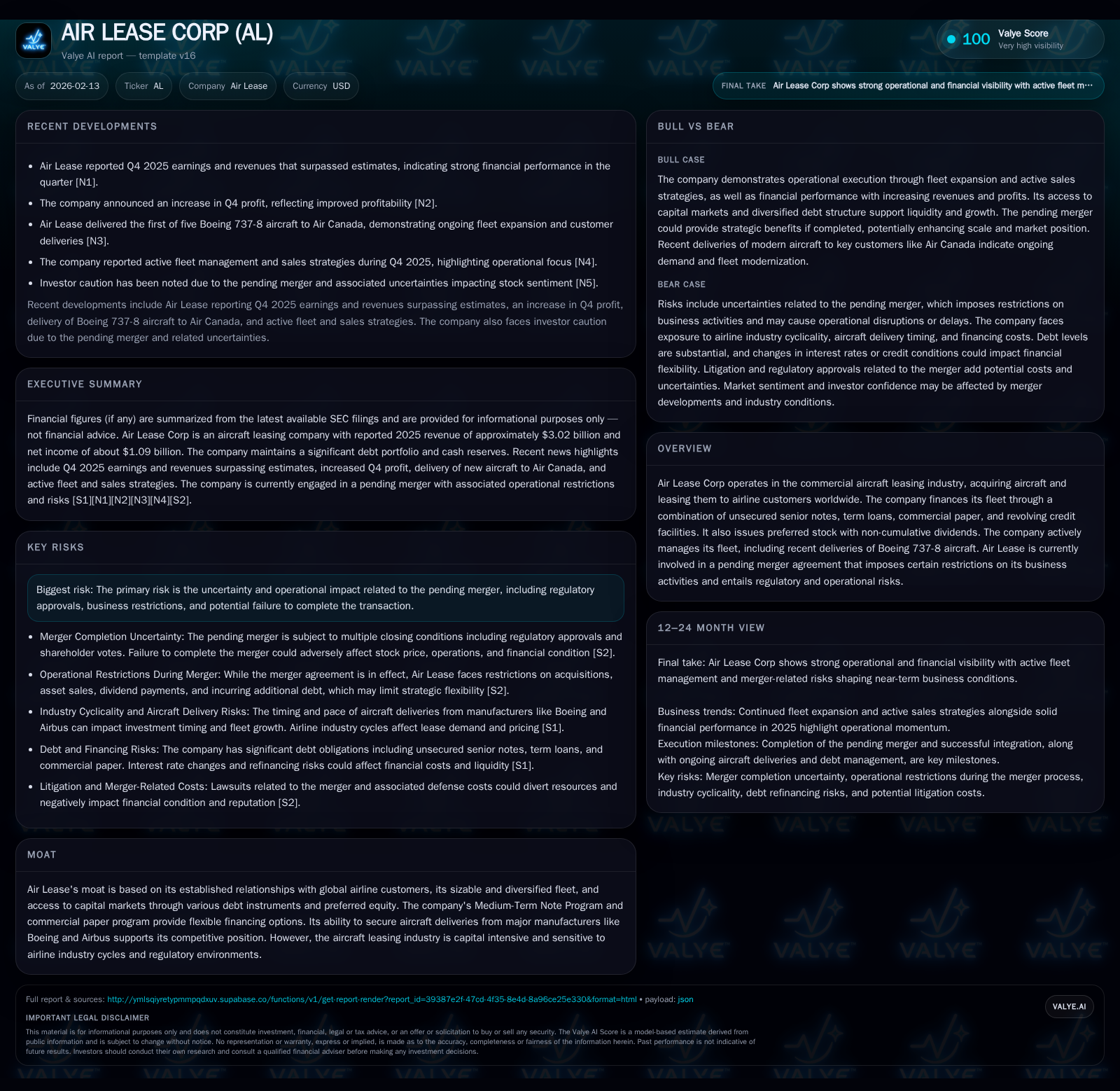
Air Lease Corp delivered strong Q4 2025 financial results, driven by active fleet expansion including Boeing 737-8 deliveries, alongside improved cash flow metrics. The company’s capital strategy remains anchored in predominantly unsecured debt financing complemented by preferred equity issuance, supporting ongoing aircraft investments exceeding $12.5 billion through 2030. However, Air Lease contends with substantive uncertainty stemming from a pending merger agreement that imposes operational constraints and regulatory approval risks. Maintaining its competitive moat through diversified fleet assets and established airline relationships, the firm must balance dividend distributions with capital-intensive commitments amid evolving market dynamics.
Flying High: AL's Recent Financial and Operational Milestones
Air Lease Corp (AL) closed out 2025 with financial results that outperformed analyst expectations on multiple fronts. The company reported net income of approximately $1.09 billion and revenues totaling around $3.02 billion for the fiscal year ended December 31, 2025 [F1][N1][N2]. These gains were propelled by an expanding aircraft portfolio and increased lease revenues linked to recent deliveries of modern aircraft models such as the Boeing 737-8 series [N3][N4]. Operating cash flows improved by nearly $58 million year-over-year to $1.7 billion, bolstered primarily by stronger customer collections attributable to fleet growth [S1]. This operational momentum underscores AL’s capacity to translate strategic asset expansion into tangible financial performance.
However, beneath this positive operational narrative lurks the shadow of an unresolved merger agreement that tempers forecast visibility and injects a degree of strategic caution into management’s outlook and investor sentiment.
Aircraft Investments and Fleet Strategy Amidst an Industry Shift
With contractual purchase commitments exceeding $12.5 billion over the next five years through 2030 [S1], Air Lease continues to make assertive moves in scaling its fleet footprint. This sizable orderbook reflects commitments for both Airbus and Boeing aircraft types aimed at meeting evolving airline customer needs across global markets [N4]. The recent delivery of five Boeing 737-8 aircraft to Air Canada exemplifies AL’s tactical asset deployment that aligns well with dynamic industry demand patterns [N3]. Nevertheless, delivery timing remains susceptible to broader aerospace production constraints—a common challenge amidst fluctuating manufacturing backlogs and supply chain bottlenecks [S1].
This deliberate diversification between Airbus and Boeing platforms fosters not only operational resilience across different market segments but also signals AL’s intent to maintain fleet balance that caters to customers’ preference volatility and maintenance compatibility considerations.
Financing the Skies: Diving into Debt Structure and Capital Strategy
Air Lease's financing profile is predominantly grounded in unsecured senior debt instruments totaling roughly $19.4 billion as of the end of 2025 [S1]. This includes senior notes, term loans amounting to about $3.85 billion, commercial paper issuance approximating $1.36 billion introduced during the year, along with revolving credit facilities [S1]. Secured debt accounts for just under half a billion dollars mostly tied to specific export credit arrangements.
Critically, nearly 77% of AL’s total indebtedness is fixed-rate debt—an intentional posture intended to stabilize interest expense amid evolving rate environments [S1]. The composite interest cost hovered around 4.15% in late 2025 with fixed-rate instruments yielding approximately 3.91%, which collectively moderates refinancing risk while supporting predictable cash flow planning [S1]. This balance allows AL flexibility; the commercial paper program provides short-term funding agility complementing longer maturity notes.
Capital expenditures remain substantial given aircraft acquisitions anticipated between $3–4 billion in 2026 alone; however, these may fluctuate subject to developments surrounding the pending merger [S1]. Preferred stock issuances with non-cumulative dividends further diversify AL’s capital base while imposing dividend payment ceilings protecting liquidity.
Turbulence Ahead: The Merger’s Complex Regulatory and Operational Implications
The pending merger fundamentally reshapes Air Lease's near-term operating landscape via regulatory scrutiny and imposed business constraints [S2]. Critical closure conditions encompass majority shareholder approvals, antitrust clearances under the Hart-Scott-Rodino Act along with international competition mandates, plus endorsements from U.S. foreign investment bodies including CFIUS [S2]. These multifaceted requirements inject meaningful uncertainty around timing if not ultimate consummation.
Failure or delay in completing the transaction could trigger significant repercussions ranging from adverse stock price reactions through diminished operational agility due to imposed standstill provisions within the deal framework [S2][N5]. The company faces potentially elevated legal costs tied to enforcement or termination disputes—including a stipulated $225 million breakup fee payable if AL terminates without cause—and collateral reputational pressures affecting stakeholder trust.
Moreover, the announced merger interrupts standard aircraft order management involving transfer of existing purchase rights after closing (‘Orderbook Transfer’), further complicating fleet capital planning [S1]. Investor sentiment displayed caution as reflected in recent analyses advising prudence amidst this transitional backdrop [N5], underscoring how strategic ambiguity casts a long shadow despite strong underlying fundamentals.
Moat Maintenance: Customer Relationships and Competitive Positioning
Air Lease's moat rests firmly on its established rapport with a diversified global airline clientele—relationships that enable recurring lease renewals and cross-selling opportunities evidenced by sustained contract activity post-pandemic recovery phases [valye_report_excerpt.overview][valye_report_excerpt.moat]. Ensuring access to prioritized aircraft deliveries from industry titans Boeing and Airbus additionally fortifies competitive positioning by aligning product availability closely with emerging market demand.
The scale and composition of AL's fleet—both narrowbody jets like Boeing 737 series as well as widebody assets—enhance its adaptability across diverse geographic routes while mitigating concentration risk inherent in single-model portfolios.
A sophisticated financing capability spanning unsecured securities issuance alongside preferred equity issuance further underpins its ability to capitalize on market opportunities swiftly—a strategic lever not universally accessible among competitors constrained by tighter balance sheet flexibilities.
Balancing Dividends, Cash Flow, and Capital Commitments
Dividend payments remain tightly calibrated within policy limits set at $0.22 per share quarterly for Class A common stock alongside preferred stock dividend caps reflecting varied rates up to approximately $15 per share annually depending on series [S1]. This structure reflects an intent to preserve liquidity amid sizable ongoing capital demands linked to fleet renewal and expansion.
Operating cash flow gains underpin this dividend approach; despite elevated interest payments driven by higher average borrowing costs—a consequence of rising rates—cash inflows improved overall owing to enhanced rental revenue streams supported by fleet scale increases [S1][F1]. However, significant insurance recoveries linked to past geopolitical disruptions also contributed a one-time uplift in investing activities cash flow during the year enhancing near-term financial stability.
Capital outlays remain hefty due principally to aircraft acquisitions projected close to or above $3 billion annually but tempered somewhat in late 2025 due to timing adjustments influenced by merger-related uncertainties.
Risk Matrix: Integrating Market Volatility with Strategic Execution
Beyond merger-centric challenges lie persistent operational risks stemming from external factors characteristic of highly cyclical air travel markets affecting lessee creditworthiness—shifts that could cascade into heightened default risk or renegotiation scenarios impacting lease revenue continuity [valye_report_excerpt.risks][S1].
Manufacturer delivery uncertainties remain material; although contractual commitments are secured through both Airbus and Boeing sources totaling over $12 billion through decade-end, actual production pace is vulnerable to supply chain disruptions or shifts in aerospace labor or materials markets [S1].
Interest rate exposure is partially mitigated by fixed-rate financing dominance but not entirely eliminated given approximately one-quarter of debt bears floating costs potentially exposing AL’s interest expense profile to volatility amidst macroeconomic tightening cycles.
Market sentiment also increasingly contemplates these intertwined risk vectors alongside evolving regulatory landscapes implicating future transaction execution feasibility.
Investor Takeaways: Growth Potential Versus Pending Uncertainty
Air Lease Corp exemplifies a dual narrative: robust underlying commercial traction supported by expanding revenues, strong net profits surpassing one billion dollars for calendar 2025, active fleet replenishment actions aligned with customer needs—and yet this comes tempered by meaningful transactional risks crystallized in an unresolved merger process fraught with regulatory hurdles and attendant business constraints [N5][F1][S2].
Investors face a nuanced equation where demonstrable operational strength must be weighed against potential valuation compression triggered by delay or failure scenarios related to the pending transaction—noting contractual termination fees offering partial downside cushioning but not obviating deeper reputational or strategic impact.
Careful monitoring of merger progress remains essential given its outsized influence on Air Lease’s capital deployment agility and overall growth trajectory moving forward.
This report synthesizes available filings as of early February 2026 alongside recent market commentary without making investment recommendations or price forecasts. Readers should consider underlying uncertainties inherent in corporate transactions coupled with cyclical aviation industry dynamics when evaluating company prospects.
Disclaimer: This is research-only, informational analysis and not investment advice. It may include AI-generated interpretation and general industry context. Always verify important details using primary sources.

Comments