
Strategic Resilience and Risk Dynamics in Sixth Street Specialty Lending’s Niche BDC Play
Navigating capital management, regulatory constraints, and niche positioning underscores TSLX’s complex operational landscape.
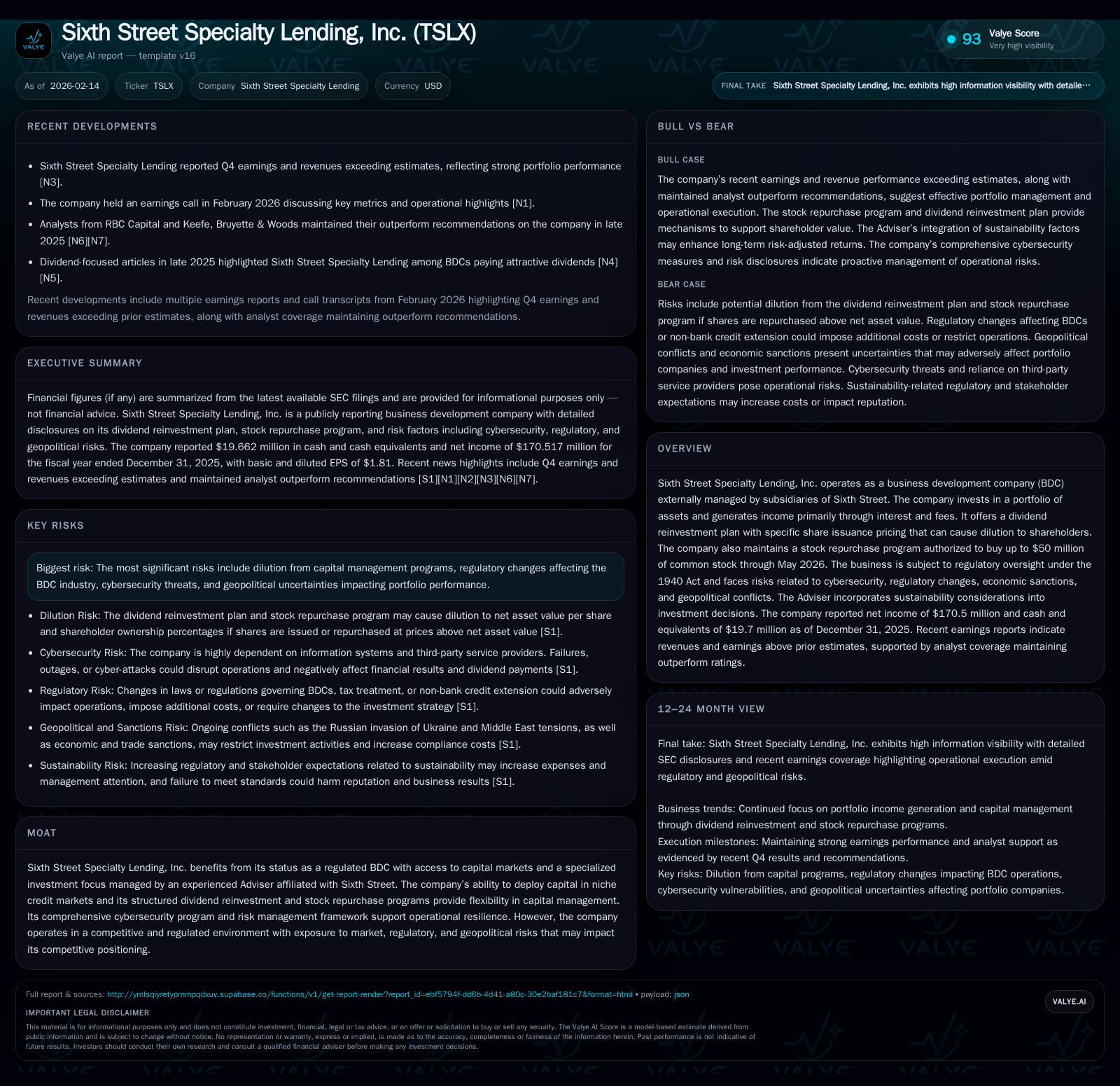
Sixth Street Specialty Lending, Inc. (TSLX) operates within the tightly regulated and competitive Business Development Company (BDC) sector, leveraging specialized investment expertise to deploy capital in niche credit markets. The firm's multi-layered valuation approach and capital deployment tools like a dividend reinvestment plan and a $50 million stock repurchase program illustrate sophisticated strategies balancing growth and shareholder value. However, regulatory oversight, dilution risks from capital programs, cybersecurity concerns, and geopolitical uncertainties pose ongoing challenges that require vigilant management and strategic foresight.
Inside Sixth Street Specialty Lending’s Portfolio: Valuation Nuances and Market Implications
Sixth Street Specialty Lending, Inc. navigates the intricate complexities of valuing a portfolio predominantly composed of illiquid credit instruments lacking active market quotations. The company adopts a disciplined quarterly valuation cadence relying on collaboration between investment professionals, their Adviser’s management team, the Audit Committee, the Board of Directors, and engaged independent third-party valuation specialists. This multi-layered governance ensures both rigor and objectivity in measuring fair value under U.S. GAAP guidelines stemming from ASC Topic 820 [S1].
Given that most portfolio holdings are private or thinly traded loans and equity stakes, reliance on observable market prices is often unavailable; hence estimates incorporate enterprise valuations of portfolio companies factoring in net debt/equity structures, collateral realizations, cash flow capacity, comparable public securities, and interest rate environment shifts. External corroboration through relevant market transactions or secondary sales bolsters these fair value determinations.
While this structured process lends methodological soundness, it inherently introduces valuation uncertainty due to subjective assumptions about underlying portfolio company fundamentals and macroeconomic variables. Investors and analysts reliant on reported earnings should weigh these inputs when interpreting profitability metrics that embed unrealized gains or losses [S1][F1].
Capital Deployment Strategies: Dividend Reinvestment and Stock Repurchase Programs Under the Microscope
TSLX’s nuanced capital deployment backbone features two pivotal mechanisms: a dividend reinvestment plan (DRIP) and an authorized $50 million stock repurchase program executed under Rule 10b5-1 arrangements [S1]. The DRIP enables shareholders to reinvest dividends into common stock at an issuance price tied to market price dynamics but subject to a floor linked to the company’s most recently computed net asset value (NAV) per share.
This pricing structure means shares issued under DRIP can sometimes be granted at values below prevailing market prices, resulting in effective dilution for shareholders who opt out — their ownership percentage is diluted over time as more shares enter circulation below market valuations. While this mechanism supports liquidity for recurring dividends via share issuance instead of cash outlay, the trade-off is gradual incremental dilution that requires careful investor consideration.
Counterbalancing dilution risks is the $50 million stock repurchase program designed to provide liquidity support and potentially buoy share price during market softness. Trades are executed by Goldman Sachs as an agent under predefined volume limits responsive to share price declines [S1]. However, buying shares above NAV reduces net asset value per share proportionately due to the premium paid relative to underlying assets’ book value. Thus repurchases can paradoxically dilute economic interests even as they visually support market price stability.
The interplay between these two capital management tools — dilutive dividend reinvestments versus buybacks potentially above NAV — illustrates TSLX's balancing act between growth-oriented reinvestment flexibility and shareholder value protection [S1][F1].
Regulatory Frameworks and Compliance: The 1940 Act’s Influence on TSLX's Operations
As a Business Development Company regulated under the Investment Company Act of 1940 (the "1940 Act"), TSLX operates within a highly prescriptive compliance environment that shapes its strategic choices. These mandates impose constraints on diversification ratios, leverage ceilings, valuation processes, reporting rigor, governance structures, and periodic disclosures [S1].
Capital raising activities are carefully monitored to maintain status as a BDC with attendant benefits like pass-through tax treatment but also bind companies to certain governance disciplines not applicable in unregulated vehicles. This regulatory overlay influences TSLX's investment universe—favoring middle-market direct lending opportunities where structuring advantages can be maximized under statutory limits.
Moreover, adherence to these provisions ensures investor protections but erects operational barriers that competitors outside BDC frameworks might not encounter. These dynamics influence return profiles since cost structures must absorb compliance overhead while still generating yield premiums over traditional fixed income alternatives.
Understanding this landscape is central to comprehending how TSLX engineers portfolio construction decisions balancing regulatory compliance without cramping opportunistic deployment in specialty finance niches [S1][Valye_report_excerpt].
Risk Factors Beyond The Balance Sheet: Cybersecurity, Geopolitical Risks, and Market Volatility
Beyond credit-specific concerns typical of lending entities lies a swath of less visible yet materially impactful risk vectors discussed candidly in TSLX's disclosures [S1]. Foremost among these are cybersecurity vulnerabilities intrinsic to its dependence on digital infrastructure managed by its Adviser and third-party service providers.
System failures or breaches could trigger operational interruptions impacting dividend reliability or valuation transparency — outcomes that would likely unsettle investor confidence promptly. The company's acknowledgment of this threat underlines the criticality of robust systems architecture amid an expanding cyber threat landscape.
Equally significant are geopolitical tensions influencing portfolio companies' operating environments — ranging from economic sanctions regime shifts to trade disruptions or regional conflicts. Since borrower cash flows derive from real-world markets susceptible to such shocks, performance volatility may exceed traditional credit cycles.
These non-financial risks compound market volatility exposure; even isolated events could cascade into headline impacts altering general market perceptions about BDC sector resilience or specific portfolio health [S1][Valye_report_excerpt].
Adviser Expertise and Sustainability Integration: Building Moat Strength Amid Competition
Central to TSLX's enduring competitive moat is its Adviser relationship embedded within subsidiaries of Sixth Street—a prominent alternative asset manager possessing deep sector insight and niche lending expertise [Valye_report_excerpt][N2][N3]. This affiliation affords technical prowess in sourcing bespoke deal flow across fragmented credit markets underserved by larger institutions.
Moreover, the Adviser’s deliberate integration of sustainability factors into investment decision-making marks a forward-looking posture aligning with increasing regulatory demands and investor preferences around Environmental, Social, Governance (ESG) considerations. This approach not only mitigates emerging regulatory risks but enhances long-term portfolio resilience by proactively addressing sustainability-related credit risks.
Such strategic depth fosters differentiation in an increasingly crowded BDC space often characterized by commoditized lending offerings. It also enriches dialogue with stakeholders prioritizing responsible investment principles amid broader systemic shifts toward sustainable finance globally [N2][N3][Valye_report_excerpt].
Earnings Performance Snapshot: Analyzing Q4 Results Against Market Expectations
TSLX’s Q4 2025 earnings releases heralded solid operational momentum consistent with its established profile [N1][N2][N3][F1]. Revenues exceeded consensus forecasts signaling effective portfolio yield capture coupled with fee income strength from tailored lending mandates.
Net income reached approximately $170.5 million for full-year 2025 bolstered by disciplined cost controls while preserving liquidity buffers evidenced by nearly $20 million in cash equivalents at year-end [F1]. This liquidity cushion suggests prudent balance sheet management readying the platform for potential market dislocations or selective new originations.
Analysts highlighted this financial performance as indicative of resilient income streams despite challenging macroeconomic headwinds affecting broader credit availability paradigms [N2][N3]. Such outcomes reinforce confidence in the firm’s ability to generate attractive risk-adjusted returns while navigating complex portfolio valuation nuances previously discussed.
Future Outlook: Balancing Growth Ambitions With Dilution and Regulatory Uncertainties
Looking ahead, Sixth Street Specialty Lending confronts an intricate balancing act—aiming to expand its footprint in specialty credit markets while rigorously managing dilution dynamics attendant upon its capital deployment apparatus [S1][Valye_report_excerpt]. The simultaneous presence of dividend reinvestment-induced share accretion alongside ongoing stock repurchases presents nuanced scenarios for NAV per share trajectories.
Regulatory evolutions impacting BDC operating models remain an open horizon risk factor requiring agile responses lest unforeseen changes constrain future capital formation avenues or investment mandates.
Finally, macroeconomic uncertainties—ranging from inflationary pressures affecting borrower fundamentals to fluctuating interest rate trends—necessitate calibrated underwriting discipline preserving portfolio quality without sacrificing tactical growth initiatives.
Overall, maintaining transparent communication regarding capital strategy implications alongside adherence to stringent compliance standards will be vital for sustaining long-term stakeholder trust amidst this dynamic ecosystem.
Disclaimer: This report provides a detailed analytical overview based on publicly available information as of February 14, 2026. It does not constitute investment advice nor recommendations regarding securities transactions. Readers should conduct their own due diligence before making financial decisions.
Disclaimer: This is research-only, informational analysis and not investment advice. It may include AI-generated interpretation and general industry context. Always verify important details using primary sources.

Comments