
Camden Property Trust’s Multifamily Resilience Amid Interest Rate and Market Shifts in 2025
Camden Property Trust showcased strong multifamily real estate performance in 2025, anchored by strategic market focus and disciplined capital management despite macroeconomic pressures.
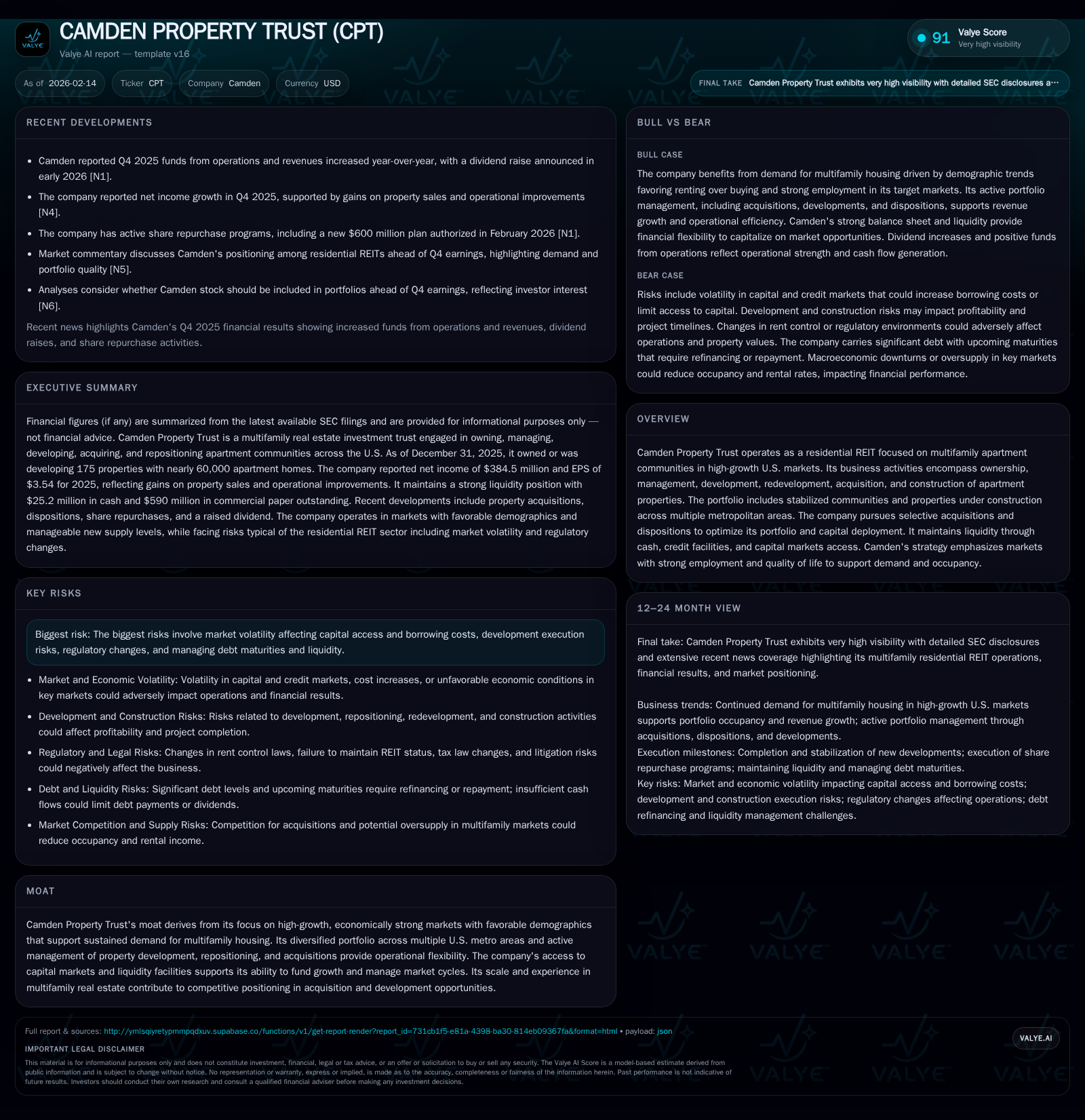
Camden Property Trust solidified its position as a leading residential REIT by leveraging a diverse portfolio concentrated in high-growth U.S. markets, enabling modest same-store revenue growth and a notable rise in net income to $384.5 million in 2025. The company’s ongoing development projects and prudent liquidity management underscore resilience amid rising interest rates and evolving regulatory risks. Dividend increases and positive investor actions reflect confidence, while sector-wide dynamics frame Camden's outlook as cautiously optimistic.
Camden’s Portfolio Footprint: Scale and Market Selection
Anchoring its competitive edge, Camden Property Trust controls a formidable portfolio of 175 multifamily communities spanning roughly 59,921 apartment homes across high-growth metropolitan areas in the U.S.[S1][F1]. This geographic mix is far from incidental; the company's deliberate targeting of markets exhibiting vigorous economic expansion, rising employment levels, and above-average quality-of-life metrics ensures sustained renter demand. Such demand underpins occupancy stability—a critical pillar for cash flow predictability in multifamily assets.
By diversifying across multiple submarkets rather than concentrating risk in one region, Camden harnesses a resilient revenue base capable of withstanding localized economic disruptions or regulatory shifts. These dynamics enhance operational leverage as new supply introductions remain measured relative to absorption capacity within chosen locales.[S1]
2025 Financial Performance: Growth Amid Challenges
The fiscal year closed on a notably strong note for Camden. Net income soared to $384.5 million from $163.3 million in the prior year—an impressive leap largely attributable to gains realized on sales of operating properties alongside significantly reduced impairment charges on land development activities[S1][F1]. Concurrently, the operational side reported same-store revenue increases of approximately 0.8%, bolstered chiefly by improved occupancy rates and enhanced ancillary income streams[S1][N1].
This growth unfolded amid persistent macroeconomic headwinds — notably rising interest rates that could lean on rental affordability and investor sentiment — yet Camden maintained steady margins. The firm also absorbed higher depreciation expenses linked to four new acquisitions completed during the year,[S1] reflective of an active but disciplined capital recycling strategy aimed at optimizing portfolio composition.
Navigating Development and Construction Pipelines
Camden advances its footprint prudently through new developments, currently managing three ongoing projects slated to deliver a combined total of 1,162 apartment units with an estimated remaining investment need of $213.8 million[S1]. These assets are anticipated to contribute initial occupancy phases within two years.
Such controlled project scope allows Camden to moderate exposure to typical construction execution risks—including cost overruns or delayed leasing—while capitalizing on favorable demographic trends fueling multifamily demand. It also provides nimbleness to pause or adjust development cadence if market conditions evolve adversely.
Capital Structure and Liquidity Management Under Pressure
In an ascending interest rate environment, Camden's capital framework warrants close attention. The company carries significant debt maturities concentrated over the next few years—with effective yields on various tranches ranging from approximately 2.9% up to just over 5%[S2]. Balancing this is cash and equivalents totaling about $25 million at year-end[S1][F1], supplemented by access to credit lines ensuring financial flexibility.
Rising borrowing costs present headwinds that could pressure net operating income through increased interest expenses as leases turn over or refinancings arise. Yet Camden’s measured leverage profile and staggered maturities mitigate imminent refinancing shocks. These factors support ongoing operations without compromising dividend distributions or development funding capacity.
Risk Outlook: Interest Rates, Regulation, and Competition
Camden's risk portrait is emblematic of broader residential REIT sector vulnerabilities intensified post-2025. Escalating interest rates threaten property valuations by compressing cap rates while increasing debt service burdens; concurrently, higher financing costs can dampen acquisition appetite or project starts[S1]. Moreover, evolving rent control legislation across major markets could restrict rate-setting freedom on renewals or new leases, potentially capping revenue growth.
The company faces additional challenges encompassing short lease terms that magnify exposure to rental cycles and cybersecurity threats imperiling tenant data or operational systems.[S1] Competition remains robust for well-located assets as institutional investors seek steady income streams amidst fixed income volatility—heightening acquisition price levels.
Dividend Strategy and Shareholder Returns Evolution
Investor confidence found voice through Camden’s decision to raise dividends recently[N4], signaling management’s conviction in cash flow sustainability despite market pressures. This increase enhances yield-generated returns at a time when some investors turn toward structured options strategies to boost income—examples include trading tactics aiming to elevate CPT yield from near 3.9% up toward 7% via derivatives[N7].
Such moves illustrate a nuanced investor base recognizing Camden's blend of growth potential alongside defensive qualities inherent in multifamily housing during uncertain monetary cycles.
Sector Context: Residential REIT Terrain Post-2025
Positioned amid a dynamic residential REIT landscape transitioning beyond pandemic-era disruptions, Camden benefits from tailwinds including robust urban rental demand coupled with constrained homeownership affordability[N2][N3]. Analysts acknowledged its Q4 earnings strength as a bellwether for sector health ahead of earnings season[N2], prompting rallies including upwards of 7% over recent months[N8].
This collective optimism reflects expectations that well-managed portfolios concentrated in economically vibrant regions will outperform peers more exposed to stagnation or oversupply.
Forward-Looking Considerations and Strategic Priorities
Looking forward, leadership emphasizes calibrated portfolio growth aligned with favorable demographic trends underpinning renter propensity but cushions guidance with caution around development execution risks and liquidity management amidst credit market variability[S1]. Maintaining discipline in acquisitions alongside flexible capital deployment remains key amid inflationary cost pressures.
While macroeconomic uncertainties persist—particularly around the trajectory of interest rates—the strategic focus on high-quality markets combined with operational expertise positions Camden favorably to navigate evolving multifamily housing economics heading into mid-decade.
This report synthesizes publicly disclosed financial filings and recent market commentary without issuing investment recommendations. Investors should consider risks outlined herein alongside broader macroeconomic contexts when evaluating multifamily real estate exposures.
Disclaimer: This is research-only, informational analysis and not investment advice. It may include AI-generated interpretation and general industry context. Always verify important details using primary sources.

Comments