
Lloyds Banking Group: Bridging Heritage and Digital Innovation Amid Regulatory Pressures
Exploring Lloyds Banking Group’s fusion of historic UK banking dominance with a forward-looking digital strategy in an evolving risk landscape.
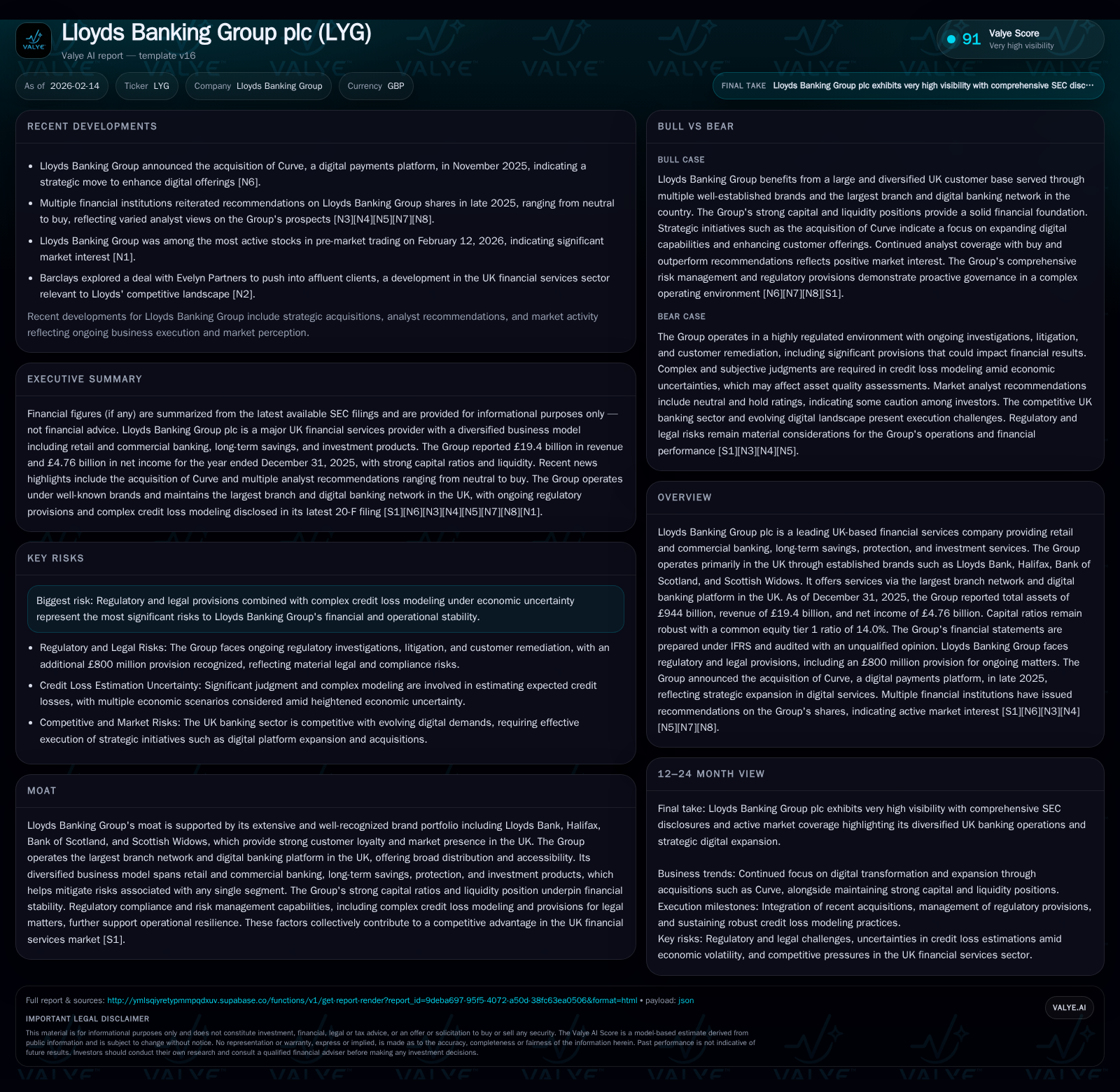
Lloyds Banking Group stands as a pillar of the UK financial sector, anchored by its historic brands such as Lloyds Bank and Halifax, complemented by Scotland's Bank of Scotland and Scottish Widows. Its diverse portfolio spans retail banking to investment and protection services, reinforced by a robust capital base and expansive branch and digital footprint. The acquisition of Curve signals Lloyds’ strategic pivot toward fintech innovation, balancing legacy strengths with market modernization. However, complex credit risk modeling amid geopolitical uncertainty and hefty legal provisions present ongoing challenges. Moving forward, Lloyds must integrate digital advances while navigating regulatory headwinds and economic unpredictability to maintain its competitive moat.
Legacy Strength: Foundations of a UK Banking Giant
Lloyds Banking Group’s story is interwoven deeply into Britain’s financial history. The Group traces its lineage back to the origins of Taylors and Lloyds in Birmingham during the 18th century, progressing through landmark mergers such as the 1995 union of Lloyds Bank plc with TSB Group plc to form Lloyds TSB Group.[S1] This blend of historic entities expanded further when Scottish Widows joined the fold in 2000, enriching the Group's footprint in long-term savings and protection.[S1] The pivotal 2009 acquisition of HBOS — itself emerging from Halifax plc and Bank of Scotland — not only enlarged scale but diversified geographic reach within the UK market.[S1] These foundational moves forged a conglomerate with formidable brand recognition covering multiple customer segments; from retail depositors reliant on local branches to insurance clients served by legacy specialists.
This rich heritage underpins customer trust that remains a cornerstone for Lloyds’ market identity today. In an industry where reputational capital can be as valuable as financial capital, Lloyds leverages its deep historical roots to reinforce loyalty within established demographic segments while providing stability through decades of proven stewardship.
A Multifaceted Business Model: Retail to Long-Term Investments
The organization diversifies across several complementary verticals—retail banking, commercial banking, long-term savings, insurance protection products, and investment services—enabling Lloyds to spread systemic risks that might afflict any single segment.[valye_report_excerpt][S1] Its retail banking units operate under storied names like Lloyds Bank, Halifax, and Bank of Scotland catering to personal depositors alongside small-to-medium enterprises. Meanwhile, Scottish Widows channels expertise into pensions, life assurance, and wealth management.
This multi-pronged approach buffers the Group against cyclical downturns affecting specific lines or regions; for example, slumps in commercial lending demand may be offset by steady inflows from insurance premiums or investment management fees. By owning an expansive range across financial services, Lloyds positions itself not just as a lender but a comprehensive wealth partner to UK households.
Capital Robustness and Financial Performance in 2025
At December 31, 2025, the Group reported impressive financial scale: total assets reached £944 billion with revenue landing at £19.4 billion.[F1][S1] Net income closed at £4.76 billion reflecting solid operational efficiency despite headwinds.[F1] Such figures affirm profitability in a competitive market confronting macroeconomic pressures.
Crucially, capital adequacy remains a standout strength with a Common Equity Tier 1 (CET1) ratio of 14.0%, Tier 1 capital at 16.2%, and total capital at 18.9%.[S1] These healthy buffers indicate sound liquidity management and preparedness for potential shocks—a vital attribute amidst tightening regulatory frameworks domestically and internationally. The auditors issued an unqualified opinion on both financial statements and internal controls over reporting,[S1] reinforcing credibility with stakeholders.
Decoding Complex Credit Risk and Regulatory Provisions
Behind headline profitability lies intricate risk management machinery. The recognition of £3.2 billion in expected credit losses (ECL) as at year-end highlights the challenge posed by forecasting defaults under economic uncertainty.[S1] Management employs multi-scenario economic forecasts including base case plus upside/downside variations weighted probabilistically (e.g., severe downside at 10%), utilizing Monte Carlo simulations adjusted for nuanced supply-side risks.[S1]
The impairment assessment blends collective evaluations for retail/commercial portfolios with individual analyses for high-value stage-3 loans requiring judgment about workout probabilities and recovery valuations.[S1] Auditors singled out these ECL calculations as critical audit matters due to their subjective complexity requiring expert skill sets.
Moreover, alongside credit loss estimates sits an £800 million provision set aside for ongoing legal/regulatory matters affecting bottom-line profitability.[valye_report_excerpt][S1] Such provisions underscore the expensive nature of compliance risks in banking—costly both financially and reputationally—and remain areas necessitating continuous oversight.
Digital Leap: The Strategic Acquisition of Curve
Signaling intent beyond traditional banking paradigms, Lloyds acquired Curve—a digital payments platform—in late 2025 according to recent disclosures.[valye_report_excerpt] This move positions Lloyds squarely within fintech evolution trends pivoting on flexible payment solutions integrating multi-card access through one app interface.
Curve offers not just incremental product breadth but opens gateways into younger demographics accustomed to seamless digital experiences outside conventional branch visits. Such strategic acquisitions reflect active efforts by legacy banks confronted with tech-savvy challengers to innovate organically or through partnerships rather than cede ground entirely.
Balancing Traditional Branch Networks with Digital Innovation
Remarkably, this digital thrust complements—not replaces—Lloyds' maintenance of the largest physical branch network across the UK.[valye_report_excerpt] This dual-channel model caters effectively to demographics varying widely in technological adoption: older customers who prefer face-to-face interactions coexist alongside digitally native clients demanding robust mobile offerings.
Managing this hybrid distribution entails significant investment but yields competitive advantages through enhanced accessibility breadth—critical given many UK regions still rely on bricks-and-mortar presence for essential banking services.
Moat Analysis: Competitive Advantages in a Saturated Market
Lloyds’ structural advantages intertwine brand heritage (Lloyds Bank, Halifax), distribution scale (largest UK branch network), diversified business mix (retail banking plus savings/protection), capital robustness (CET1 ratio at 14%), alongside sophisticated risk controls encompassing credit provisioning models tailored for uncertain macro backdrops.[valye_report_excerpt][S1]
These features collectively erect formidable barriers to entry for competitors—especially newcomers lacking extensive physical reach or cross-product offerings. While challenger banks often boast nimble technology stacks, they frequently miss out on integrated wealth/product ecosystems or deep customer ties consolidated over generations.
Risks East and West: Economic Uncertainty and Legal Exposures
No analysis is complete without acknowledging headwinds shaping near-term prospects. Geopolitical tensions—with knock-on effects such as US trade tariff adjustments—introduce volatility translating into uncertain credit defaults projected through management’s complex impairment models.[S1]
Concurrently, substantial legal contingencies represented by an £800 million provision illustrate persistent regulatory scrutiny costs eroding earnings power; these demands leave little room for complacency regarding governance or compliance frameworks.
Continued economic fluctuations present scenario-planning challenges where baseline assumptions may deviate abruptly impacting asset quality metrics.
Investor Sentiment and Momentum Considerations
Market focus reflected both confidence in Lloyd's enduring fundamentals yet recognition of imminent challenges around earnings season start-of-year activity.[N1][N2]
Analysts note momentum-related interest backed by solid balance sheet numbers (£19.4bn revenue; £4.76bn net income; robust CET1 ratio) yet tempered caution arises from regulatory/legal provisioning pressures underscoring profit variability.[N2]
Hence investor views dynamically balance between appreciating strategic positioning—particularly post-Curve acquisition—and monitoring downside risks linked to macroeconomic uncertainties.
Looking Ahead: Strategic Opportunities and Watchpoints
Going forward, Lloyds faces pivotal execution phases:
- Successful integration of Curve’s technology & user base will measure how effectively traditional bank infrastructure meshes with fintech agility;
- Continued vigilance over credit portfolio quality amid evolving geopolitical/economic dynamics remains critical;
- Navigating regulatory compliance cost structures without sacrificing innovation budgets presents complex resource trade-offs;
- Scenario planning embedding alternative macroeconomic trajectories will underpin adaptive strategic responses;
- Maintaining customer loyalty across multiple age cohorts via blended physical/digital channels will sustain franchise durability.
Strategic foresight aligned with operational discipline appears fundamental as Lloyds seeks equilibrium between safeguarding legacy strengths while accelerating digital modernization amidst an increasingly challenging environment.
This analysis synthesizes publicly available information including SEC filings [S1][S2], recent news sources [N1][N2], and Valye News proprietary research snapshots [F1]. It is intended solely to provide insightful context without directing investment action or recommendations.
Disclaimer: This is research-only, informational analysis and not investment advice. It may include AI-generated interpretation and general industry context. Always verify important details using primary sources.

Comments