
Citizens Financial Group in 2026: Leveraging Regional Breadth and Dual-Segment Strength Amid Sector Headwinds
Citizens Financial Group's wide regional footprint and balanced consumer-commercial banking model underpin resilience as it navigates economic and regulatory complexities.
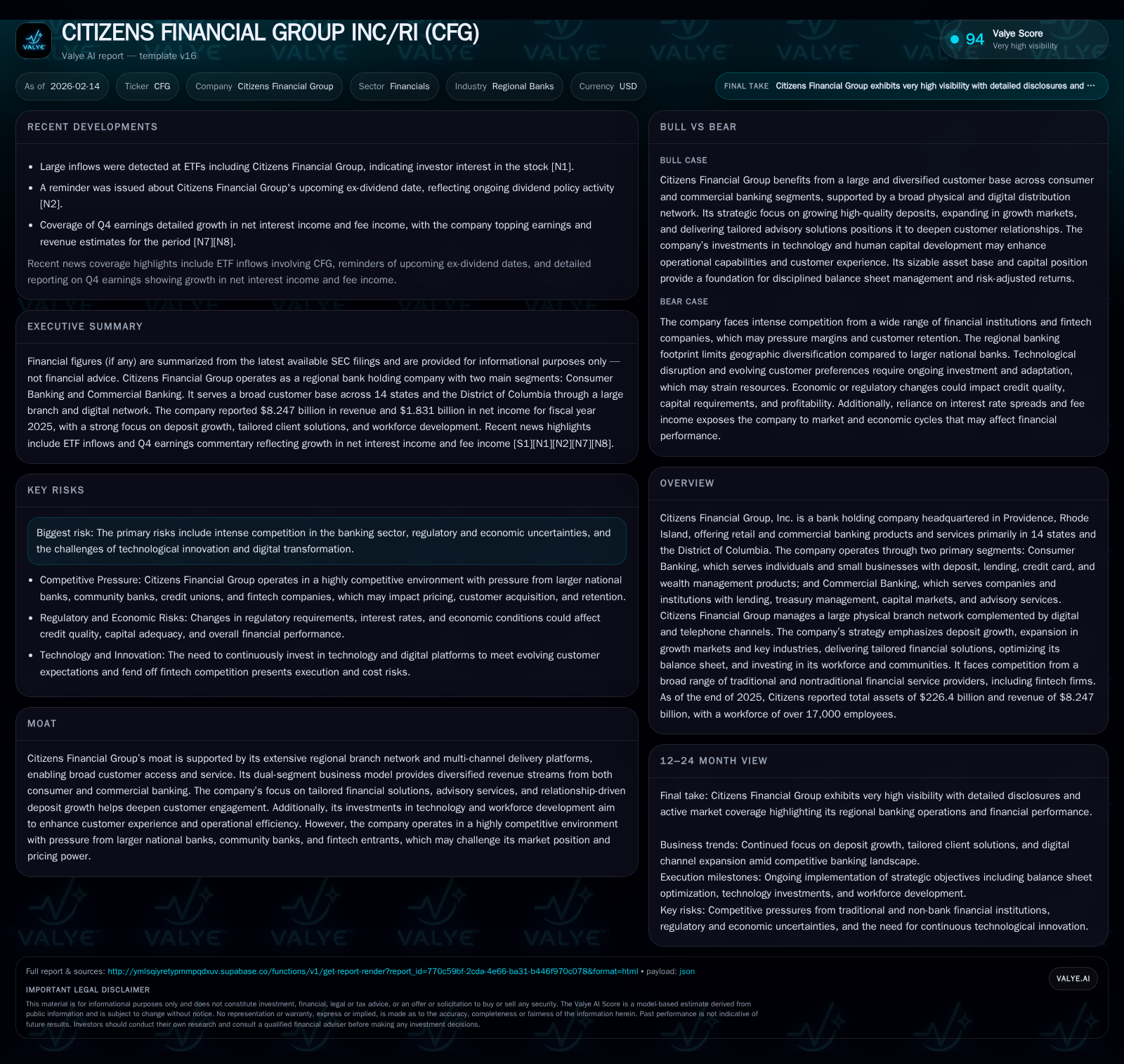
Citizens Financial Group (CFG) operates over 1,000 branches across 14 states plus D.C., offering diversified retail and commercial banking services. In 2025, CFG delivered robust financial results driven by net interest income growth and fee expansion, outperforming market expectations despite macroeconomic challenges. The bank is addressing inflationary pressures and evolving regulatory demands by investing in technology and workforce while leveraging its multi-channel delivery model. Competitive dynamics from fintechs and national banks intensify pricing pressures, but CFG’s focus on tailored solutions and community engagement supports customer loyalty. Looking ahead to 2026, CFG plans to optimize margins and sustain deposit growth amid a complex environment.
Citizens Financial at a Glance: Broad Reach Meets Banking Diversity
Citizens Financial Group, Inc. (CFG), headquartered in Providence, Rhode Island, stands out in the U.S. regional banking landscape due to its expansive physical presence paired with a digital and telephone service continuum. Serving customers primarily across 14 states plus the District of Columbia through more than 1,000 branches along with approximately 3,100 ATMs, CFG commands significant accessibility in markets that blend urban density with suburban communities [S1]. At year-end 2025, the company reported total assets of $226.4 billion and deposits amounting to $183.3 billion [F1], illustrating substantial scale for a regional bank.
This geographic breadth is matched by business diversity: the company’s operations are structured across two primary segments—Consumer Banking targeting individuals and small businesses with deposit products, mortgage lending, credit cards, wealth management solutions; and Commercial Banking focusing on middle-market companies to large institutions with loans, treasury management, capital markets offerings, and advisory services [S1]. Such segmentation underpins diversified revenue streams which help mitigate concentration risk inherent in single-sector dependence.
Additionally, Citizens strives to integrate traditional branch-based relationship banking with digital innovation via online platforms that enable customers nationwide to perform transactions seamlessly—a key component given shifting client preferences towards digital channels [valye_report_excerpt.overview]. This hybrid distribution approach forms the backbone of CFG’s strategic positioning within evolving banking behaviors.
Dual Engines of Growth: Consumer and Commercial Banking Insights
The Consumer Banking segment is extensive in scope: it caters not only to everyday banking needs through deposit accounts but also extends into credit products like mortgages, home equity lines of credit, credit cards as well as wealth management services for affluent customers via Citizens Private Bank [S1]. Operating roughly 1,000 branches staffed by around 5,100 employees alongside nearly 1,500 lending and savings specialists enables tailored client servicing that spans basic transactional accounts through sophisticated investment guidance.
Meanwhile, the Commercial Banking division targets enterprises requiring financing support—ranging from lending solutions to cash management—and sophisticated advisory capabilities covering mergers & acquisitions or capital markets engagement [S1]. The segment employs a client-centric approach structured around market segments such as Middle Market & Midcorporate business clients or Treasury/Wholesale Payments teams focused on operational efficiencies for institutional customers.
Together these segments provide CFG with complementary revenue bases: consumer deposits tend to offer stable low-cost funding while commercial loans often carry higher yields complemented by non-interest fee income streams linked to treasury or advisory services. This balance inherently reduces dependence on any one line of business or economic cycle phase.
2025 Financial Performance Highlights: Beating Expectations
In Q4 2025 earnings reports released mid-January 2026, CFG exceeded analyst consensus on both earnings per share and revenue metrics [N4][N5][N6]. Drivers were notable: net interest income (NII) grew robustly indicating success in expanding earning assets amid rising rate environments while fee income increased through wealth management and commercial treasury service growth. Margin expansion was another positive signal emphasized by management’s outlook for further improvement throughout FY26 [N8].
This outperformance came despite broader uncertainties affecting many banks related to loan demand softness or competitive pressure compressing spreads. The ability of Citizens Financial Group to deliver both top-line growth alongside cost discipline highlights operational resiliency supported by strategic execution on both consumer credit offerings and commercial product sets.
Navigating Inflation and Funding Pressures: Risks on the Horizon
CFG’s risk disclosures explicitly underscore inflation-related challenges that could erode profitability if funding costs rise faster than asset yields or if borrower repayment capacities weaken [S1]. Inflation drives upward pressure on salaries for talent retention—as staffing constitutes a considerable expense—and raises operating costs generally.
Liquidity remains anchored primarily by customer deposits which are relatively low-cost compared with wholesale funding alternatives; however, any impairment in deposit stability due to competitive or economic shocks would elevate reliance on secondary borrowing markets such as debt issuance or Federal Home Loan Bank advances where access may be sensitive to market conditions [S1]. Thus maintaining strong capital adequacy alongside active monitoring of liquidity metrics is vital for uninterrupted operations.
Regulatory Landscape: Supervisory Challenges and Strategic Impact
As a federally regulated bank holding company under the Federal Reserve Board’s oversight with its banking subsidiary regulated by the OCC—and subject also to CFPB jurisdiction—CFG operates under a stringent supervisory framework [S1]. Regulatory risks include potential restrictions arising from examinations or enforcement actions that might constrain business activities or limit capital distributions including dividends or share repurchases.
The company acknowledges that failure to meet evolving supervisory expectations could lead to formal or informal sanctions adversely impacting strategic initiatives such as geographic expansion or product development [S1]. This regulatory environment requires constant compliance investment alongside proactive dialogue with regulators to align business objectives with supervisory standards.
Technological Investments: Balancing Digital Innovation with Branch Strength
CFG leverages its extensive branch network not as an exclusive channel but coupled intentionally with digital platforms—mobile apps, online portals—and call centers enabling omnichannel customer experiences [valye_report_excerpt.moat]. This investment enables it to serve tech-savvy demographics without abandoning customers who value traditional face-to-face interactions.
Emerging fintech competitors intensify pressure on pricing power especially for deposit accounts or consumer lending. In response Citizens continues enhancing digital capabilities while optimizing branch operating models. This multifaceted approach aims at increasing operational efficiency alongside improving satisfaction metrics critical for retention in today’s convenience-oriented marketplace.
Competitive Terrain: Standing Out Amid Fintechs and National Giants
Competition arises from three fronts: larger national banks leveraging scale advantages; community banks with deep local ties; fintech entrants presenting agile user experiences often at disruptive price points [valye_report_excerpt.moat][S1]. CFG’s moat partially derives from its entrenched regional presence combined with personalized financial advisory approaches particularly within Commercial Banking segments.
However, market realities impose pressure on net interest margins due to intense price competition for deposits coupled with heightened customer expectations shaped by fintech innovation cycles. Customer retention hinges increasingly on delivering tailored financial solutions addressing specific industry challenges—as opposed to generic mass-market products—to reinforce loyalty bonds.
Dividend Strategy and Capital Management: What Investors Should Watch
The company maintains a steady dividend policy supported by solid capital levels evidenced by stockholders’ equity of $26.3 billion at year-end 2025 [F1]. Recent announcements remind investors of upcoming ex-dividend dates accentuating consistent shareholder returns [N12]. Furthermore preferred stock series such as Series H currently yield above 7% reflecting attractive fixed-income-like options within CFG’s capital structure [N13].
Capital allocation balances sustaining organic growth investments whilst returning excess capital via dividends or repurchases when feasible—an approach mindful of regulatory constraints emphasizing prudence particularly amid macro uncertainty.
Community Commitment and Workforce Strategy: Building Sustainable Value
CFG explicitly integrates workforce investment initiatives focused on enhancing employee skills aligned with digital transformation needs along with community engagement programs aimed at bolstering economic inclusion within its core markets [valye_report_excerpt.overview][S1].
This dual emphasis contributes not only to social license but also indirectly supports business outcomes through improved employee retention rates—critical amid competitive labor markets—and strengthened brand reputation fostering deeper client affinities in local communities.
Outlook for 2026: Strategic Priorities and Market Positioning
Looking ahead, Citizens Financial Group aims at further margin improvements guided by operational efficiencies combined with disciplined loan portfolio growth [N8][S1]. The company seeks continued deposit expansion emphasizing relationship-driven strategies while navigating an unpredictable economic environment marked by inflationary uncertainty.
Strategic execution will confront challenges imposed by supervisor scrutiny potentially limiting risk appetite or capital distribution flexibility alongside ongoing competitive dynamics where fintech innovation reshapes client expectations. Success will likely derive from agile technology adoption harmonized with legacy strengths—a balance CFG appears committed to maintaining as evidenced by recent disclosures [valye_report_excerpt.risks].[N8]
Disclaimer: This analysis presents an examination of Citizens Financial Group’s business model, financial performance, risk factors, competitive positioning, regulatory environment, technological investments, dividend policy, community involvement, workforce strategy, and outlook based solely on verified data sources including SEC filings ([S1]), Nasdaq news reports ([N4]–[N13]), company facts ([F1]), and Valye Research excerpts. It does not constitute investment advice or recommendations but aims to provide informed insights about CFG’s strategic context in early 2026.
Disclaimer: This is research-only, informational analysis and not investment advice. It may include AI-generated interpretation and general industry context. Always verify important details using primary sources.

Comments