
Coinbase's Transformation into the Everything Exchange Amid Market and Regulatory Challenges
Analyzing Coinbase Global Inc’s strategic evolution and financial resilience as it broadens its platform scope and navigates intensified volatility and compliance demands in late 2025.
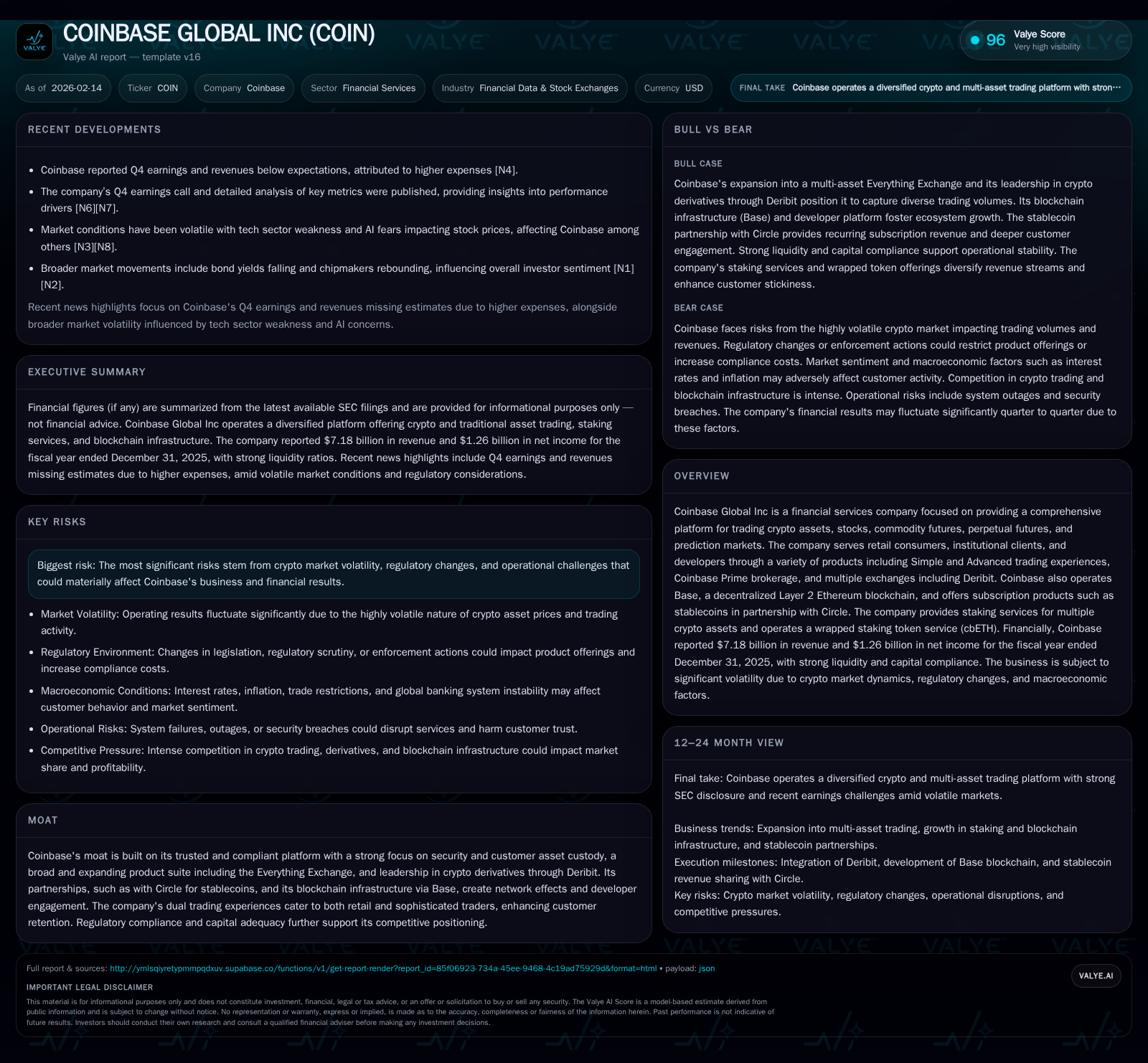
In 2025, Coinbase pivoted ambitiously toward becoming an 'Everything Exchange,' expanding beyond traditional crypto trading to include stocks, commodity futures, perpetual futures, and prediction markets. Despite this innovative expansion, the company faced margin pressures evidenced by Q4 earnings misses tied to increased operational spending and regulatory compliance costs. The acquisition of Deribit bolsters Coinbase’s leadership in crypto derivatives, complementing its layered product suite. However, the company continues to grapple with inherent market volatility, regulatory scrutiny, and the challenge of scaling diverse revenue streams while maintaining high trust standards.
Redefining the Exchange: Coinbase’s Ambition to Be All-Encompassing
Coinbase Global Inc undertook a bold strategic redefinition in late 2025 by launching what it terms the "Everything Exchange." This evolution stretches far beyond Coinbase's earlier identity as a crypto-only exchange. By incorporating not only cryptocurrencies but also stocks, commodity futures, perpetual futures, and prediction markets into its platform in December 2025 [S1], Coinbase aims to capture broader segments of financial market participants across retail consumers, institutional clients, and developers.
This shift signals Coinbase’s intent to be a one-stop shop for diverse asset classes traditionally fragmented among separate trading venues. Retail users benefit from a unified way to engage both legacy and emerging markets; institutional players gain comprehensive custody and brokerage services; developers tap into Coinbase’s Base chain infrastructure for building applications bridging onchain and offchain economies.
Strategically, this initiative leverages Coinbase's existing trust capital — highlighted by rigorous compliance protocols — while offering ease-of-use innovations across two distinct trading experiences detailed as Simple trade for newcomers and Advanced trade targeting professional traders [S1]. This bifurcation caters precisely to varying sophistication levels without compromising the integrity or transparency that underpins the brand’s moat.
By broadening asset access under one roof and integrating derivative products alongside spot trading across multiple asset classes, Coinbase attempts to build network effects that could entrench users deeper into its ecosystem over time. Such an approach nudges the company beyond commoditized crypto exchanges towards a diversified financial services platform.
Financial Trajectory: From Growth to Margin Pressures
Coinbase's fiscal year ended December 31, 2025 reflected robust topline growth with revenues hitting $7.18 billion accompanied by $1.26 billion in net income [F1]. Nevertheless, recent quarterly results tell a more nuanced story. Fourth-quarter earnings fell short of analyst expectations due primarily to elevated operational expenses [N1][N5]. This divergence spooked some market watchers who cite rising cost structures as a sign of growing pains amid aggressive expansion.
Various factors contributed to margin pressures in Q4 including higher outlays related to security incident reimbursements (the Data Theft Incident), investments in infrastructure supporting new products such as derivatives markets integration (Deribit), and an expanded workforce necessary for regulatory compliance efforts [N1][S2]. Though still profitable on an annual basis, these expense trends point to near-term volatility in profit margins as Coinbase balances innovation-led growth with cost discipline.
The tension between scaling breadth of offerings while managing expense inflation underscores an important character of the company’s transitional phase—growth does not yet translate smoothly into proportional profitability gains given macroeconomic headwinds.
The Deribit Acquisition: Strengthening Leadership in Crypto Derivatives
Coinbase augmented its product moat significantly through acquiring Deribit in August 2025 for approximately $687.6 million in cash consideration [S2]. Deribit stands as a leading crypto derivatives exchange specializing in options and futures contracts—a segment experiencing accelerated demand from both retail speculators and sophisticated institutionals.
Integrating Deribit allows Coinbase not only to embed derivatives within its Everything Exchange vision but also positions it as a leader amidst heightened competition in crypto options markets where liquidity fragmentation has been a limiting factor historically. This acquisition is expected to generate synergies by consolidating order flow onto a trusted platform offering cross-asset trading capabilities.
Financially speaking, Deribit's purchase accounts for a substantial portion of investing cash outflows during 2025 alongside increased investments in crypto assets held for investment purposes and loan originations for institutional clients [S2]. The strategic bet on derivatives reflects management confidence in future margins arising from more complex products despite short-term expense uptick.
Navigating Regulatory Breach and Compliance Waters
A defining challenge shaping Coinbase's operational narrative remains regulatory risk coupled with security imperatives. The Data Theft Incident triggered voluntary reimbursements exceeding $250 million in cash outflows during the first nine months of 2025 alone [S2]. Such incidents heighten scrutiny from regulators globally while pressuring margins.
In parallel with incident management costs are ongoing capital adequacy requirements imposed upon various subsidiaries handling customer custodial funds including stablecoins like USDC issued via Circle partnership [S2]. As of September 30, 2025, eligible liquid assets exceeded customer custodial fund liabilities ensuring liquidity safeguards but necessitating sizable cash buffers that could otherwise be deployed commercially.
These combined forces ratchet up operating expenses tied directly to risk management functions encompassing legal fees, compliance staffing, technology enhancements for cybersecurity resilience, and regulatory reporting obligations [S1][N1]. While costly upfront, these measures reinforce Coinbase's critical moat dimension—trusted asset custody underpinned by regulatory adherence that competitors have struggled to match at scale.
Broadening Consumer Access: Simple and Advanced Trading Experiences
Central to Coinbase's user retention strategy is its dual-pathway consumer interface offering:
- Simple trade: An intuitive UI designed for novice investors enabling straightforward transactions across cryptocurrencies as well as new assets such as stocks and futures.
- Advanced trade: A feature-rich environment catering to active traders requiring real-time order books, sophisticated charting tools, live trade history data feeds, and direct access to derivative order flow [S1].
By maintaining separate experiences tuned finely to each user segment’s needs rather than one-size-fits-all design logic, Coinbase expands addressable market reach while mitigating churn risks resulting from interface usability mismatches. These differentiated experiences underpin engagement metrics vital for sustained transaction fee revenues despite episodic trading volume fluctuations inherent in crypto cycles.
This segmentation strategy also complements institutional onboarding efforts where varied counterparty sophistication mandates tailoring interfaces accordingly.
Subscription Products and Stablecoin Partnerships: New Revenue Pillars
Amid transactional volatility characteristic of crypto trading fees influenced by fluctuating volumes and asset prices lies another promising source of recurring revenue: subscription services.
Coinbase's collaboration with Circle on stablecoins represents a cornerstone providing more predictable fee streams aligned with fiat-pegged digital currencies widely used by traders seeking hedging or payment utility [S1]. Staking offerings including cbETH—wrapped staking tokens allowing users exposure to Ethereum consensus-layer rewards—further diversify revenue away from spot market commissions towards services that generate passive income flows based on underlying asset holdings.
These subscription-like products help smooth revenue profiles over time since their economics are less sensitive to moment-to-moment market volatilities compared with pure transaction fees. As appetite grows within both retail segments eager for yield opportunities and institutions requiring regulated digital asset income solutions, these offerings become integral pillars supporting balance sheet stability.
Cash Flow Dynamics and Capital Structure Amid Expansion
Operating cash flow turned negative during the first nine months of 2025 (–$638 million), driven mainly by:
- A significant $2.1 billion increase in cash used to purchase USDC stablecoins responding to surging customer demand,
- Approximately $253 million paid out voluntarily relating to customer reimbursements following the Data Theft Incident,
- Additional operational costs linked to expanding staff headcount and infrastructure investments [S2].
Simultaneously investing activities recorded heavier outflows totaling nearly $1.65 billion largely due to:
- The aforementioned $687.6 million Deribit acquisition,
- Heightened purchases of crypto assets held for investment,
- Increased origination volume in fiat loans directed at institutional financing customers [S2].
Financing activities offset these cash uses by providing almost $1.9 billion mainly through proceeds from convertible note issuances maturing between 2029–2032 aimed at bolstering liquidity during this growth phase [S2]. End-of-year balance sheets reflected cash & equivalents exceeding $11 billion alongside strong current ratio metrics (~2.34) signaling robust short-term liquidity buffers capable of weathering further expansion or stress scenarios [F1].
While capital raises justify confidence in funding runway perseverance amid volatile external conditions—including tighter regulatory scrutiny—monitoring cash burn evolution remains critical as the Everything Exchange ramps deployment costs further.
Managing Volatility: Risks Embedded in Crypto Market Realities
Coinbase operates within an ecosystem punctuated by extraordinary uncertainty stemming from price swings across thousands of crypto assets combined with evolving government regulation worldwide [S1]. This backdrop results in highly unpredictable quarterly results driven principally by:
- Variability in crypto asset prices impacting trading volume incentives,
- Customer adoption rates influenced by sentiment shifts,
- Possible suspension or modification of products per emerging compliance issues,
- Sudden changes in accepted tradable assets reflecting regulatory edicts or internal risk assessments,
- Competitive threats altering service offerings or pricing dynamics.
System integrity risks also loom large given reliance on third-party blockchain networks which may suffer outages or vulnerabilities beyond Coinbase’s direct control exposing operational continuity hazards [S1]. Moreover, talent retention challenges amid intense industry competition threaten innovation cycles necessary for maintaining leadership advantages.
Collectively these inherent risks make forecasting difficult; period-over-period comparisons lose significance when sudden shocks perturb usage patterns unexpectedly—a reality investors must understand as integral rather than exceptional within the cryptocurrency domain.
Looking Ahead: Strategic Opportunities and Challenges for Coinbase
As Coinbase advances further into its Everything Exchange vision supported by Base chain developer infrastructure initiatives forming alongside stablecoin collaborations,[N13] it stands at a crossroads balancing ambitious product diversification against external headwinds:
- Macroeconomic uncertainties such as interest rate rises or global banking instability may dampen overall investor risk appetite thereby impacting volumes.
- Emerging technical innovations introduced by competitors or new decentralized protocols might commoditize aspects of exchange services reducing pricing power unless Coinbase keeps pace effectively.
- Increasingly complex regulatory landscapes require continuous investments into compliance technologies potentially straining future margins.
Yet Coinbase’s substantial liquidity position exceeding $11 billion combined with demonstrated operational scale offers insulation uncommon among pure-play crypto companies particularly those reliant solely on transaction fees[N13][F1]. Its hybrid model integrating retail simplicity with advanced features alongside institutional-grade brokerage strengthens competitive differentiation.
In conclusion, while near-term volatility is almost assured due to layered market forces spanning economic cycles through regulatory evolutions,[N7] Coinbase's multi-pronged approach rooted firmly in trustworthiness combined with broad asset access positions it intriguingly within both today’s turbulent environment and tomorrow’s expanding digital finance frontier.
Disclaimer: This analysis is intended solely for informational purposes drawn from public filings and news reports without providing investment recommendations.
Disclaimer: This is research-only, informational analysis and not investment advice. It may include AI-generated interpretation and general industry context. Always verify important details using primary sources.

Comments