
Anebulo Pharmaceuticals at a Crossroads: Clinical Promise Meets Strategic Transformation
Anebulo Pharmaceuticals navigates challenging financial and regulatory terrain while advancing selonabant for cannabis intoxication treatment.
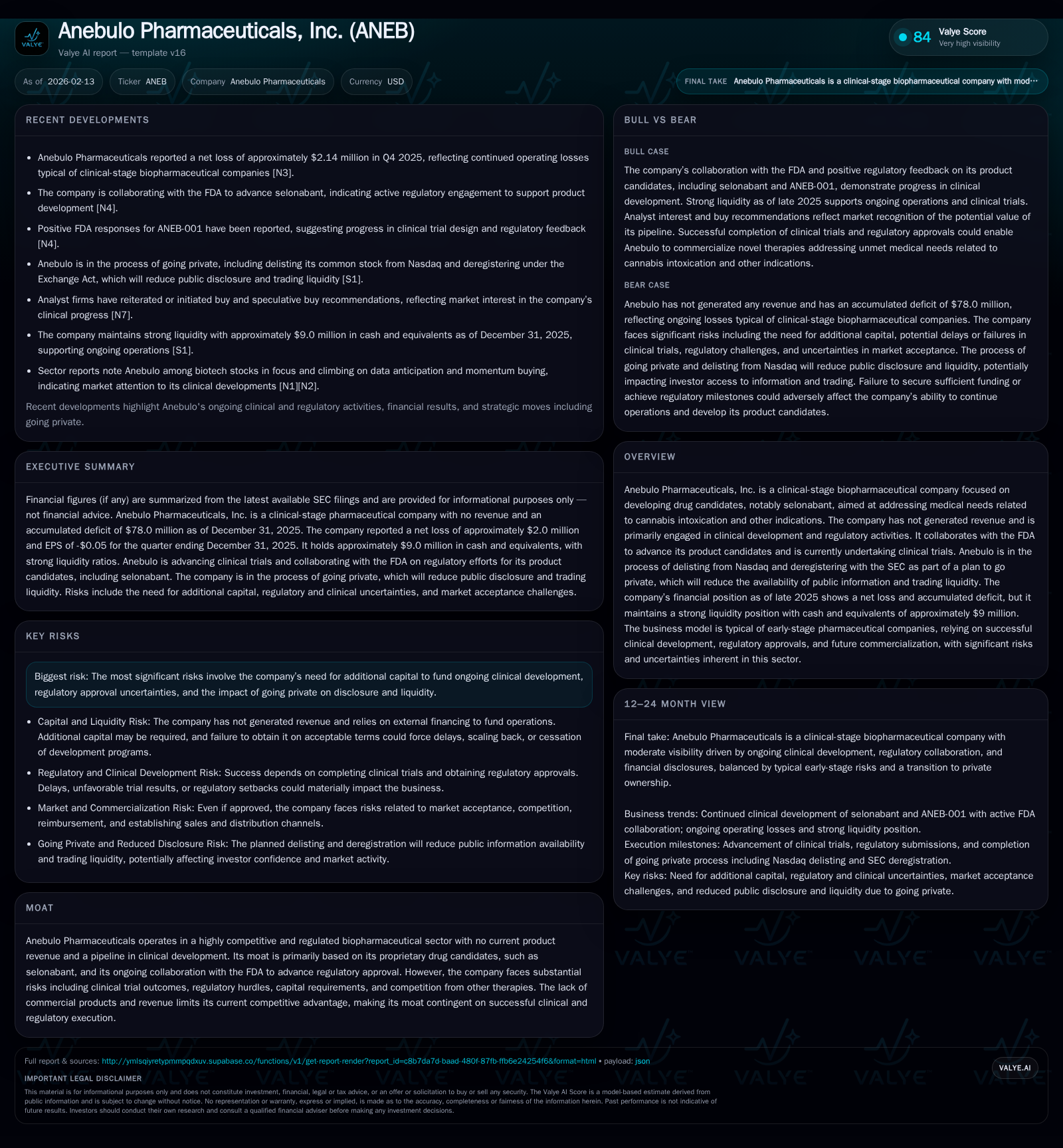
Anebulo Pharmaceuticals, an early-stage biopharmaceutical firm, is focused on developing selonabant — a novel therapy targeting cannabis intoxication, an underexplored medical area with growing public health relevance. Despite promising clinical potential and active collaboration with the FDA, Anebulo faces typical hurdles of biotech startups including sustained net losses, capital constraints, and operational challenges. The company’s recent decision to delist from Nasdaq and go private marks a strategic pivot that will reshape its funding options, liquidity profile, and public transparency. Success hinges on navigating clinical development milestones and market dynamics amid these structural shifts.
Unlocking the Promise of Selonabant: A Novel Approach to Cannabis Intoxication
At the heart of Anebulo Pharmaceuticals stands selonabant, their flagship drug candidate positioned to address the pressing yet under-addressed issue of cannabis intoxication. Unlike other therapeutic areas flooded with competing products or established standards of care, cannabis intoxication remains a space largely devoid of approved medical interventions despite increasing recreational use and associated health concerns. This void presents both opportunity and scientific challenge. Selonabant aims to mitigate acute intoxication effects through a novel mechanism (details undisclosed in public filings), potentially establishing a first-of-its-kind treatment.
Though still early in clinical development with no revenue generation to date [F1], this candidate defines Anebulo's raison d'être. The firm’s 2025 financials underscore typical characteristics of pre-commercial biotechs: persistent net losses coupled with concentrated investment in research activities [S2]. This positioning predicates future value almost exclusively on successful trial progression—a high-stakes gamble emblematic of pioneering pharmaceutical ventures.
Clinical Development Milestones and Regulatory Synergy with the FDA
Anebulo's ongoing clinical trials represent pivotal mileposts shaping the company's trajectory. Explicit details on trial phases or enrollment timelines remain sparse; however, recent disclosures confirm sustained interaction with the FDA that reflects a degree of regulatory confidence—arguably an important intangible competitive asset [S2]. Such administrative engagement can facilitate smoother navigation of complex approval pathways; yet it does not inoculate against systemic risks like unanticipated delays or unfavorable data readouts.
The firm anticipates escalating research and development expenditures as these studies advance—consistent with sector norms where cost intensifies significantly approaching pivotal data collection [S2]. While collaborative momentum may smooth some procedural wrinkles, inherent uncertainties persist. Trial timing deviations or additional required studies could materially affect cash burn rates or timeline expectations.
Financial Health Amid Growth: Assessing Liquidity and Cash Burn
Turning to the balance sheet reveals a nuanced picture reflective of an enterprise balancing growth aspirations against fiscal discipline. As of December 31, 2025, Anebulo reported approximately $9 million in cash and equivalents juxtaposed against an accumulated deficit nearing $78 million—a ratio mirroring typical early-stage pharma firms heavily invested in pipeline maturation without commercial inflows [F1][S2]. Current assets outstrip current liabilities substantially (current ratio >31), indicating stable short-term liquidity buffers that underpin near-term operational continuity.
However, this cushion exists within constraints; ongoing negative earnings (net loss around $2 million last reported quarter) emphasize continuous consumption of resources without offsetting revenues [F1]. The company recognizes that unless alternative funding is sourced or clinical outcomes drive valuation upticks attracting capital infusion, the operational runway could narrow quickly [S2]. Therefore, efficient management of expenditures during this growth window is imperative.
Navigating Risks: Capital Demands, Clinical Uncertainties, and Market Dynamics
Embedded within Anebulo’s journey are multifaceted risks stretching beyond mere financial metrics. Financing remains paramount—the need for supplemental capital to complete clinical programs is explicitly acknowledged alongside potential operational impacts should such funds prove elusive [S2]. Moreover, the stochastic nature of drug development cannot be overstated: adverse trial results or emergent competitor therapies could undermine perceived value sharply.
Operationally, scaling manufacturing capabilities for eventual commercial quantities poses challenges common among biotechs new to production logistics. Simultaneously, marketing hurdles loom large given untested physician receptivity and patient acceptance for treatments addressing acute cannabis intoxication—a relatively nascent therapeutic context [S2]. Limited prior experience across regulatory approval processes compounds these uncertainties further.
Strategic Shift: Understanding the Implications of Going Private
A defining recent development involves Anebulo's strategic decision to delist from Nasdaq alongside deregistering with the SEC as it pursues a path toward privatization [valye_report_excerpt][S2]. This move likely aims at reducing burdensome disclosure requirements while potentially lowering ongoing administrative costs—common rationales for pre-commercial companies feeling constrained by public markets.
Nonetheless, going private diminishes trading liquidity and narrows investor accessibility—potentially complicating future capital raises traditionally supported by public equity markets. Reduced transparency may also limit broader stakeholder insight into corporate progress. Paradoxically, while offering internal management flexibility during critical developmental phases, it introduces opacity that might dampen external engagement when fresh financing becomes necessary.
Competitive Landscape: Positioning Within the Biopharmaceutical Ecosystem
In assessing their place within the broader biopharma landscape focused on cannabinoid-related indications, Anebulo faces an evolving but crowded scientific horizon filled with other early-stage innovators exploring various mechanisms to manage cannabinoid toxicity or substance misuse more broadly [valye_report_excerpt][S2]. Their proprietary focus on selonabant provides some differentiation—but unlike incumbents in more established domains like oncology or immunology, they lack entrenched market presence or diversified product portfolios.
Hence their moat is largely contingent upon demonstrating compelling efficacy results first and securing regulatory approval second. Scientific breakthroughs by competitors could displace current promise unless Anebulo achieves timely validation. This dynamic underscores how fragile competitive standing remains absent commercialized products or established partnerships.
Future Outlook: Balancing Innovation with Operational Realities
Looking ahead, Anebulo must calibrate cautious optimism against hard realities characteristic of clinical-stage biotech enterprises. Upcoming clinical readouts constitute crucial inflection points potentially capable of reshaping external perceptions positively—or triggering reassessment depending on outcomes [S2][valye_report_excerpt][F1]. Concurrently, sustaining operational viability hinges on managing limited liquidity prudently amid escalating expenses tied to R&D commitments.
Strategic privatization affords managerial agility; however, it may also constrict straightforward access to public capital markets just as milestone events require robust funding influxes. Overall prospects thus remain delicately balanced between promise embodied by unaddressed medical needs served by selonabant versus familiar headwinds spanning clinical risk, financing scarcity, competitive advances, and market acceptance barriers.
Disclaimer: This analysis is based solely on publicly available information as provided up to February 2026. It does not constitute investment advice or recommendations. Readers should conduct independent due diligence before making any financial decisions.
Disclaimer: This is research-only, informational analysis and not investment advice. It may include AI-generated interpretation and general industry context. Always verify important details using primary sources.

Comments