
Atmus Filtration Technologies: Navigating Tariffs and OEM Reliance in a Complex Supply Chain
Atmus Filtration Technologies underscores operational resilience despite tariff-induced pressures and concentrated OEM customer dependencies.
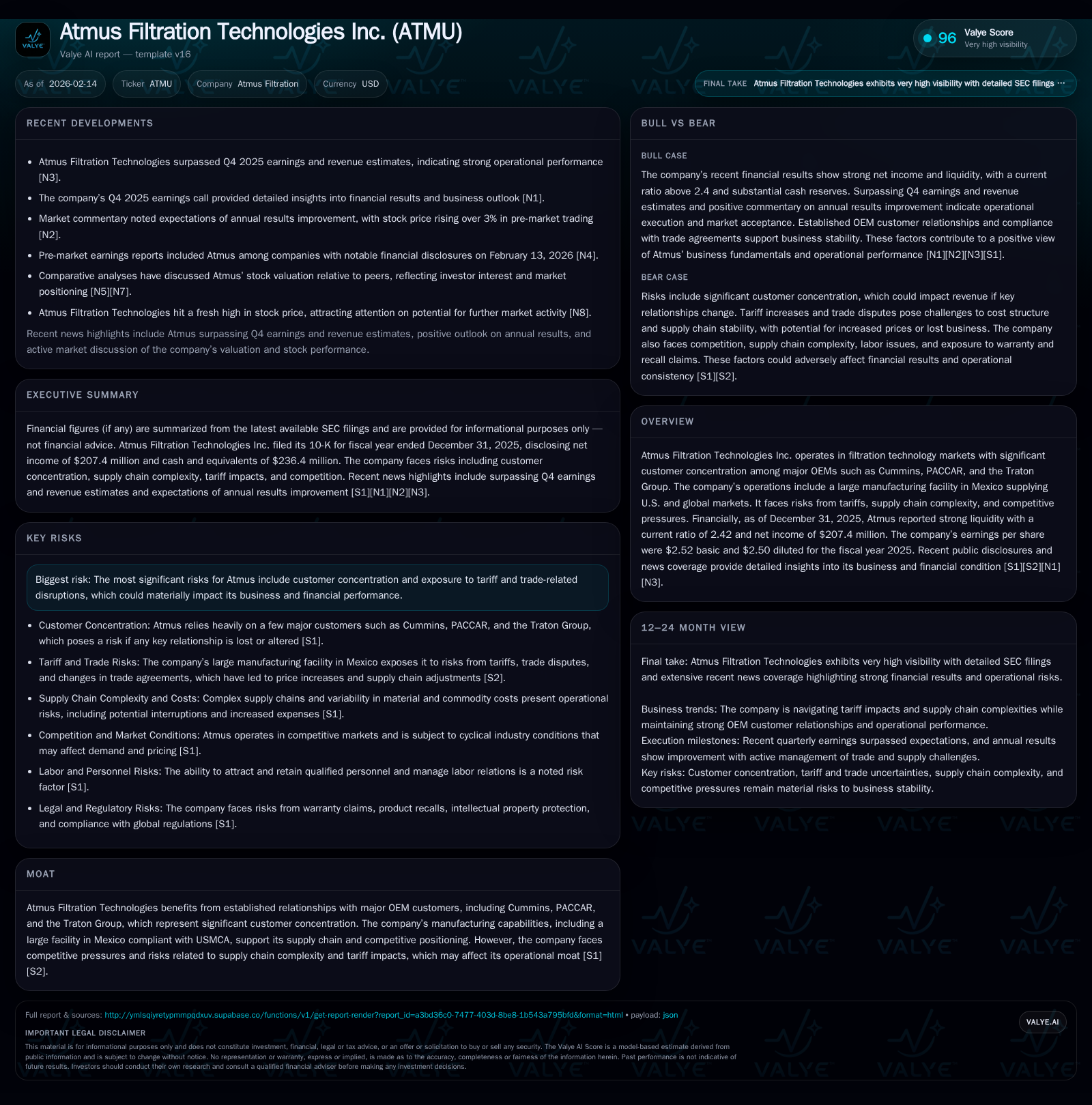
Atmus Filtration Technologies Inc. leverages its strong foothold with major OEM customers—Cummins, PACCAR, and the Traton Group—while operating a strategically important manufacturing facility in Mexico compliant with USMCA rules. The company reported robust full-year 2025 financial results highlighted by a net income of $207.4 million and a healthy current ratio of 2.42, reflecting solid liquidity and cost management amid supply chain complexities. However, tariff escalations since early 2025 and significant customer concentration present persistent risks that could pressure margins and operational flexibility going forward.
Atmus at a Glance: Market Position and Customer Dependencies
Atmus Filtration Technologies Inc. operates at an intersection of advanced filtration technology markets heavily tied to several marquee Original Equipment Manufacturers (OEMs), notably Cummins, PACCAR, and the Traton Group [S1][S2]. This highly concentrated customer base is a double-edged sword: on one hand, it provides Atmus with long-standing partnerships that serve as a moat by securing stable revenue streams; on the other, it constitutes a significant risk factor given reliance on tenant clients whose procurement decisions can materially sway Atmus’s financial performance.
This concentration implies heightened sensitivity to any shifts in OEM production levels or changes in supplier preferences. While these OEM relationships underpin Atmus’s credibility in filtration technologies for commercial trucks and engines sectors, reliance creates vulnerability to demand cyclicality inherent to the transportation industry [S1]. Atmus’s after-sales market exposure adds further dimensions of customer preference risks. Together, these factors highlight the intricacies of revenue stability balanced against contractual dependency.
Manufacturing Stronghold in Mexico: Strategic Advantages and Trade Implications
Atmus’s flagship manufacturing facility located in San Luis Potosi, Mexico plays a pivotal role in its operational architecture [S1][S2]. This site supplies both the U.S. market and global customers, leveraging geographical proximity combined with cost-effective labor markets to maintain competitive production economics.
Critically, Atmus's Mexican operations benefit from compliance with the United States-Mexico-Canada Agreement (USMCA), permitting tariff exemptions on qualifying goods destined for the U.S. market [S2]. This certification provides a crucial buffer against some of the tariff headwinds triggered by recent U.S. trade policy tightening initiated in February 2025.
Nevertheless, uncertainty persists due to fluctuating trade relations involving key countries such as China, Canada, India alongside Mexico. Despite temporary exemptions that ease immediate cost pressures, changing tariff stances can rapidly alter supply chain cost structures forcing operational shifts or price adjustments [S2]. This environment mandates agile supply logistics management while monitoring geopolitical developments closely.
Breaking Down the Q4 2025 Beat: What the Numbers Really Tell Us
The full-year results ending December 31, 2025 highlight Atmus's operational strength amidst adversity [N1][N3][F1]. Net income totaled $207.4 million with basic EPS at $2.52 (diluted $2.50), surpassing consensus projections. These results underpin effective cost control measures alongside successful implementation of price increases aimed at offsetting rising tariff-driven material costs.
Revenue trends demonstrated robustness indicating sustained demand from core OEM clients despite macroeconomic pressures [N3]. Notably, effective management of raw material inflation alongside tactical pricing kept profit margins intact—a signal of sound operational discipline reflective in elevated earnings ratios.
The market reacted positively post earnings release with pre-market stock gains exceeding 3%, reflecting investor confidence bolstered by forward-looking guidance improvements [N2]. However, underlying sensitivities related to external shocks remain visible below surface-level optimism.
The Supply Chain Knot: Tariffs, Trade Wars, and Adaptive Strategies
Since February 2025 the company has faced intensified tariffs levied on imports from China, Mexico, Canada and India imposed by the U.S., triggering complex adjustments across procurement channels [S2]. The administration's phased approach includes temporary sector-specific exemptions including for certified USMCA-compliant products largely produced by Atmus but carries inherent risks should exemptions expire or contracts evolve adversely.
These regulatory variances prompted Atmus to raise product prices strategically to counterbalance escalating input costs stemming from tariffs on finished goods and raw materials [S2]. Nevertheless, this tactic presents risks around buyer pushback or reduced competitiveness versus lower-cost rivals adapting faster to trade environments.
Mitigation measures also involve potential diversification of sourcing locations alongside continuous evaluation of supply chain resilience against sudden policy shifts or retaliatory actions by trading partners [S2]. The dynamic nature of international trade relations requires sustained vigilance ensuring continuity without excessive cost inflation.
Risks Under the Microscope: Customer Concentration and Competitive Pressures
Customer concentration remains paramount among risk considerations for Atmus [S1]. Dependence on three major OEMs implies that any disruption — be it contract loss, renegotiation unfavorable terms or demand fluctuations — could substantially depress revenues.
Competitive intensity within filtration markets compounds this risk profile given competitors may seek to leverage technological advancements or pricing innovations to erode incumbent advantages. Barriers to entry exist given specialized manufacturing expertise but evolving automotive emissions standards could alter client preferences towards alternative filtration technologies over time [S1].
Moreover external factors such as labor disruptions or raw material shortages add operational volatility exacerbating risks linked to concentrated customer channels.
Financial Fortitude Amid Uncertainty: Liquidity, Leverage, and Growth
From a financial standpoint Atmus exhibits considerable strength at year-end 2025 [F1]. Current assets stood at $892 million against current liabilities approximating $368 million resulting in a robust current ratio of 2.42 — indicative of solid short-term liquidity cushions capable of absorbing unexpected shocks linked to tariffs or supply chain bottlenecks.
Cash and equivalents totaled $236 million providing ample runway for tactical investments whether in productivity improvements or selective expansion initiatives designed to broaden the customer base beyond current focal OEMs [F1].
Although debt instruments exist as part of capital structure commitments (term loans & revolving credit facilities), indebtedness is prudently managed restricting excessive leverage which could otherwise constrain adaptability during volatile economic cycles [S1]. This balance sheet posture fosters confidence in sustaining both operations continuity and strategic flexibility simultaneously.
Looking Forward: Potential Catalysts and Market Sentiment
Looking ahead into 2026, multiple variables loom potentially altering Atmus's trajectory situated amid global economic shifts and evolving trade policies [N2][N7][N8]. Ongoing negotiations surrounding tariff modifications between the U.S. and partner countries could relieve some existing cost pressures or alternatively intensify them if protectionist measures escalate further.
Market sentiment appears cautiously constructive as evidenced by share price appreciation following earnings beats coupled with analyst comparisons positioning Atmus favorably relative to peer filtration firms though mindful of premium valuations signaled by recent equity performance [N7][N8].
Positive catalysts might include successful expansion beyond traditional heavy truck segments or value-accretive partnerships mitigating customer concentration risks while adverse scenarios revolve around potential OEM order contractions or disruptive regulatory changes impinging profitability.
This analysis aims solely to provide an informed perspective on Atmus Filtration Technologies' business dynamics based on available public disclosures as of early 2026. It does not constitute investment advice or recommendations regarding securities transactions.
Market actors should conduct their own due diligence aligned with individual investment objectives before making decisions related to Atmus Filtration Technologies Inc.
Disclaimer: This is research-only, informational analysis and not investment advice. It may include AI-generated interpretation and general industry context. Always verify important details using primary sources.

Comments