
Vistagen Therapeutics: At the Crossroads of Neuroscience Innovation and Clinical-Stage Challenges
Balancing the promise of novel neuroscience therapies against financial constraints and regulatory risks defines Vistagen’s current juncture.
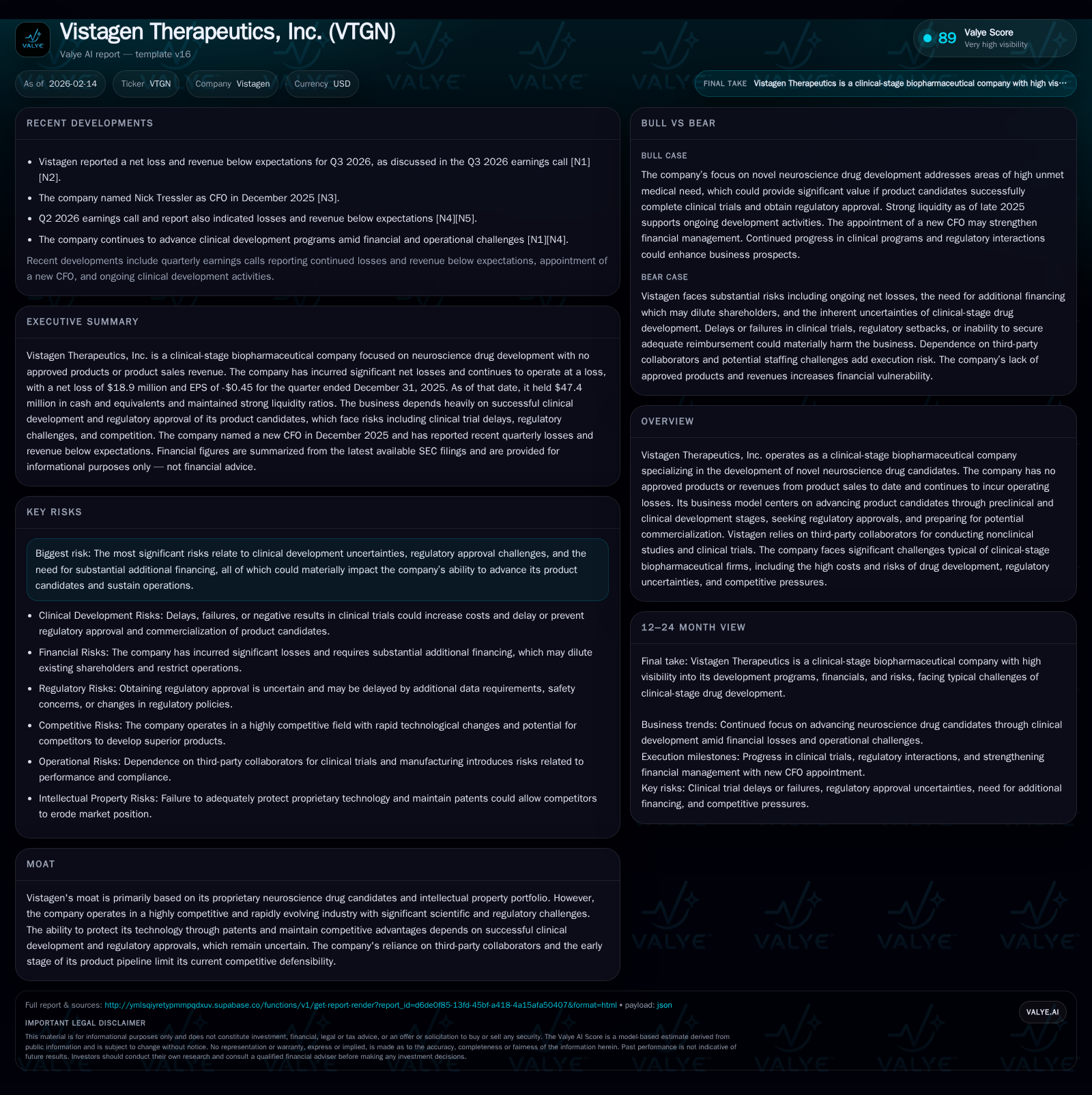
Vistagen Therapeutics, a clinical-stage biopharma company focused on innovative neuroscience drug candidates, operates within a highly uncertain domain marked by significant clinical and financial risks. The firm lacks approved products or revenues, faces steep operational burn, and relies heavily on external collaborations to advance its pipeline. Recent quarterly results highlight ongoing net losses amid Nasdaq listing pressures and underscore the critical need for additional financing, which carries dilution risks. Upcoming clinical milestones and regulatory decisions remain pivotal catalysts shaping the company's near-term trajectory.
The Promise and Perils of Neuroscience Innovation
Neuroscience has long presented one of the most alluring yet formidable frontiers in biopharmaceutical research. The complex neurobiology underlying mental health disorders demands highly specialized approaches that frequently yield unpredictable development results. Vistagen Therapeutics embodies this high-risk, high-potential paradigm. As a clinical-stage entity with no approved therapies or commercial revenue to date, it navigates an uncertain path fraught with inherent scientific challenges. Their focus on innovative compounds addressing unmet neuroscience needs places them in a unique niche but simultaneously amplifies risk given the historically low success rate in translating early-stage findings into effective marketed drugs [F1][S2].
A distinct feature of Vistagen's profile is its commitment to pioneering first-in-class treatments. However, this ambition is shadowed by practical constraints — substantial operating losses accompanied by dependency on external funding cast a long shadow on its runway for sustained development [S2]. That juxtaposition — vibrant innovation caught within rigorous financial realities — defines much of Vistagen’s corporate context.
Vistagen’s Research Pipeline: A Deep Dive into Novel Candidates
At the heart of Vistagen’s potential lies a portfolio of proprietary neuroscience drug candidates. While detailed specifics remain guarded due to early development stages, their filings reveal that these compounds are designed to address central nervous system disorders lacking effective treatment paradigms [S2]. Intellectual property protections form an essential pillar supporting this pipeline, yet their strength is contingent upon successfully crossing clinical milestones that validate therapeutic benefits.
Currently, all candidates are preclinical or early-phase clinical trials — meaning definitive proof-of-concept data is pending. This status aligns with typical biotech developmental sequences but underscores the precarious nature of their competitive moat. The outcome of ongoing studies will dictate whether Vistagen advances from hopeful innovator to credible competitor in crowded neurological therapy markets [F1][S2].
Financial Health Check: Balancing Cash Reserves Against Operational Burn
Vistagen's reported cash and equivalents totaled approximately $47.4 million as of December 31, 2025, while current liabilities stood around $13.5 million, translating into a current ratio near 4.7 — indicative of solid short-term liquidity [F1]. Yet beneath this surface cushion lies the robust operational burn synonymous with clinical-stage biopharmaceutical firms.
The company’s aggressive R&D initiatives, coupled with ongoing trial costs and administrative expenses, have resulted in sizeable net losses — nearly $19 million for fiscal 2025 [F1][N2]. These figures illuminate the narrow runway remaining without further capital infusion, especially as costs tend to accelerate near pivotal clinical read-outs or manufacturing scale-up phases.
Consequently, the financial picture presents a dual narrative: adequate liquidity today contrasted against looming capital needs that will challenge survival absent successful fundraising efforts.
Clinical Trial Setbacks and Regulatory Hurdles: Parsing Recent Developments
Information from Vistagen’s Q3 2026 earnings call reveals continued adherence to planned study timelines but also acknowledges inherent unpredictability tied to clinical endpoints and regulator interactions [N1]. The absence of any currently marketed product pushes urgency on trial success; however, delays or negative data outcomes could escalate costs and stall momentum.
Moreover, the company reiterates that regulatory approvals remain uncertain variables influenced by both trial performance and broader FDA review patterns within neuropsychiatric drug approvals [S2]. Such regulatory complexity heightens operational risk — any unforeseen hurdle could materially disrupt forecasted progress.
Therefore, recent commentary reflects cautious optimism tempered by clear acknowledgments of vulnerability intrinsic to pioneering new neuroscience medicines under stringent oversight.
Strategic Reliance on Collaborators: Strength or Vulnerability?
A core component of Vistagen’s operational model involves third-party contractors handling nonclinical studies and clinical trials [S2]. This arrangement provides flexibility, allowing cost-efficient scaling relative to pipeline demands without large fixed infrastructure investments.
However, dependence on external collaborators introduces exposure to timing inconsistencies, quality control issues, or contractual renegotiations that may influence trial integrity or timelines adversely. Such reliance requires meticulous management oversight while accepting that control over critical path activities remains partially externalized.
Hence, this strategy represents a double-edged sword — leveraging partnerships delivers nimbleness but concomitantly amplifies systemic execution risk across development programs.
Market Position: Intellectual Property Amid Fierce Industry Competition
Within pharmaceutical innovation cycles, intellectual property defense often delineates sustainable competitive advantage. For Vistagen, patents around its novel neuroscience molecules constitute a foundational moat [S2]. Nonetheless, given the early pipeline stage and rapid technological advances industry-wide, this moat remains provisional until supported by tangible clinical proof points.
Competitive dynamics in neuroscience drug development encompass not only rival biotechs but also large multinational entities pursuing similar therapeutic niches using diverse modalities. Success thus hinges on both maintaining robust patent portfolios and demonstrating superior efficacy or safety profiles during trials.
Consequently, while IP rights offer theoretical exclusivity benefits today, practical enforceability will depend heavily upon future empirical validations happening along uncertain timelines.
The Dilution Dilemma: Financing Needs Versus Shareholder Value
The fundamental financial reality confronting Vistagen centers on reconciling escalating capital demands with shareholder interests. Frequent equity financings represent the principal mechanism through which operational continuity is secured given the absence of product revenues [S2][N2]. Yet such financing events invariably result in dilution effects diminishing existing ownership stakes.
Management acknowledges this tension openly. In their disclosures, they stress that further raises may be necessary “to continue nonclinical/clinical development” while cautioning such activities “may cause substantial dilution” or restrict operational freedom should covenant terms become burdensome [S2].
This dynamic creates an intrinsic balancing act — securing sufficient funding without compromising investor confidence requires thoughtful timing aligned with favorable pipeline news flow.
Nasdaq Listing Risks and Their Implications for Investor Confidence
Among documented risk factors is the threat posed by non-compliance with Nasdaq Capital Market listing standards [S2]. Failure to maintain required minimum share prices or market capitalization parameters can trigger delisting procedures with attendant consequences including depressed liquidity and diminished access to public capital markets.
Given Vistagen's volatile trading patterns common among small-cap biotechs facing clinical uncertainty, this represents a tangible concern impacting investor sentiment. Any credible delisting risk could cascade into widening bid-ask spreads or reluctance among institutional holders to engage actively.
Therefore, safeguarding compliance remains not merely regulatory housekeeping but integral to maintaining overall market standing amid already elevated strategic uncertainties.
Forward-Looking Challenges and Key Milestones Ahead
Looking forward, several critical inflection points will shape Vistagen’s trajectory. Anticipated readouts from ongoing clinical studies constitute primary drivers likely to recalibrate perceptions of program viability [N1][S2]. Concurrently, obtaining regulatory feedback or approvals—whether accelerated designations or full marketing authorizations—will mark substantial validation milestones if achieved.
On financial fronts, prudent management of upcoming funding rounds will be essential to sustain operations beyond near-term deadlines without excessive dilution burdens [S2]. Furthermore, continued engagement with collaborators demands vigilance to mitigate potential execution risks embedded within contract research organization relationships.
Success at these intersections could propel Vistagen into more prominent competitive positioning; failure or delays would compound existing challenges encapsulating much of its business risk profile.
Disclaimer: This analysis is for informational purposes only and does not constitute investment advice or recommendations.
Disclaimer: This is research-only, informational analysis and not investment advice. It may include AI-generated interpretation and general industry context. Always verify important details using primary sources.

Comments