Assessing Fuse Group Holding's Multi-Sector Ambitions Amid Operational and Financial Pressures
Fuse Group Holding Inc. juggles mining, biotech, and consulting ventures, but financial strain and limited assets raise questions on its growth viability.
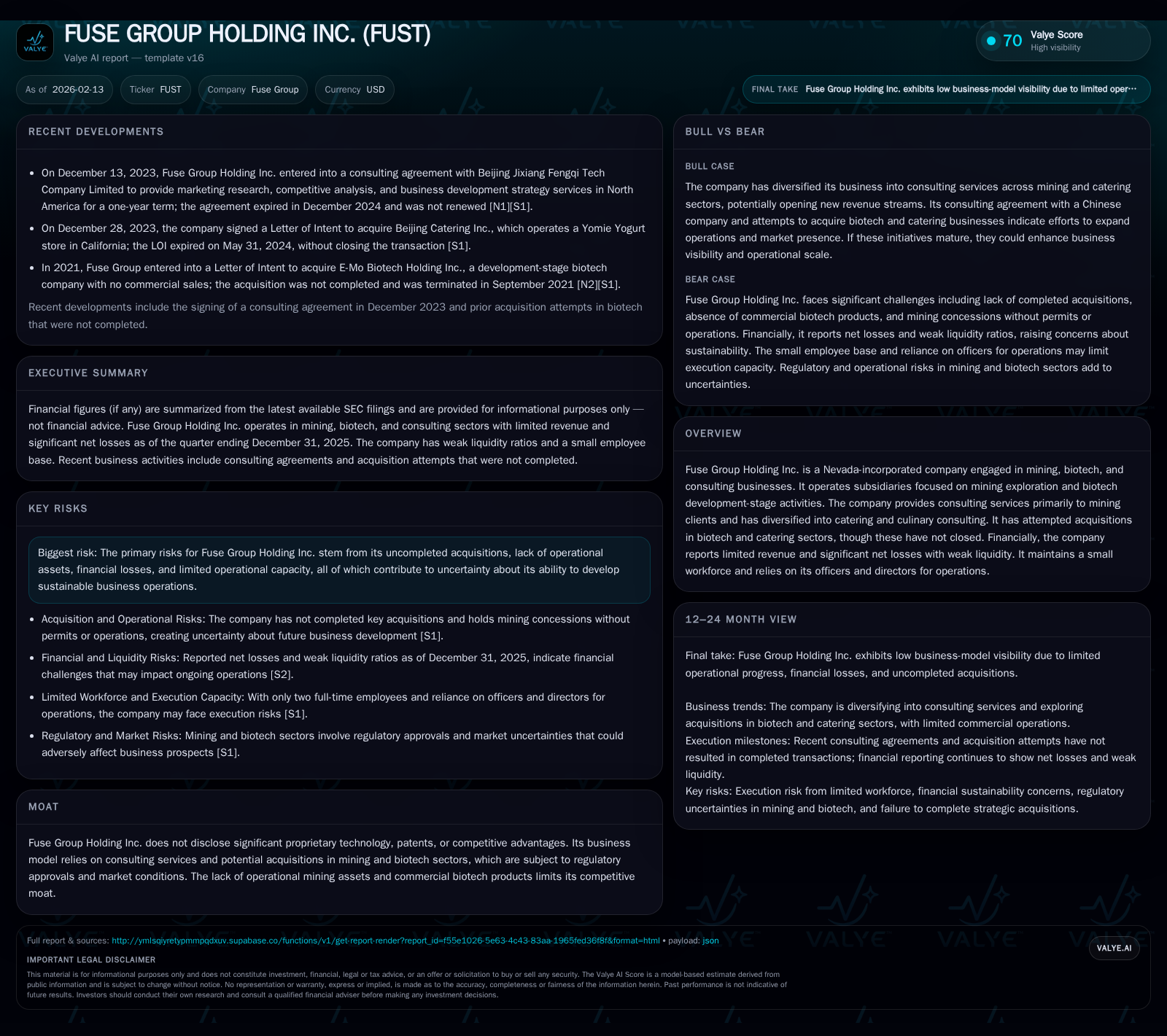
Fuse Group Holding Inc., incorporated in Nevada since 2013, operates a complex structure spanning mining exploration rights, early-stage biotech development, and consulting services including culinary advisory. Despite ambitious diversification, the company faces significant operational hurdles: it holds no active mining operations or commercial biotech products, relies heavily on unclosed acquisitions, reports minimal revenue against pronounced net losses, and exhibits weak liquidity ratios. Governance depends on a small team of officers and directors without a broad workforce to scale these endeavors. Without proprietary advantages or secured regulatory approvals, Fuse’s multifaceted strategy confronts fundamental challenges to achieving long-term sustainable growth.
Fuse Group Holding: Origins and Expanding Horizons
Incorporated under Nevada law on December 24, 2013, Fuse Group Holding Inc. presents itself as a multi-industry player focused on mining exploration, biotechnology development, and consulting services [S1]. Its corporate architecture is composed of several subsidiaries: Fuse Processing, Inc., targeting mining opportunities; Fuse Trading Limited (acquired and later divested); and Fuse Biotech Inc., dedicated to biotechnological ventures [S1]. This structure reflects a deliberate attempt to enter diverse sectors with potential synergies in natural resource exploration and emerging technologies.
From inception through early incorporation activities between 2016 and 2020, the company has staged pathways toward these sectors by acquiring rights and building consulting capabilities rather than developing substantial physical assets [S1]. Notably, the pivot towards consulting also introduces nontraditional lines such as catering advisement—an unusual addition that underscores an adaptive but scattered expansion approach.
Mining Ventures: From Rights to Reality or Risks?
Despite asserting involvement in mining exploration across continents including Asia and North America via its Processing subsidiary [S1], Fuse Group's tangible footprint remains elusive. The core reported mineral holdings center on concessions for five mineral sites within Mexico acquired through agreements dating back to MOUs made in 2018 [S1]. However, these concessions have not transitioned into operational mines; they hold no permits or surface rights necessary to commence extraction activities.
The absence of requisite governmental approvals for mining operations critically undermines feasibility. Moreover, the company owns no physical equipment or facilities linked directly to production [S1]. Such circumstances imply that from an asset perspective—and considering market risks linked with regulatory compliance—the mining arm functions more as a speculative portfolio than an active producer.
Biotech Aspirations: Developmental Stage or Dreams Deferred?
Fuse Biotech Inc., formed initially as Fuse Technology Inc., represents the company’s most nascent pillar [S1]. With no documented commercial products nor delivered technological breakthroughs mentioned in filings up to December 2025, this segment remains firmly developmental stage [S1].
The biotechnology field generally demands substantial upfront R&D investment combined with long time horizons before revenue generation. Given Fuse's limited capex evidenced by financial disclosures (discussed below), the company appears constrained in advancing this vertical beyond exploratory efforts.
The lack of disclosed intellectual property rights such as patents or trade secrets further diminishes perceived near-term value creation prospects from this segment within the broader business mix.
Consulting and Culinary Diversification: A Strategy or Scattershot?
Consulting services comprise another dimension of Fuse Group’s operational ambitions. Initially focused on facilitating client acquisitions within the mining sector by performing due diligence and market research [S1], the company has extended consulting offerings into catering and culinary advisory—sectors notably distinct from their original core areas [S1].
While diversification can be a prudent mitigation tactic against sector-specific risks, such expansion raises questions about strategic coherence versus opportunistic scattergun approaches. The carved-out niche of culinary consulting may reflect attempts to generate incremental revenue streams amid stagnant progress in mining and biotech.
Nonetheless, these consultations appear small-scale with sparse documentation on sizable contracts or recurring clients. This signals that the consulting business might serve mostly operational expenses rather than act as a growth engine.
Financial Strain and Liquidity Challenges: Reading the Numbers
Analyzing Fuse Group’s latest financial snapshot reveals considerable fragility impeding sustainable growth initiatives. Total revenue reported for year-end December 31, 2025 stands at roughly $7,683—an extremely modest figure relative to typical industry benchmarks [F1].
Concurrently, net losses run approximately $32,492 over the same period indicating recurring negative profitability without meaningful offsetting revenues [F1]. Cash reserves totaling around $20,472 are insufficient when juxtaposed with current liabilities exceeding $350,000 resulting in a dangerously low current ratio of about 0.09—a classic indicator of liquidity distress limiting ability to meet short-term obligations [F1].
Such numbers suggest that despite ongoing business activities across sectors described earlier, operating efficiencies are strained sharply by fixed costs and lack of substantial income generation avenues reducing runway for organic expansion.
Governance and Operational Capacity: The Human Factor
The complexity woven through Fuse Group’s multi-sector approach contrasts with its highly constrained organizational bandwidth. Filings confirm reliance predominantly on officers and directors who serve dual roles encompassing leadership oversight alongside daily operational responsibilities [S1,S2].
Absence of larger staffing rosters curtails scalability potential necessary for deploying capital effectively across disparate projects including exploration licensing procedures or biotech R&D management. The hands-on but thinly spread executive involvement may exacerbate execution risk especially considering pending transactions requiring negotiations and compliance monitoring.
The Acquisition Gambit: Unclosed Deals and What They Mean
Fundamental to Fuse’s stated growth path is an acquisition strategy aimed at incorporating additional entities primarily within mining and biotech segments [S1]. For instance, a February 2021 share exchange agreement targeted acquiring full ownership of Mexican company Portafolio en Investigacion Ambiental S.A de C.V., holding mineral concession rights [S1]. However, actual closures remain contingent upon government approvals related to transfer of mineral concessions—none secured as per recent disclosures—with oral agreements underscoring continued uncertainty.
Similarly, prior MOUs arranged for concession purchases lacked follow-through beyond exclusive purchase rights deadlines [S1]. These stalled transactions create ambiguity in projections since anticipated fuller control over tangible assets never materialized. They also challenge investor confidence by raising doubts whether acquisition pipelines will yield concrete portfolio enhancements needed for revenue scaling.
Competitive Landscape and Moat Analysis: Searching for Advantage
Evaluating competitive positioning reveals negligible proprietary technology assets or patented innovations underpinning Fuse’s valuation proposition [valye_report_excerpt]. Its reliance primarily on consulting contracts combined with speculative resource claims lacks durable competitive moats protecting against rivals possessing entrenched mine operation infrastructure or established biotech platforms.
Absent product commercialization capabilities in biotech also leaves it vulnerable amid innovation-driven peers enjoying barriers to entry via IP protection—a crucial factor given biotech’s capital intensity.
This lack of defensible positions reinforces that Fuse’s business model is heavily dependent on successful asset acquisition deals coupled with effective service delivery rather than unique technological leverage.
Risks in Focus: Fragile Foundations and Uncertainty Ahead
Explicit risk disclosures highlight numerous existential threats facing Fuse Group including cash flow insufficiency compounded by low working capital ratios; inability thus far to secure necessary regulatory permits critical for converting mining concession rights into operable mines; dependence on few personnel capable of managing multi-sector demands; uncertainties inherent in deal closures with third parties; plus absence of immediate revenue-generating assets beyond modest consulting fees [valye_report_excerpt,S2].
These factors collectively shape an outlook where achieving sustainable operations is fraught with material execution risks—amplified further by general market conditions impacting both commodity prices influencing mining viability and funding landscapes affecting early-stage biotech ventures.
Outlook: Can Fuse’s Ambitions Materialize into Sustainable Growth?
Balancing Fuse Group Holding’s diversified ambitions against observable realities suggests that while versatility may provide multiple shot opportunities at breakout success across sectors like mining exploration and biotechnology development, current operational constraints cast doubt on imminent scaling capacity. Financial statements evidence minimal incoming cash streams insufficient for absorption of cash burn associated with exploration expenditures or clinical development costs [F1,S2].
Without closing outstanding acquisitions under transparent terms backed by regulatory endorsements—the cornerstone intended for expanding asset base—and enlarging human resources geared towards implementation efficiency—as presently constrained staffing alludes—Fuse faces an uphill journey toward profitability or self-sustaining growth trajectories.
In sum, while aspirations are broad-ranging embracing mining concession potentials alongside futuristic biotech endeavors augmented by service diversification into catering consultancy,the simultaneous pursuit without solid foundational footing risks diluting focus thereby amplifying structural fragility inherent given present financial health metrics.
Disclaimer: This analysis is based solely on publicly available SEC filings as of early 2026 without making projections or recommendations regarding securities offered by Fuse Group Holding Inc. Readers should conduct independent due diligence before forming investment views.
Disclaimer: This is research-only, informational analysis and not investment advice. It may include AI-generated interpretation and general industry context. Always verify important details using primary sources.

Comments