
Capstone Green Energy: Navigating Growth and Liquidity in the Microturbine Frontier
Capstone Green Energy advances its resilient microturbine solutions amid expanding international presence and financial balancing acts.
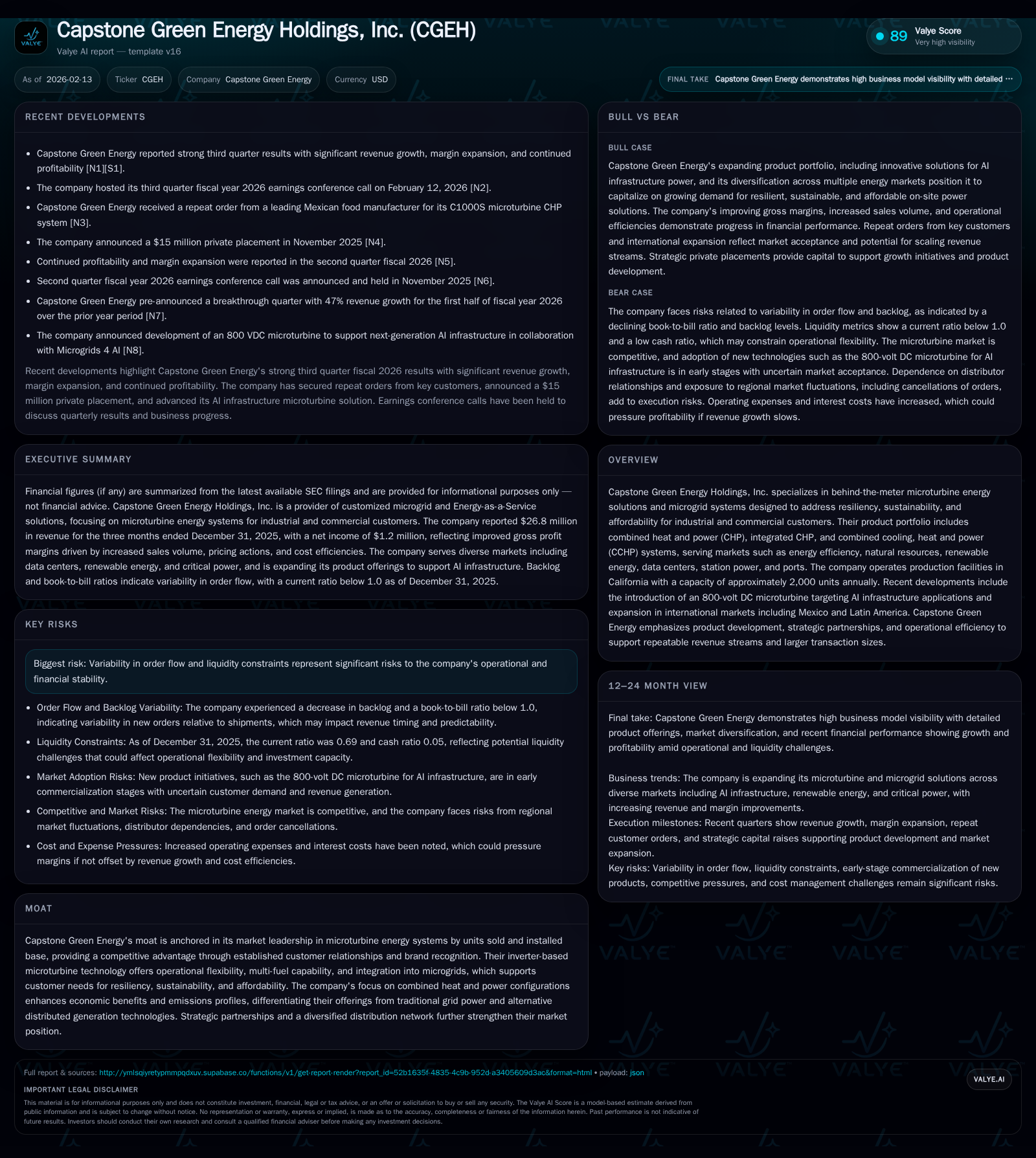
Capstone Green Energy Holdings, Inc. stands as a leader in behind-the-meter microturbine technology, delivering energy solutions that address the pressing trilemma of sustainability, resiliency, and affordability for industrial and commercial users. The company’s notable strengths include a diverse product lineup featuring combined heat and power systems, a substantial installed base, and new initiatives like an 800-volt DC microturbine tailored for AI infrastructure. While recent quarters show robust revenue growth and margin expansion, Capstone faces liquidity pressures driven by working capital mismatches and order flow variability. Strategic partnerships and international expansion into Latin America provide growth avenues, yet operational execution must balance emerging financial risks amid evolving distributed generation industry dynamics.
Behind the Microturbine Curtain: Capstone's Core Innovation and Market Leadership
In the rapidly evolving landscape of distributed energy resources, Capstone Green Energy Holdings, Inc. has carved a distinctive niche through its advanced inverter-based microturbine technology. The firm offers behind-the-meter energy solutions focused on industrial and commercial sectors requiring dependable, clean power supply. Central to Capstone’s value proposition is its suite of products encompassing combined heat and power (CHP), integrated CHP (ICHP), and combined cooling, heat and power (CCHP) configurations — systems designed not merely for electricity generation but also optimized heat recovery enhancing overall system efficiency. This positions Capstone ahead of many competitors reliant on simpler on-site generation technologies.
The company's manufacturing capacity in California supports roughly 2,000 units annually, underscoring substantial production scale relative to this specialized market segment [F1], [S2]. Their inverter architecture yields operational flexibility by enabling smooth integration with other distributed energy resources within microgrid environments. Such integration is increasingly sought after to satisfy customer demands for resiliency—ensuring uninterrupted operations despite grid outages—and sustainability objectives through reduced emissions. Multi-fuel capabilities extend market applicability across traditional natural gas grids and emerging biogas or renewable fuels.
Capstone's leadership is further evidenced by an extensive installed base — reportedly the largest by microturbine units sold worldwide — which nurtures enduring customer ties and provides brand validation that new entrants find difficult to replicate. This legacy supports a moat grounded not only in technology but also deep client relationships fostered over years of deployment experience.
The Energy Trilemma Addressed: Sustainability, Resiliency, Affordability in Action
Capstone directly tackles what is often described as the "Energy Trilemma"—simultaneously achieving sustainability, resiliency, and affordability in power provisioning. Their products’ cogeneration capability leverages waste heat from electricity production to generate usable thermal energy or cooling via CCHP setups. This significantly enhances fuel-use efficiency while reducing greenhouse gas footprints compared to conventional grid electricity plus onsite boilers or chillers.
Critical applications highlight this balance: data centers requiring stringent uptime can deploy Capstone’s resilient microgrids; ports aiming to cut emissions benefit from cleaner fuel options; renewable biogas projects capitalize on multi-fuel flexibility [N4]. Economically, while direct grid power may appear cheaper per kWh in some regions due to scale economies or subsidies, hidden costs such as interconnection fees or reliability premiums frequently tip the scales toward on-site generation.
Capstone’s systems are designed for 'peak shaving,' effectively moderating expensive demand charges amid volatile electricity pricing regimes. Such operational adaptability addresses affordability without compromising environmental goals—a compelling trifecta increasingly demanded by commercial end-users [F1], [S2], [N4].
New Frontiers: International Expansion and Advanced Product Launches
Expansion beyond North America represents a strategic thrust for Capstone as it seeks higher-growth markets. Notably, recent orders such as the C1000S unit placed in Brazil illustrate tangible steps penetrating Latin American infrastructure sectors focused on natural gas-fired critical power applications [N3]. Mexico and broader Latin American markets offer promising demand drivers due to accelerating electrification paired with limited grid robustness.
Complementing geographic diversification is technology advancement exemplified by the launch of an innovative 800-volt DC microturbine platform tailored toward AI data center infrastructure—an emerging vertical with acute power density and resilience needs [Valye report excerpt]. This product reflects a savvy understanding of future workload demands where high-voltage DC architectures can reduce conversion losses and improve system efficiency.
Such initiatives potentially broaden revenue streams while enhancing Capstone’s image as a forward-thinking solution provider capable of addressing next-generation energy challenges beyond legacy distributed generation realms.
Financial Pulse Check: Revenue Growth Against Liquidity Constraints
Capstone’s reported third quarter fiscal 2026 results unveiled robust topline momentum with $26.8 million in revenue accompanied by margin expansion validating operational leverage effects [N1], [F1]. Net income registered around $1.2 million signaling continued profitability amid growth efforts. These metrics suggest successful execution on core manufacturing scale-up alongside effective cost management.
However, beneath this positive surface lie financial stress points notably reflected in liquidity ratios; the current ratio recently stood at approximately 0.69—substantially below conventional benchmarks for comfortable short-term solvency [F1], [S2]. The imbalance between current assets ($50 million) versus current liabilities ($73 million) signals potential constraints managing working capital demands amid fluctuating order inflows.
The company itself acknowledges the unpredictability inherent in its order flow can strain cash flows, exacerbating risk around operational continuity if sustained mismatches occur [S2]. Maintaining adequate financing flexibility thus becomes pivotal to support ongoing manufacturing cycles without disruption even while top-line indicators remain promising.
Strategic Partnerships and the Ecosystem Effect
Although recent announcements lack explicit new strategic partnership formations, Capstone’s moat fundamentally depends on robust collaborative networks spanning distributors, integrators, fuel suppliers, and technology partners [Valye report excerpt]. These alliances facilitate market reach extensions especially crucial when entering new geographies or constructing integrated microgrid offerings requiring cross-domain expertise.
Partnerships enable bundled solutions combining equipment sales with Energy-as-a-Service (EaaS) models—augmenting customer stickiness through service contracts beyond point-in-time hardware transactions [S2]. They also improve feedback loops accelerating innovation responsiveness while providing extended technical support infrastructure vital for complex installations.
Given intensified competition among distributed energy resource providers embracing different technological approaches (e.g., fuel cells, solar-plus-storage), safeguarding these ecosystem relationships constitutes a key defensive barrier reinforcing Capstone’s competitive standing.
Industry Positioning Amidst Distributed Generation Trends
The broader shift toward decentralized generation places companies like Capstone at the fulcrum of modern grid modernization strategies emphasizing localized resilience alongside carbon reduction targets [S2], [Valye report excerpt]. Compared with simple-cycle generators or renewables alone, Capstone’s inverter-based systems embody hybrid attributes balancing reliability (dispatchable power), environmental impact (low emissions), and flexibility (multi-fuel operation).
Their approach aligns well with increasing regulatory encouragement for distributed energy resource aggregation forming community microgrids or virtual power plants able to provide ancillary services back to utilities or wholesale markets. However, such positioning requires continuous innovation given fast-evolving tech landscapes—including battery cost declines and emerging hydrogen possibilities threatening traditional combustion-centric solutions.
Economic trade-offs remain particularly nuanced: onsite generation must justify capital outlays relative to often subsidized utility supply while navigating complex interconnection rules sometimes hindering deployment speed [S2]. Claimed advantages like peak shaving or waste heat utilization must translate into tangible savings perceived by end customers.
Operational Efficiency vs Order Flow Variability: Navigating Risk
Operational execution emerges as a double-edged sword; while production facilities possess significant capacity (~2,000 units per year), uneven order inflows introduce planning complexity that can inflate overhead costs or delay shipment timelines impacting customer satisfaction and working capital needs simultaneously [S2], [Valye report excerpt].
Liquidity constraints compound this challenge as cash tied up in inventory or receivables restricts maneuverability during lean periods. Management’s risk disclosures candidly emphasize these pressures as principal uncertainties potentially affecting future results.
Mitigation strategies may involve tighter sales forecasting disciplines, diversified contracting terms including advance payments or leasing models reducing initial capital burden placed on buyers. Additionally, embracing digital tools enhancing supply chain visibility could optimize inventory management crucial under fluctuating demand scenarios.
Future Outlook: Tailwinds and Headwinds on the Horizon
Looking ahead, Capstone appears positioned to capture secular tailwinds driven by global decarbonization mandates necessitating resilient clean energy solutions across critical business segments including data centers growing exponentially due to digital economy demands [N1], [Valye report excerpt]. Expanding international addressable markets alongside targeted product innovations such as high-voltage DC microturbines uniquely position their offerings within evolving energy frameworks.
Nevertheless, caution flags arise from liquidity dynamics compounded by inherent market cyclicality reflected in order flow variability [S2]. Balancing expansion ambitions with disciplined financial stewardship remains paramount to avoiding operational disruptions risking brand reputation accrued over decades.
Investors observing this narrative must weigh solid fundamental progress against emergent fiscal vulnerabilities. Ultimately, success hinges on translating technological differentiation into scalable commercial outcomes sustainably amidst intensifying distributed generation competition globally.
Disclaimer: This analysis is provided solely for informational purposes without any express or implied recommendation regarding securities or investment strategies related to Capstone Green Energy Holdings, Inc.
Disclaimer: This is research-only, informational analysis and not investment advice. It may include AI-generated interpretation and general industry context. Always verify important details using primary sources.

Comments