
FONAR Corporation: Legacy MRI Innovator Navigating Industry Pressures and Transition
FONAR Corporation leverages distinctive Upright® MRI technology and integrated diagnostic services amidst reimbursement and regulatory headwinds.
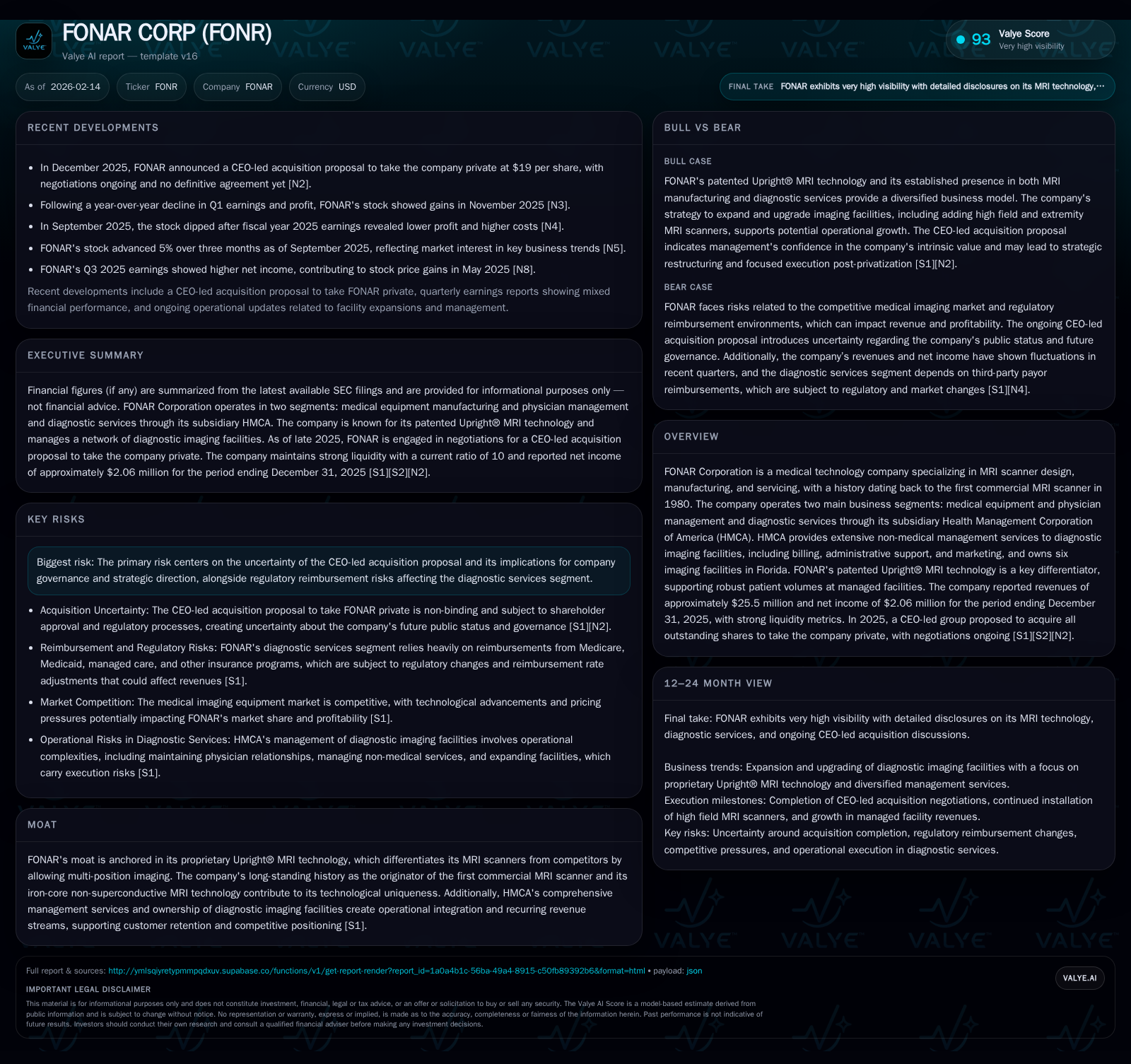
FONAR Corporation, a pioneer in MRI technology since the 1980 introduction of the first commercial MRI scanner, operates through two segments: medical equipment manufacturing and physician management/diagnostic services via its subsidiary HMCA. Its patented Upright® MRI scanner remains a technological differentiator in a competitive landscape defined by reimbursement challenges, inflationary pressures, and evolving regulatory frameworks, particularly in Florida. As of year-end 2025, the company reported modest profitability supported by strong liquidity. A CEO-led buyout proposal currently under negotiation introduces strategic uncertainty affecting governance and future direction.
Company Background and Business Segments
FONAR Corporation stands out as a legacy player in magnetic resonance imaging (MRI) technology, tracing its roots back to the creation of the first commercial MRI scanner in 1980. The company's foundation rests on technological innovation notably characterized by its iron-core non-superconductive magnet design—a divergence from conventional superconductive magnets used widely across the market. This design underpins its "open" MRI scanners introduced initially in 1980 and further evolution into its signature Upright® Multi-Position™ MRI scanners. These devices enable scanning patients while sitting or standing, affording diagnostic views not available with traditional horizontal scanners.
FONAR’s operations bifurcate into two main segments: the medical equipment segment focuses on designing, manufacturing, selling, and servicing MRI scanners; while the physician management and diagnostic services segment operates through its wholly owned subsidiary Health Management Corporation of America (HMCA). HMCA extends beyond typical clinical operations by administering an integrated suite of non-medical services such as billing, administrative support, marketing, credentialing, IT services, compliance consulting, contract negotiations, and staffing to diagnostic imaging facilities it manages or owns—including six proprietary centers situated across Florida.
Differentiation Through Upright® MRI Technology
At the heart of FONAR’s moat lies its patented Upright® MRI technology. Unlike traditional superconductive superconducting magnets that necessitate patients lying flat within confined tubes, FONAR's upright scanners use an iron-core permanent magnet system that allows flexible patient positioning—including standing or seated scans. This innovation broadens diagnostic possibilities particularly for musculoskeletal conditions where weight-bearing imaging provides enhanced clinical insights.
This technological uniqueness confers several competitive advantages:
- Clinical differentiation: Multi-positional imaging potentially improves diagnostic accuracy for certain conditions.
- Patient comfort: The open design mitigates claustrophobia issues common with standard closed-bore MRIs.
- Operational integration: Robust utilization rates at HMCA-managed centers largely driven by these unique scanners support recurring revenue generation.
Notwithstanding this differentiation, FONAR continues grappling with challenges faced generally across medical device manufacturers including evolving reimbursement policies that impact end-user demand.
Financial Performance Snapshot
For the fiscal year ending December 31, 2025, FONAR reported revenues totaling approximately $25.5 million alongside net income of around $2.06 million [F1]. These figures reflect stable but modest growth trajectories within segments constrained by external pressures. Of particular note is FONAR’s liquidity position; as of mid-2025, cash and equivalents stood at roughly $56.3 million against current liabilities near $14.4 million—yielding a current ratio near 10 [F1]. This substantial liquidity buffer underpins operational flexibility amid an environment marked by economic uncertainty.
Industry Challenges: Reimbursement Environment and Inflationary Pressures
The predominant source of FONAR’s revenue emanates from HMCA’s scanning center business where commercial success is intimately tied to payer reimbursement rates. The company explicitly highlights exposure to declines in Medicare, government programs, and private insurer reimbursements [S1]. Despite efforts to offset rate cuts through volume increases and cost controls, inflationary pressures have hampered efficiency gains.
Rising costs of labor and materials elevate capital requirements especially when expanding or establishing new imaging centers—delaying profitability milestones. These macroeconomic headwinds restrain organic growth prospects and necessitate greater strategic focus on cost management.
Regulatory Risk Factors: Florida Insurance Law Dynamics
HMCA’s hub of operations in Florida exposes it to amplified regulatory risk stemming from recent legislative activity affecting insurance schemes governing patient payments for imaging services [S1]. The Tort Reform Act enacted in March 2023 altered negligence laws leading to increased unpaid receivables alongside rising administrative overheads at affiliated centers.
Repeated legislative attempts to repeal Florida’s no-fault automobile insurance laws—which would shift payment mechanisms towards a fault-based model—pose additional uncertainties around billing delays and volume fluctuations [S1]. While some proposals were vetoed or stalled in committee recently, recurrent efforts continue to cast long shadows over financial predictability.
Operational Risks: Cybersecurity Vulnerabilities and Referral Dependence
FONAR acknowledges pronounced cybersecurity risks intrinsic to managing sensitive patient data across clinical sites reliant upon complex IT infrastructure. Prior identification of material weaknesses in internal IT controls has driven mitigation initiatives; however, lingering vulnerabilities create exposure to ransomware attacks or data breaches that could disrupt operations materially [S1]. Enhancing cybersecurity defenses entails increasing capital allocation amid competitive cost pressures.
Additionally, HMCA’s reliance on third-party physician referrals as a linchpin for patient volume creates business risk should referral patterns shift due to competitive dynamics or altered provider relationships [S1]. Maintaining referral networks thus requires continuous engagement strategies alongside service quality improvements.
Competitive Landscape Considerations
Market competition for diagnostic imaging patients remains fierce with numerous facilities vying based on quality reputation, geographic accessibility, pricing strategies, and service breadth [S1]. FONAR’s integrated approach combining proprietary technology with facility ownership aims to carve defensible niches but must continually invest in product enhancements like its Upright® MRI platforms alongside excellence at managed sites.
Strategic Uncertainty: CEO-Led Going-Private Proposal
On July 7, 2025, a group led by the Company’s CEO Timothy Damadian proposed acquiring all outstanding public shares intending to take FONAR private [S1]. Given that this same leadership group holds voting control presently—and has expressed unwillingness towards alternative transactions—the move generates ambiguity regarding governance structures and strategic priorities post-transaction.
The company established an independent Special Committee equipped with advisors to assess terms diligently with stockholder interests paramount. The ultimate outcome remains unresolved but marks a pivotal inflection point influencing investor considerations around transparency versus opportunity for restructuring away from public market pressures.
Analysis: Navigating Between Innovation Legacy and Sector Headwinds
From an industry perspective (analysis), innovation cycles within MRI technology have slowed as dominant players rely heavily on superconductive magnet designs offering higher magnetic field strengths favored in many clinical scenarios. FONAR’s niche Upright® system serves specific clinical indications but may limit overall market penetration relative to all-encompassing platforms integrating advanced software solutions including AI-assisted image interpretation now gaining traction broadly.
Integration via HMCA provides valuable steady-state cash flow buffering cyclical variability inherent in capital equipment sales but simultaneously exposes the company to payor mix risks heightened by geographic concentration in Florida.
Increased regulatory complexity combined with volatile reimbursement frameworks—common stressors across healthcare—require ongoing adaptability from management with agility both operationally and strategically vital amid potential ownership transitions.
Looking forward (analysis), leveraging core technology advantages will likely necessitate augmented R&D investments toward newer scanner models or adjunct digital offerings enhancing workflow efficiencies—a domain many peer competitors advance aggressively fueled by deep pockets absent at smaller players like FONAR.
Meanwhile mitigating external risks such as cybersecurity demands vigilant governance oversight coupled with proactive legislative advocacy addressing Florida's shifting insurance statutes could alleviate some margin pressure at HMCA-operated sites.
Conclusion
FONAR Corp embodies a blend of pioneering technological heritage paired with modern-day operational complexities characteristic of mid-sized medical technology entities embedded within healthcare delivery chains. Its iconic Upright® MRI platform maintains distinctiveness yet faces scalability limits within competitive global markets dominated by entrenched OEMs emphasizing superconductive magnet architectures enhanced by software capabilities.
Parallelly, the diversified model incorporating physician management services via HMCA affords diversified revenue inflows albeit exposed directly to reimbursement cuts compounded by inflationary challenges plus region-specific legislative risks impacting cash flow reliability.
Concurrently unfolding corporate governance shifts precipitated by CEO-led privatization initiative inject an additional layer of uncertainty shaping future strategic trajectory—potentially realigning priorities away from public scrutiny toward longer-term value creation initiatives but delaying visibility for investors reliant on transparent quarterly disclosures.
Stakeholders should monitor developing legislative outcomes within Florida closely along with progress regarding transaction negotiations confirming governance realignment scenarios going forward amidst broader healthcare reimbursement evolutions impacting small-cap device manufacturers dependent on managed service models.
Disclaimer: This report is for informational purposes only and does not constitute investment advice or an offer to buy or sell securities. It reflects analysis based solely on publicly available information as of its publication date without forecasting future performance.
Disclaimer: This is research-only, informational analysis and not investment advice. It may include AI-generated interpretation and general industry context. Always verify important details using primary sources.

Comments