
Legacy Education Inc.: Navigating Healthcare Education Growth Amid Regulatory Complexities
Legacy Education Inc. leverages its accredited healthcare-focused colleges in California to capitalize on surging workforce demands while contending with evolving regulatory landscapes.
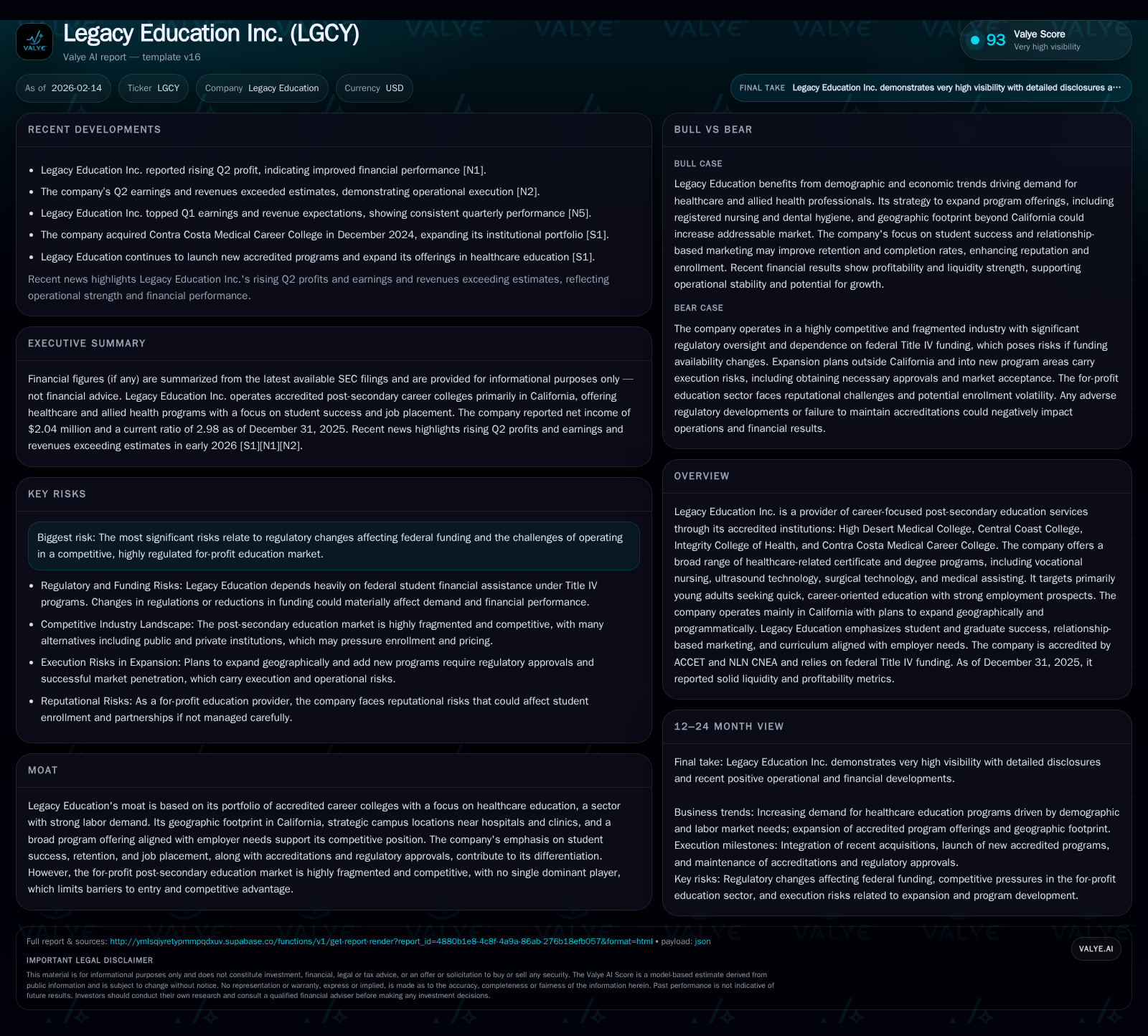
Legacy Education Inc. operates a portfolio of accredited career colleges primarily in California that specialize in healthcare education programs aligned with strong labor market demand. The company’s recent financial results underscore operational momentum supported by solid liquidity and profitability. However, Legacy faces significant regulatory challenges tied to its reliance on federal Title IV funding and the complex approval processes for new programs and campuses. Its strategic focus on student outcomes and measured program expansion positions it favorably within a fragmented and competitive for-profit education market, although regulatory risks remain a key headwind.
A Footprint Rooted in Healthcare Education
Legacy Education Inc. stands out through its concerted investment in a cluster of healthcare-focused career colleges — High Desert Medical College (HDMC), Central Coast College (CCC), Integrity College of Health, and Contra Costa Medical Career College (CCMCC). Each institution caters to career-bound students seeking relatively quick educational pathways into growing healthcare subsectors such as vocational nursing, ultrasound technology, surgical technology, and medical assisting [S1], [F1].
HDMC, with campuses spread across Lancaster, Bakersfield, and Temecula, serves the largest student body (~1,956 enrolled as of mid-2025) and plans to initiate new programs pending regulatory approval — surgical technology among them — highlighting its adaptive curriculum strategy [S1]. CCC’s smaller but diverse program offerings complement this footprint, notably adding MRI technology programs starting October 2025 [S1]. All four institutions primarily operate within California's robust labor markets near hospitals and clinics; this geographical positioning supports not only recruitment but crucially job placement post-graduation.
This focus on healthcare aligns well with sustained labor shortages nationally and regionally within nursing and allied health professions — an industry context that bolsters Legacy’s relevance. By concentrating on career colleges rather than broader academic offerings, Legacy targets a niche committed to filling immediate market needs.
Financial Health Mirrors Operational Momentum
Recent quarterly disclosures confirm Legacy Education’s positive operational trajectory. The Q2 2026 earnings report revealed revenues surpassing analyst forecasts alongside net income of approximately $2 million [N1], [N3], [F1]. The company maintains cash reserves exceeding $21 million with a current ratio near 3, indicating solid short-term liquidity [F1]. This balance sheet strength offers strategic flexibility for planned expansions while cushioning against sector volatility.
Such financial stability supports Legacy’s growth ambitions without over-leveraging the business amid regulatory uncertainties. Notably, these results indicate balanced growth driven by both enrollment increases in core healthcare programs and effective cost management.
Accreditation and Regulations: Double-Edged Sword
Legacy Education’s accreditations through ACCET (Accrediting Council for Continuing Education and Training) and NLN CNEA (National League for Nursing Commission for Nursing Education Accreditation) serve as foundational pillars enabling participation in critical federal Title IV programs [S1]. Without these credentials, institutional eligibility for federal student aid would be jeopardized, threatening both revenue streams and enrollment inflows.
Yet navigating the labyrinthine regulatory landscape is challenging. The company must maintain strict adherence to myriad rules covering every dimension—from marketing practices to graduation rate reporting, curriculum content to facility standards—exacting significant compliance costs [S1], [S2]. The risk of sanctions is tangible: monetary fines, restrictions on operations, or outright loss of accreditation can materially disrupt business.
While these regulations limit new entrants—providing some moat effect—the resulting pressure on profit margins is non-trivial. They also inject a degree of uncertainty into Legacy’s forward outlook given regulatory shifts can occur abruptly.
Program Expansion and Geographic Strategy
Legacy’s continued expansion of specialized programs reflects an acute sensitivity to employer demand dynamics. HDMC's upcoming surgical technology AAS launch scheduled for October 2025 following Bureau approvals demonstrates a deliberate scaling approach anchored by market feedback rather than broad-based proliferation [S1]. Similarly, CCC's introduction of cardiac sonography alongside MRI associate degrees signals broadening scope within the technical medical fields.
Despite being concentrated in California—a mature higher education territory—the company exhibits strategic intent towards scaling offerings that deepen programmatic relevance rather than aggressive geographic proliferation. This program-focused growth aims to enhance student pipeline prospects without diluting quality or incurring excessive compliance risk that broader geographic moves might entail.
Student Success Metrics and Employer Alignment
Though granular data on retention or graduation is limited in available documents, Legacy explicitly prioritizes student success as a competitive differentiator [valye_report_excerpt], [S1]. Relationships with local employers facilitate feedback loops ensuring curricula align closely with workforce needs. This alignment improves job placement rates—critical metrics for both accreditors and prospective students evaluating ROI on tuition investment.
The company’s relationship-based marketing strategies thrive partly because graduates find meaningful employment promptly—in turn reinforcing brand reputation. In an environment where alternative educational options proliferate online or via community colleges, tangible employment outcomes sustain Legacy’s value proposition.
Competitive Landscape in For-Profit Post-Secondary Education
The sector remains highly fragmented with no monopolistic players dominating nationally. Companies like Universal Technical Institute (UTI) excel predominantly in automotive/machinist trades while American Public Education (APEI) addresses broader online public education markets [N2], [N4]. Against this backdrop Legacy’s focused healthcare niche offers insulation from direct competition yet still subjects it to overarching pricing pressures endemic across for-profit providers.
Fragmentation reduces barriers but also constrains pricing power; thus Legacy’s ability to leverage accreditation credibility, localized medical networks, and relevant program portfolios becomes paramount for differentiation.
Risks from Regulatory Shifts and Funding Dependencies
Reliance on Title IV federal aid remains Legacy's greatest source of vulnerability given it accounts for a substantial proportion of student funding [S1]. Any adverse changes—whether through policy reform tightening eligibility criteria or enforcement actions linked to compliance failures—could precipitate swift revenue declines.
Additional risks arise from potential accreditation reviews or state-level regulatory adjustments impacting authorization status or permissible program types [S1], [S2]. Marketing practices are also under scrutiny broadly across the sector; failures here can trigger costly investigations or mandated operational changes.
These factors exacerbate competitive pressures by increasing operational complexity while elevating risk premiums inherent to valuation models considering cash flow predictability.
Valuation Insights and Investment Considerations
From an analytical standpoint, Legacy balances strong underlying fundamentals—a diversified accredited institutional base focused on high-demand healthcare education segments—with significant structural risks stemming from regulatory dependencies.
Its recent quarters’ solid earnings performance backed by prudent liquidity profiles signals sound operational management capable of executing measured expansion plans without overextension [N1], [N3], [F1]. However, investors would prudently weigh these positives against the sector's susceptibility to swift regulatory evolutions that could affect eligibility for vital federal funding channels.
Moving forward, how effectively Legacy navigates approvals related to new program launches—and manages accreditation expectations—may decisively shape its medium-term growth trajectory. Additionally, successful exploration beyond Californian borders could unlock incremental scale advantages though will require careful due diligence regarding jurisdictional compliance demands.
In sum, Legacy Education Inc.’s strategic positioning within an essential service area—healthcare education—with demonstrable operational momentum paints a picture of cautious optimism tempered by regulation-driven uncertainty governing much of the US for-profit post-secondary education milieu.
Disclaimer: This analysis is provided solely for informational purposes based on publicly available information as of February 2026. It does not constitute investment advice or recommendations.
Disclaimer: This is research-only, informational analysis and not investment advice. It may include AI-generated interpretation and general industry context. Always verify important details using primary sources.

Comments