
Pluri Inc. at a Crossroads: Navigating Innovation and Financial Pressures in Cell-Based BioTech and FoodTech
Pluri Inc.’s diversified cell-based technology ambitions face critical operational and financial challenges amid early-stage development hurdles.
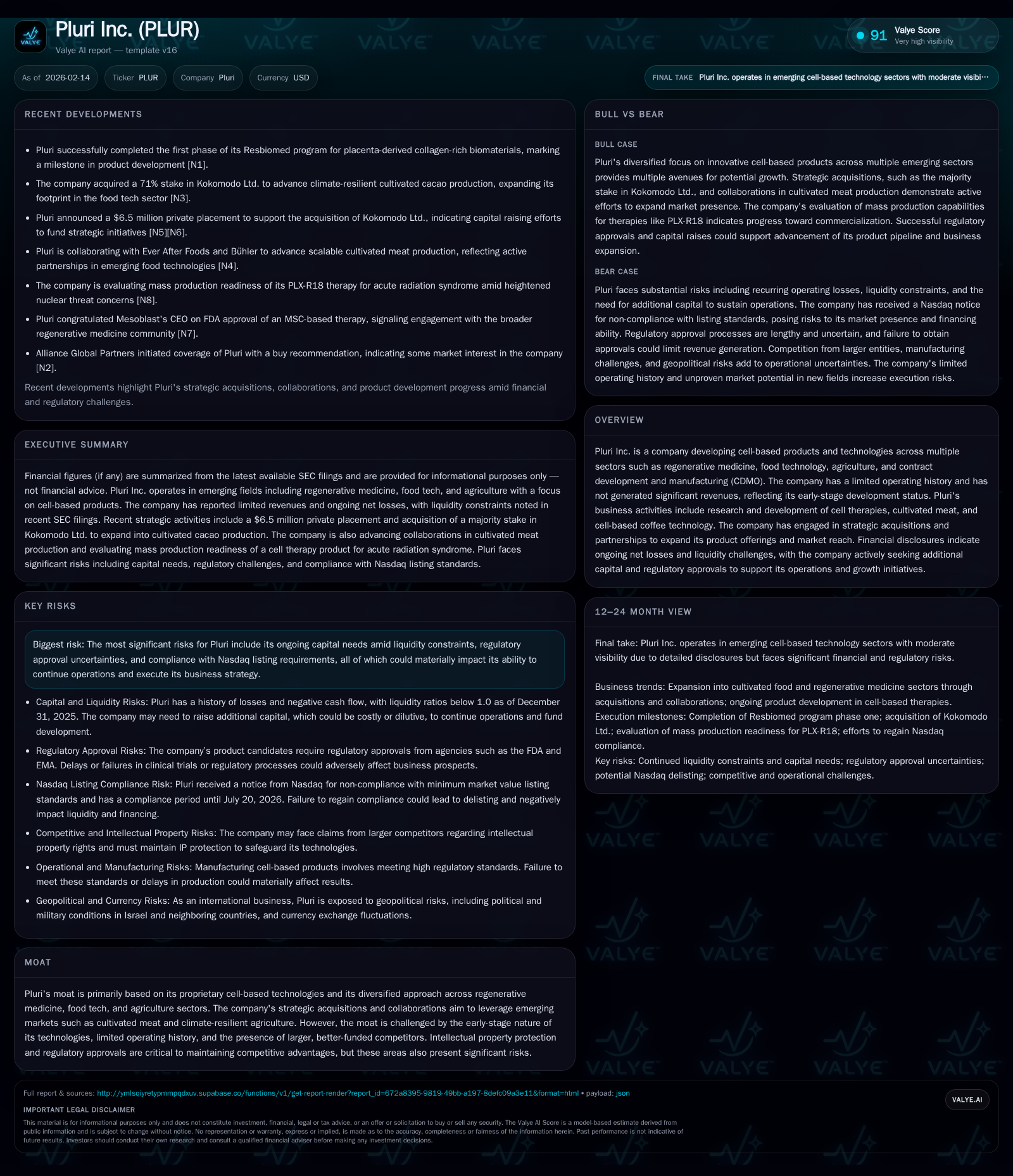
Pluri Inc. operates at the intersection of regenerative medicine, cultivated meat, agriculture, and CDMO services—an unusually broad scope for an emerging cell-technology firm. The company’s recent milestone in placenta-derived collagen biomaterials underscores its scientific progress but contrasts sharply with persistent liquidity constraints, ongoing net losses, and looming Nasdaq delisting risks. Intellectual property strength and strategic partnerships offer some defensive moats, yet significant uncertainties remain around regulatory approvals, market adoption, and capital adequacy. As Pluri strives to advance complex technologies across nascent industries, it stands at a pivotal junction balancing promise against operational survival.
A Vision of Cells Across Industries: Pluri’s Broad Playbook
Pluri Inc. represents a strikingly ambitious endeavor in the realm of cell-based technologies by pursuing applications spanning regenerative medicine, food technology, agriculture, and contract development/manufacturing services. This breadth distinguishes Pluri amid early-stage peers typically focused on narrower verticals. Its portfolio encompasses cell therapies aimed at medical repair and regeneration; cultivated meat ventures targeting alternative protein markets; innovative cell-based coffee technology seeking to disrupt conventional beverage production; agricultural innovations likely leveraging cellular approaches for climate resilience; plus a CDMO segment offering biotech manufacturing capabilities[ F1 ].
Such wide-ranging aspirations reflect both an opportunity and a daunting operational complexity. Managing multiple technology paths simultaneously strains resources—particularly for a company with limited historical revenue or commercial traction. Each vertical demands specialized R&D expertise, regulatory navigation, market validation, and customer engagement distinct from the others. This multi-armed strategy underscores Pluri’s scientific ambition yet inherently heightens execution risk amid early-stage development.
Breaking Down the Resbiomed Milestone: What Does Success Mean?
Amid these competing priorities, Pluri recently announced completion of phase 1 in its Resbiomed program focused on placenta-derived collagen-rich biomaterials—a noteworthy milestone illustrating concrete progress within its regenerative medicine pipeline[ N1 ]. Placenta-sourced collagen holds potential as a biomaterial scaffold facilitating tissue repair or therapeutic delivery, positioning Pluri toward clinical translation pathways.
Phase 1 conclusion typically confirms initial safety parameters in humans but remains several steps removed from efficacy demonstration or commercial readiness. Nevertheless, reaching this developmental threshold is essential to validating foundational R&D efforts and justifying follow-on investment. It signals that some of Pluri’s long-term scientific commitments might mature into clinically meaningful products if subsequent phases progress without delay.
However, isolated achievements here are tempered by the broader realities of pipeline breadth coupled with resource limits. Whether resourced sufficiently to advance multiple product candidates remains an open question affecting investors' assessment of near-term viability.
Early-Stage Technology Meets Market Realities: The Innovation Hurdle
Pluri’s exploratory products—including cultivated meats and cell-based coffee—reside in nascent markets defined by disruptive promise yet plagued by uncertain adoption curves[ S1 ]. Cultivated meat technology must overcome substantial scale-up challenges to reduce production costs while assuring safety standards attractive to consumers reluctant about lab-grown foods. Similarly, introducing cell-based coffee seeks not only biological feasibility but also consumer palate acceptance intertwined with regulatory classification complexities.
Moreover, Pluri's limited operating history compounds uncertainties around scaling manufacturing processes effectively or securing sustainable demand streams under evolving legislative frameworks controlling food-tech innovations globally.[ S1 ]
This environment demands patient capital and nimble adaptation as market experiments unfold unevenly worldwide. For Pluri — still verifying foundational R&D hypotheses — these variables translate into fundamental financial risk layers tied directly to technological maturation timelines alongside unpredictable competitive dynamics.
Financial Health Under the Microscope: Liquidity, Losses, and Listing Risks
Scrutinizing Pluri’s latest financial statements reveals an acute liquidity crunch threatening near-term stability. Despite persistent innovation work, revenue during FY2025 remained nominal at approximately $198k USD while net losses ballooned beyond $6.5 million[ F1 ]. Cash reserves tally just under $4.7 million against current liabilities around $32.3 million—placing the current ratio at a concerning 0.43 well below healthy thresholds indicating potential solvency distress[ F1 ].
These figures imply operational burn rates far outstripping inflows with scant immediate prospect of self-sustaining cash generation absent external capital injections.[ S2 ] Such imbalance inherently constrains flexibility for R&D advancement or strategic initiatives.
Adding urgency is Nasdaq’s formal notice citing failure to maintain minimum market value listing standards (requiring MVLS ≥ $35 million), though compliance efforts have been granted a 180-day window through mid-2026[ S2 ]. Should the company fail this test without remediation measures like capital raises or asset restructurings, risks escalate toward delisting—further limiting access to equity capital markets and investor participation.
The Regulatory Gauntlet: Navigating Approvals and Nasdaq Compliance
Regulatory approval landscapes present formidable barriers encompassing product-specific clearances within medical devices or food safety jurisdictions alongside strict marketplace operation rules.[ S1 ][ S2 ] Each vertical—medicine, food-tech, CDMO—faces separate governing bodies with distinct evidentiary thresholds creating compound uncertainty layers.
Simultaneously stringing Nasdaq continued listing criteria compliance adds another operational constraint requiring swift financial stabilization.[ S2 ] The confluence of regulatory rigor plus financial monitoring imposes pressure on management decision-making with considerable impact on survival prospects.
Failure along any regulatory route could stall product commercialization indefinitely while continued noncompliance with exchange rules threatens trading status — both outcomes eroding shareholder value unpredictably.
Moat or Mirage? Competitive Edges Amidst Big Players
Pluri stakes defensibility claims on proprietary cell-based technology IP portfolios fortified by strategic partnerships intended to broaden reach beyond internal capabilities.[ S1 ] Nonetheless early-stage status means these protections sit uneasily against competition from better capitalized incumbents actively pursuing overlapping domains.
Industry incumbents’ capacity for expensive patent litigation or aggressive IP contestation presents ongoing risk vectors undermining smaller players’ market entry attempts.[ S1 ] Whereas intellectual property forms a theoretical moat, practical sustainability hinges on navigating commercialization speeds faster than larger rivals can encroach or litigate away advantage.
Thus what on paper reads as competitive leverage requires constant guardrails in law enforcement plus rapid translation from concept-to-customer engagement under resource restraint.
Strategic Partnerships and Acquisitions: Fueling Growth or Stretching Thin?
To accelerate its cross-sector ambitions despite limited organic scale, Pluri has pursued acquisitions and collaboration deals designed to augment product portfolios and access specialized markets simultaneously[ F1 ][ S1 ].
While such moves are common for startups lacking full infrastructure breadth internally, they risk diluting focus especially if integration consumes disproportionate management bandwidth amid fragile finances.
Balancing expansion opportunities versus resource conservation remains delicate—growth via acquisition can either catalyze future revenue platforms or exacerbate existing cash flow pressures if synergies fail to materialize quickly enough.
Risks Amplified: Capital Needs, IP Vulnerability, and Market Uncertainties
Management disclosures underscore multiple interlocking risks imperiling business durability including sustained net losses necessitating frequent raises potentially dilutive to shareholders.[ S1 ][ S2 ] Intellectual property contestations loom large with possibility of costly litigation triggered by large competitors defending their positions.[ S1 ]
External influences such as geopolitical tensions related to operations in Israel introduce added instability both operationally and financially through currency risks (exposures to shekel/euro fluctuations) and regional security concerns impacting supply chains or investor confidence.[ S1 ]
Additionally inflationary trends may elevate raw material costs underpinning manufacturing ambitions further squeezing already tight budgets.[ S1 ]
Together these factors compound uncertainties extending beyond typical biotech developmental pathways into operational survival territory.
Looking Ahead: Scenarios for Survival or Transformation
Pluri faces sharply bifurcated futures over the coming months given pending Nasdaq compliance deadlines alongside ongoing R&D milestones:
- Successful capital infusion combined with advancing regulatory approvals could stabilize operations enabling iterative growth from innovative pipelines;
- Alternatively failure to meet listing requirements risks delisting shocks curtailing liquidity options just as technological validation remains incomplete;
- Strategic repositioning through asset sales or narrowed focus areas might preserve core capabilities yet limit total addressable market potential;
- Continued financial strain might force reorganization events altering ownership structure profoundly.
Investors should watch developments including financing announcements, regulatory feedback on key product candidates such as those stemming from the Resbiomed program,[ N1 ] partnership expansions that enhance cash runway,[ F1 ][ S1 ] as well as trajectory of stock price versus Nasdaq MVLS thresholds.[ S2 ]
The narrative unfolding is one where ambition contends persistently with adversity—a hallmark saga within cutting-edge cell-based bioeconomy enterprises navigating uncertain terrains.
This analysis is intended solely for informational purposes based on publicly available data including SEC filings and recent news releases; it does not constitute investment advice or recommendations. Readers should conduct their own due diligence considering inherent risks highlighted here when evaluating Pluri Inc.'s business prospects.
Disclaimer: This is research-only, informational analysis and not investment advice. It may include AI-generated interpretation and general industry context. Always verify important details using primary sources.

Comments