
Exact Sciences Corp: Strategic Resilience Amid Operational Complexities and a Key Merger in 2026
Examining Exact Sciences’ operational foundations, financial performance, and strategic trajectory following its pivotal merger agreement and recent market challenges.
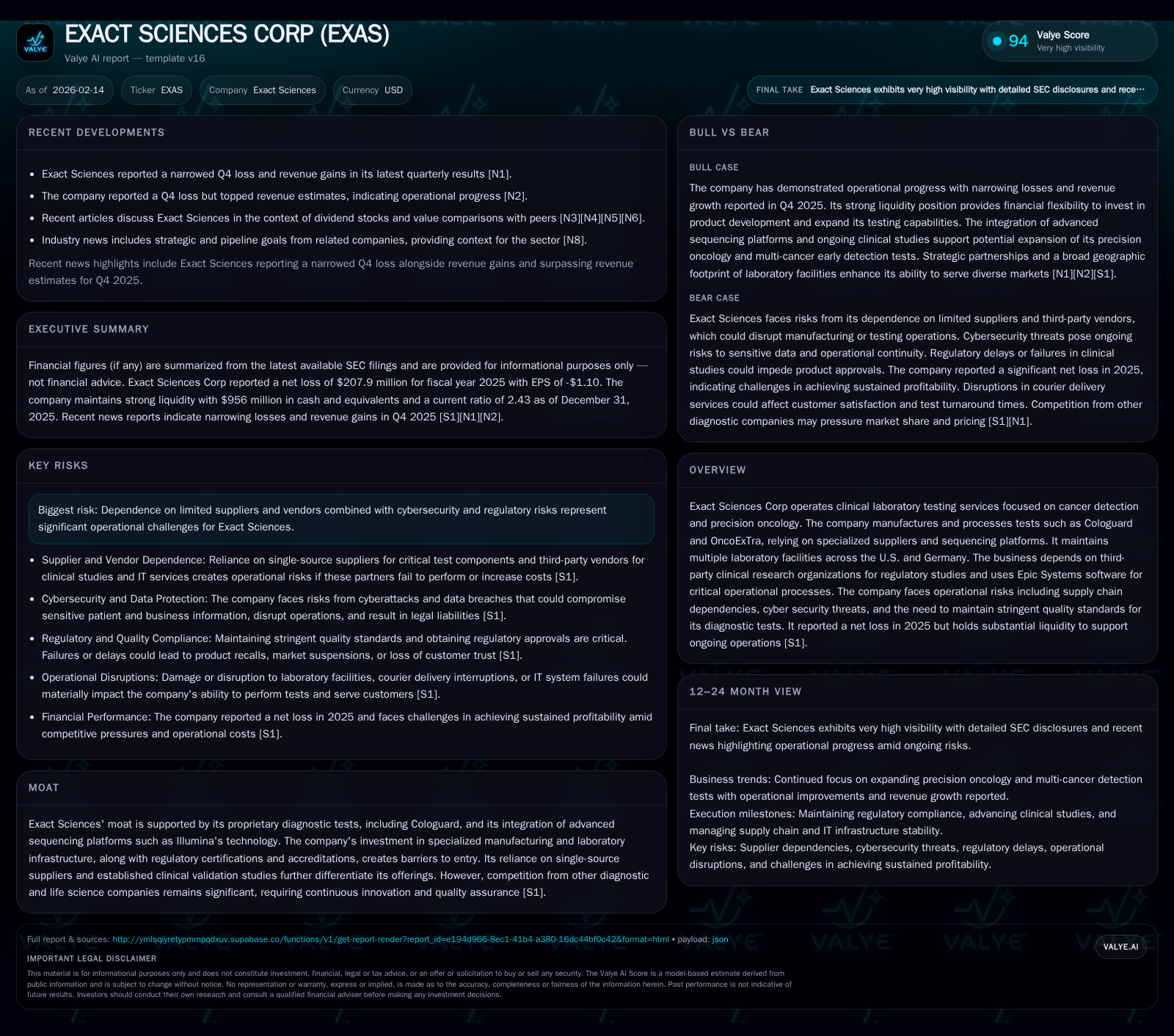
Exact Sciences stands at a critical inflection point marked by narrowing net losses despite robust revenue growth in 2025, underscoring sustained investment into innovation amid operational risks. The company's proprietary diagnostics, anchored by Cologuard and advanced sequencing partnerships, construct significant competitive moats but also hinge on single-source suppliers and specialized lab infrastructure. The recently announced merger with Abbott introduces nuanced executive incentive dynamics and corporate governance considerations. Meanwhile, supply chain constraints, cybersecurity risks, and regulatory delays continue to pressure product development timelines. Liquidity remains substantial but the sizable debt profile tempers financial flexibility looking forward. Navigating intensifying competition and regulatory headwinds will be essential for Exact Sciences to sustain long-term market leadership.
Navigating Losses Amidst Innovation: The Reality Behind Exact Sciences’ 2025 Financials
Exact Sciences’ 2025 financial disclosures tell a story of gradual progress against a backdrop of continued investment pressure. The company reported a net loss of approximately $208 million for the year ending December 31, 2025—a narrowing from prior periods—while revenues climbed steadily, reflecting improved sales traction primarily driven by core tests like Cologuard [N1, N6, S1, F1]. This juxtaposition reveals an operational model heavily weighted towards innovation; research and development outlays remain significant as the firm expands its precision oncology platform.
Liquidity is a bright spot: cash and equivalents stood near $956 million as year-end approached [F1], providing a vital buffer to support ongoing R&D efforts and day-to-day operations amid difficult market conditions. However, sustained losses underscore the delicate balance between investing for future growth and managing current profitability.
Inside the Lab: Operational Dependencies and Their Impact on Business Continuity
Central to Exact Sciences’ value proposition is its specialized laboratory network spanning Madison and Marshfield (Wisconsin), Redwood City (California), Phoenix (Arizona), and Trier (Germany) [S1]. These facilities house proprietary manufacturing processes and sequencing workflows necessary to deliver high-fidelity diagnostic outputs.
This multi-site infrastructure presents inherent vulnerability: disruptions ranging from natural disasters to power failures or even cyber incidents could severely impair test processing capacity. Insurance coverage exists but may not fully mitigate the financial or reputational fallout from prolonged outages.
Furthermore, shifts in throughput require that alternative sites have appropriate certifications — including CLIA licensing domestically and ISO accreditation internationally — restricting the company’s agility to reroute testing volume if a facility becomes unavailable. The dependency on single-source suppliers for key reagents and sequencing platforms adds another layer of risk requiring vigilant supply chain monitoring.
Decoding the Moat: How Proprietary Technology and Partnerships Shape Competitive Standing
Exact Sciences’ moat revolves around two pillars: proprietary assays such as Cologuard that have achieved clinical validation benchmarks, and integrated sequencing technology agreements exemplified by collaboration with Illumina [S1]. This convergence enables a differentiated offering with penetration in colorectal cancer screening that remains difficult for rivals to replicate easily.
However, maintaining this edge demands iterative improvements in sensitivity, specificity, workflow efficiency, and cost-containment—all while navigating tightening reimbursement environments. Competitors advancing novel liquid biopsy tests or AI-driven diagnostics pose persistent challenges requiring Exact Sciences to maintain deep technical expertise coupled with robust clinical evidence production.
Where competitors might compete on commoditized elements of testing services, Exact’s ability to integrate sequencing platforms within regulated laboratory workflows confers barriers both practical (equipment investments) and regulatory (validation studies).
Merger Dynamics: A Deep Dive into the Abbott Agreement and Executive Incentives
In late 2025 leading into early 2026, Exact Sciences entered a transformative merger agreement with Abbott Laboratories—an alliance that reshapes equity incentives for named executive officers (NEOs) [S1]. Under the terms:
- All vested stock options as of immediately before the merger's effective time were cancelled; in-the-money options were converted into cash payments based on a $105 per share merger consideration adjusted by exercise price.
- Restricted Stock Units (RSUs) granted pre-merger were accelerated to fully vested status with performance conditions deemed satisfied per actual achievement levels.
- Post-merger RSUs granted are assumed by Abbott as economically equivalent awards.
To mitigate tax consequences arising from Code Sections 280G/4999—commonly triggered by change-in-control events—Exact Sciences accelerated payment of 2025 bonuses (deemed at 115% performance level) alongside certain RSU/Performance Stock Unit awards pegged at generous multiples (up to 225% target level for some PSU grants) [S1].
These accelerated compensations carry clawback provisions tied both to financial restatements under Dodd-Frank requirements and conduct-based recoupment rules exceeding statutory minima. This blend aims to align leadership incentives toward smooth transition execution while preserving corporate governance integrity post-merger.
Supply Chain Vulnerabilities & Cybersecurity: Underlying Risks in a Sensitive Industry
The diagnostic testing ecosystem Exact navigates is inherently complex: specialized reagent suppliers create potential choke points limiting rapid response if shortages arise [S1]. Concurrently, clinical research organizations engaged for pivotal regulatory studies introduce another external dependency that may influence product approval timelines.
Cybersecurity risks loom large given the criticality of genomic data integrity and patient information confidentiality. Any breach or system outage could prompt regulatory sanctions or damage customer confidence adversely affecting test volumes. Maintaining robust IT defenses within highly regulated environments requires continuous investment which exact sciences acknowledges as intrinsic operational risk.
Risk mitigation strategies appear integrated institutionally; however, evolving threat vectors combined with supply constraints highlight areas demanding vigilant oversight going forward.
Regulatory Headwinds and Approval Delays: Influence of Government Disruptions on Growth Prospects
Recent history shows that periodic disruptions within U.S. regulatory agencies such as FDA—driven by government funding uncertainties or shutdowns—directly affect Exact’s pathway for new test approvals or label expansions [S2]. The October 2025 federal government shutdown notably deferred certain review activities impacting product rollout calendars.
Regulatory unpredictability compounds challenges inherent in diagnostic innovation where extensive datasets must validate accuracy before market introduction. Such delays not only postpone revenue generation but also dampen investor sentiment around pipeline robustness.
Mitigating these headwinds involves strategic engagement with regulators alongside portfolio diversification efforts targeting faster routes-to-market where feasible.
Balance Sheet Strength Versus Debt Profile: Liquidity as Lifeline or Leverage Concern?
Exact Sciences closed 2025 with total indebtedness exceeding $2.35 billion primarily due to convertible senior notes [S1], juxtaposed against a solid current ratio estimated at approximately 2.43 [F1]. This liquidity cushion offers operational runway during transitional phases but sizable leverage can restrict future financial maneuverability.
Key debt considerations include mandatory principal/interest payments that may compete with R&D funding or expansion initiatives for scarce cash flow allocation. The potential need for refinancing presents execution risk amidst changing credit markets.
Furthermore, goodwill plus intangible assets tied largely to acquisition premiums represent over half of total assets—subjecting the company periodically to impairment risk impacting earnings volatility [S1]. How management balances leveraging existing capital structure while preserving investment capacity remains pivotal heading into integration phases post-merger.
Looking Ahead: Market Competition, Innovation Challenges, and Strategic Imperatives
Exact Sciences operates within an intensely competitive sphere where rivals continuously emerge with potentially disruptive technologies spanning liquid biopsies to AI-enhanced molecular profiling [S1]. Maintaining leadership demands relentless innovation cycles combined with demonstrated clinical utility across expanding indications beyond colorectal cancer screening.
Strategic priorities likely encompass accelerating multi-cancer early detection programs developed through acquisitions while assuring scalability of laboratory operations without compromising quality controls. Simultaneously managing regulatory landscapes requires agility complemented by proactive policy advocacy.
The Abbott merger creates prospects for synergies in commercial reach and R&D capabilities but also poses typical integration risks common in life sciences consolidations that must be carefully navigated.
In sum, Exact Sciences today exemplifies a biotech diagnostics company walking a tightrope—leveraging proprietary science while contending with operational fragility typical of this domain. Successful navigation through these challenges will shape its enduring relevance amid ever-evolving healthcare paradigms.
This analysis is provided solely for informational purposes based on publicly available data as of February 14, 2026. It does not constitute investment advice or recommendations regarding EXACT SCIENCES CORP securities or any other instruments mentioned herein.
Disclaimer: This is research-only, informational analysis and not investment advice. It may include AI-generated interpretation and general industry context. Always verify important details using primary sources.

Comments