
Nabors Industries Ltd: Navigating Profitability Through Technology and Scale in a Volatile Energy Landscape
A detailed analysis of Nabors Industries’ operational breadth, technology-driven competitive advantages, and financial recovery amidst sector volatility.
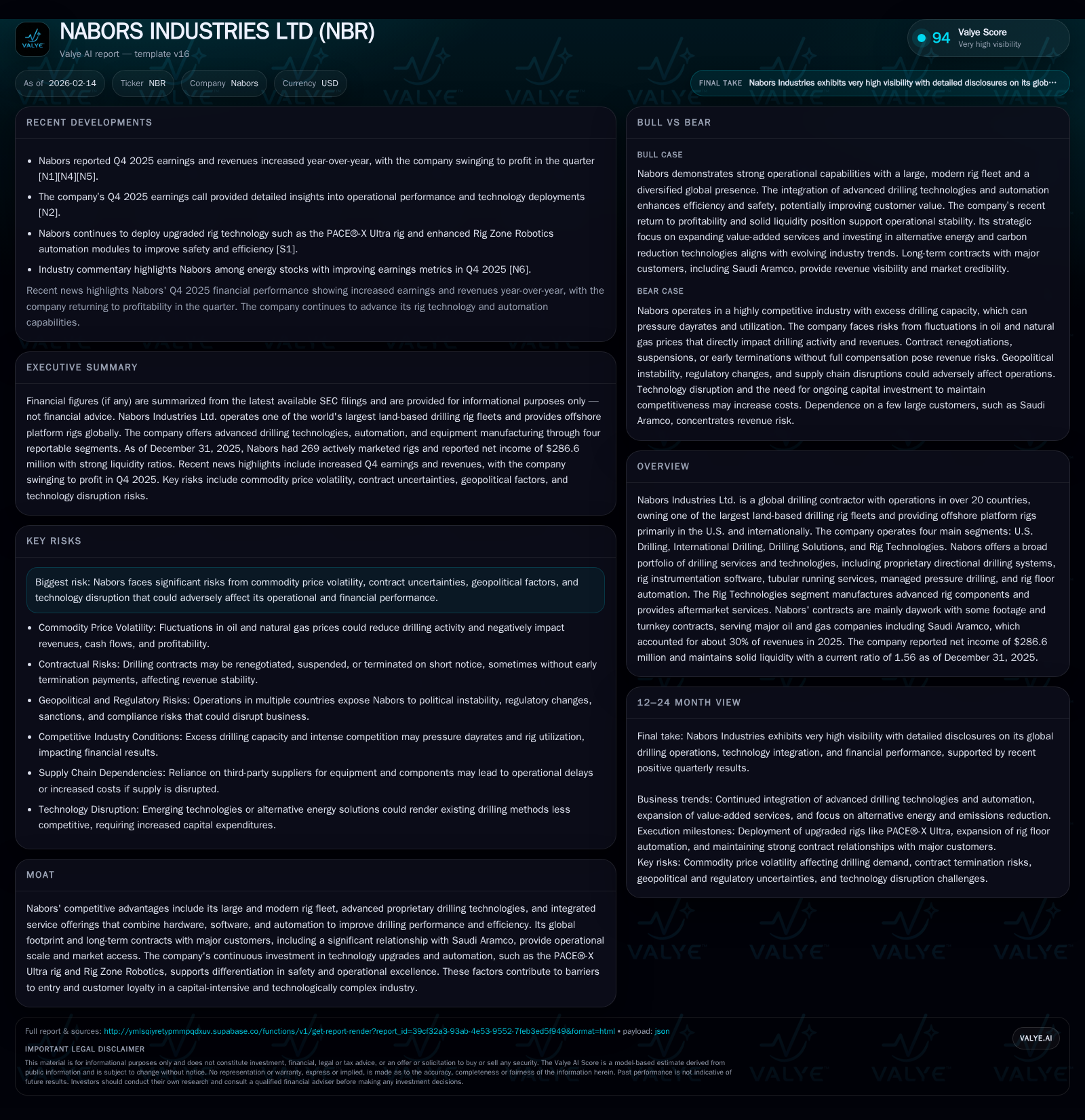
Nabors Industries Ltd. demonstrates a notable rebound in profitability after a challenging period marked by industry headwinds and volatile commodity prices. Leveraging one of the world’s largest land-based drilling fleets combined with integrated drilling technologies, Nabors balances its global operations and client concentration—particularly its pivotal relationship with Saudi Aramco—to sustain its competitive moat. While risks related to geopolitical factors, contract uncertainty, and technological disruption remain significant, the company's strategic investments in automation and emissions reduction position it for resilience amid evolving market dynamics.
Nabors at a Glance: Scope, Scale, and Service Lines
Nabors Industries Ltd. stands among the leading global drilling contractors by sheer scale and technological integration. As of December 31, 2025, Nabors maintained an extensive fleet comprising 242 land-based rigs—121 within the U.S. and the rest spread internationally—as well as 27 offshore platform rigs concentrated mainly in the U.S. Gulf of Mexico [S1]. This global footprint spans over 20 countries reflecting a mix of mature and emerging hydrocarbon basins.
The company structures its operations into four reportable segments:
- U.S. Drilling: Encompasses both land-based rigs across major U.S. shale plays and offshore platform rigs primarily in the Gulf of Mexico.
- International Drilling: Focuses on land-based rigs outside the U.S., where activity has shown incremental growth.
- Drilling Solutions: Provides ancillary services such as directional drilling systems, tubular running services, managed pressure drilling, and performance-enhancing software.
- Rig Technologies: Manufactures advanced rig components including instrumentation hardware while supporting aftermarket rig services.
Uniquely, Nabors integrates these segments to offer comprehensive drilling solutions combining proprietary hardware innovations like the PACE®-X Ultra rig with proprietary rig instrumentation and automation software [S1]. This horizontally integrated service model underpins operational efficiencies across physical rig performance and data-driven decision-making.
Breaking Down the Q4 2025 Earnings Upswing
The fourth quarter of 2025 marked a pivotal financial inflection point for Nabors as it swung back into net profitability with reported net income reaching $286.6 million—a stark reversal from prior losses [F1], crowned by revenues exceeding consensus estimates [N1][N4]. Prior to earnings release, market sentiment was cautious; some analysts forecasted potential negative earnings given slippery commodity prices and contract pressures [N7][N10]. Yet Nabors beat both revenue and EPS targets handily [N3], highlighting underlying improvements in utilization rates abroad coupled with pricing gains in select contracts.
This earnings surprise underscores the company's capacity to leverage its diversified geographic presence which offset softened U.S. activity—a subtle yet meaningful dynamic given overall flat rig working averages year-to-year (158.3 average rigs working in 2025 vs. 158.8 in 2024) [F1]. Additionally, disciplined cost controls and improved day rates contributed materially to margin recovery.
Deep Dive: Technology Fuelling Nabors’ Operational Edge
At the core of Nabors' enduring competitive moat is its commitment to innovation that merges advanced drilling hardware with state-of-the-art software analytics and automation tools. The PACE®-X Ultra rig exemplifies this approach by integrating proprietary designs that enhance speed, precision directional control, and safety protocols.
Moreover, Nabors deploys Rig Zone Robotics—a key automation initiative aimed at reducing human error and improving rig floor safety metrics—which dovetails with their broader vision to digitize drilling operations through embedded rig instrumentation platforms [S1]. These offerings enable real-time telemetry analytics facilitating predictive maintenance and proactive operational adjustments.
These technological advancements not only elevate efficiency—critical under conditions where every hour saved translates into significant economic value—but also raise barriers against new entrants given high capital expenditures required for comparable capabilities.
Segment Spotlight: U.S. Drilling Versus International Operations
Analysis reveals diverging trajectories within Nabors’ segment performance during 2025. The U.S. Drilling segment experienced a decline in average rigs working from 75.1 in 2024 to roughly 69.9 in 2025 [F1]. This dip reflects heightened competition within domestic shale areas alongside selective customer spending restraint amid lower natural gas prices.
Conversely, international drilling saw an uptick from 83.7 rigs working in prior year to around 88.4 average rigs in 2025 [F1]. Growth was driven by improving activity in Middle Eastern regions—as well as increased demand for complex land-based rigs equipped with managed pressure drilling capabilities that cater to more technically challenging reservoirs.
Offshore platform operations remained steady but concentrated primarily around the U.S. Gulf of Mexico where longstanding customer relationships support sustained utilization despite cyclical pressures.
The Strategic Significance of Saudi Aramco Relationship
Saudi Aramco accounts for approximately 30% of Nabors' revenue stream—a substantial concentration that underscores both opportunity and risk [S1]. This relationship provides stable cash flow channels anchored by long-term contracts aligned with Saudi Arabia's strategic energy initiatives.
While such dependency establishes mutual operational alignment—including collaborative technology deployments customized to Aramco's reservoir characteristics—it exposes Nabors to client-specific contract renegotiation risks or potential geopolitical developments impacting Saudi oil production plans.
Thus, while Aramco's scale offers significant revenue visibility relative to smaller counterparties, downside exposure warrants vigilance as any disruption could materially affect consolidated results.
Navigating Risk: Commodity Prices and Geopolitical Challenges
Nabors operates at the intersection of energy markets subject to pronounced volatility driven by fluctuating oil & gas prices—a primary factor influencing rig demand cycles [S1]. Elevated price uncertainty can lead clients to defer or cancel drilling projects resulting in lower activity levels.
Additionally, geopolitical risks permeate operations especially beyond North America where political instability or regulatory shifts may disrupt contract execution or asset mobility. Trade policy changes also manifest as tariffs or import restrictions affecting equipment sourcing costs—a factor accentuated after recent U.S.-imposed trade measures noted by management [S2].
Contractual uncertainties include potential suspensions or terminations without early termination fees adding complexity to revenue forecasting while fixed costs inherent to rig operations limit expense elasticity during downturns [S1].
Financial Fortitude: Balance Sheet Health and Capital Structure
As of December 31, 2025, Nabors displayed robust liquidity metrics supportive of ongoing investment needs alongside resilience against sector cyclicality. Cash and cash equivalents stood at approximately $941 million with current assets totaling $1.55 billion against $993 million in current liabilities equating to a current ratio near 1.56—a comfortable short-term coverage level endorsing strong working capital management [F1].
The company holds long-term debt obligations but emphasizes prudent leverage ratios ensuring flexibility remains intact to fund fleet upgrades such as conversion projects toward automated rigs or emissions-reduction retrofits detailed in corporate disclosures [S1]. Maintaining this financial discipline is critical given cyclicality endemic to drilling services and capital intensity demanded by technology modernization efforts.
Innovation Amid Industry Headwinds: Automation and Emissions Reduction
Environmental sustainability has emerged as an integral consideration shaping capital deployment decisions across energy services providers including Nabors. The firm actively develops technologies targeted at reducing greenhouse gases associated with drilling activities leveraging integrated system designs that optimize fuel consumption profiles alongside automation helping curtail on-site personnel exposure thereby lowering safety incidents connected to environmental hazards [S1].
These initiatives align with tightening regulatory frameworks globally mandating emissions reporting transparency plus lifecycle carbon footprint reductions potentially influencing contractor selection criteria going forward.
Yet this strategic pivot towards greener technologies imposes upfront expenditures coupled with compliance risks if evolving rules outpace internal adaptation timelines underscoring a delicate balance between cost management and environmental stewardship commitments.
Looking Ahead: Growth Opportunities and Potential Threats
In synthesizing Nabors’ operating realities, growth prospects appear tethered largely to sustained or increasing hydrocarbon exploration investment amid broader industry transitions emphasizing efficiency gains through digital transformation rather than volume alone.
The company’s differentiated technology portfolio provides a lever for gaining share especially within technically demanding formations requiring managed pressure drilling or automated interventions enhancing cost-effectiveness while mitigating human error risks.
However, persistent geopolitical uncertainty compounded by price volatility necessitates agile contract management supplemented by vigilant surveillance over large customer dependencies notably Saudi Aramco exposure.
Capital investments must continue focusing on innovation adoption balanced against disciplined financial stewardship preserving optionality amid fluctuating demand cycles characteristic of the upstream oilfield services ecosystem.
This analysis was prepared solely for informative purposes without offering investment advice or recommendations regarding securities mentioned herein. It integrates data derived from publicly filed SEC documents along with recent market news reports intended to provide an impartial overview grounded on documented facts while contextualizing industry trends affecting Nabors Industries Ltd.
Disclaimer: This is research-only, informational analysis and not investment advice. It may include AI-generated interpretation and general industry context. Always verify important details using primary sources.

Comments