
Digital Realty’s Global Expansion and Resilience in Data Center Real Estate Amid Dynamic Market Forces
Digital Realty's strategic footprint and financial outcomes in Q4 2025 spotlight its durable moat and complexities within the evolving global digital infrastructure sector.
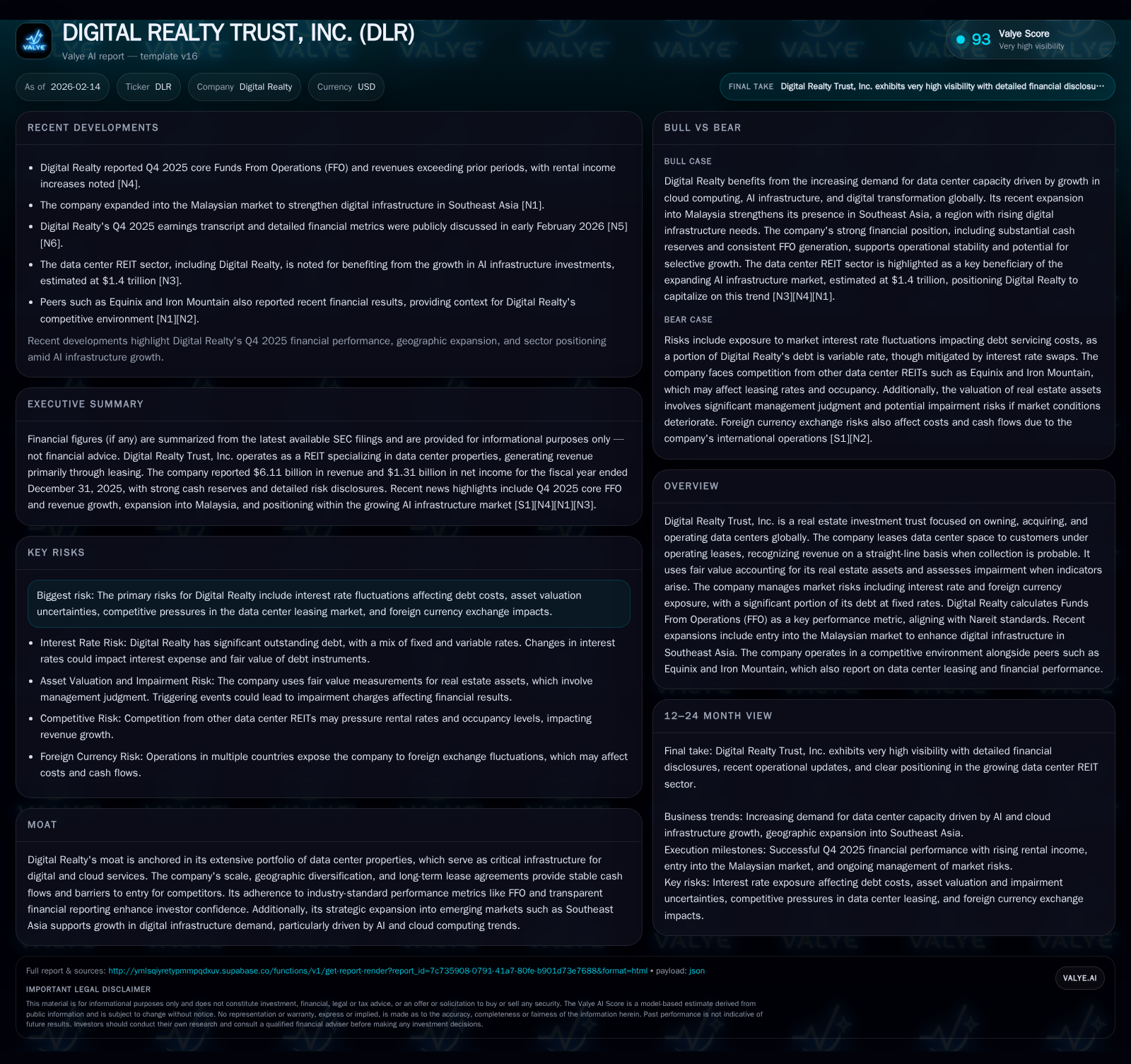
Digital Realty Trust, Inc. fortifies its position as a critical backbone provider of data center real estate with an expansive, diversified portfolio spanning mature and emerging markets. Its recent entry into Malaysia reflects a purposeful pivot to capitalize on burgeoning Southeast Asian demand driven by AI and cloud adoption. Despite strong revenue growth and core FFO outperformance in Q4 2025, nuanced pressures such as net income decline underscore ongoing challenges including interest rate impacts, currency fluctuations, and competitive market dynamics. As the company navigates fair value accounting and operational risks, it remains well poised to leverage secular tailwinds from AI infrastructure investments.
A Portfolio Built on Digital Infrastructure Backbone
Digital Realty’s foundation is rooted in an extensive portfolio of data centers that serve as vital nodes within the global digital ecosystem. These facilities underpin cloud computing services, enterprise IT workloads, and increasingly AI-driven applications requiring substantial power density and low-latency connectivity. By owning and operating data centers globally with diversified geographic footprints — spanning North America, Europe, and recently Southeast Asia — Digital Realty creates significant barriers to entry. This geographic mix mitigates regional market risks while catering to multinational customers who demand consistent service levels across continents [F1][S1].[valye_report_excerpt]
Operating leases with long durations provide the company stable, predictable cash flows that are key in a capital-intensive real estate trust business model. The leasing model benefits from substantial upfront tenant investments, contractual obligations spanning multiple years, and contractual rent escalations supporting revenue visibility. The company also employs fair value accounting for its real estate assets, assessing impairment triggers rigorously; this approach leverages management’s judgment but imposes transparency around asset recoverability—an essential feature given the volatile digital infrastructure market dynamics [S1].[valye_report_excerpt]
Thus, Digital Realty's portfolio scales both physically through vast acreage of data center space and financially via operating lease contracts structured to deliver steady income streams underpinning long-term investor confidence.
Decoding Q4 2025: Beyond Revenues and Earnings
Digital Realty’s Q4 2025 performance unveiled a multi-faceted story. The company reported annual revenues surpassing $6.1 billion driven by rental increases and portfolio expansion—figures that comfortably topped analyst expectations [N10][F1]. Core Funds From Operations (FFO), a non-GAAP measure aligned with Nareit standards representing cash earnings from operations adjusted for certain non-cash items, outperformed estimates signaling resilient operational leverage against ongoing inflationary headwinds.
However, net income declined compared to prior periods due largely to higher depreciation expenses tied to asset expansions and interest costs reflecting recent debt issuances at rising rates [N11]. This divergence between core FFO gains and net income contractions illustrates the sometimes countervailing pressures REIT accounting encounters: while operational cash generation improves through leases and occupancy gains, GAAP accounting integrates large non-cash charges impacting bottom-line metrics.
Furthermore, Digital Realty's rental revenues exhibited upward momentum amid favorable lease renewals but offset partially by heightened financing expenses—a duality investors should parse for insight on earnings quality versus headline profit figures [N2][N10]. This deep dive beyond top-line growth stresses how recurring cash flows remain sturdy even as GAAP earnings experience compression in capital-heavy environments.
Strategic Foray into Southeast Asia: A Growth Catalyst?
In early 2026, Digital Realty announced its entrance into the Malaysian market—a strategic milestone expanding the company’s footprint into Southeast Asia with fast-emerging digital infrastructure needs [N14].[valye_report_excerpt]
This move positions Digital Realty to harness robust regional demand fueled by soaring cloud adoption and AI workload deployments across Southeast Asian economies. Malaysia serves as a gateway hub offering connectivity advantages bridging East Asia with Western markets. Given the nascent state of hyperscale data center development locally alongside government incentives fostering tech infrastructure investment, this expansion aligns with long-term secular tailwinds favoring digital backbone enhancement.
Importantly, this diversification reduces reliance on saturated Western markets where competition is fierce while gaining access to higher-growth geographies likely to see accelerated capital inflows over coming years [valye_report_excerpt]. This measured risk-taking complements Digital Realty’s balanced approach amid global shifts toward distributed cloud architectures and edge computing trends concomitant with AI acceleration.
Market Positioning Amid Industry Titans
Comparatively, Digital Realty operates within a competitive landscape accentuated by peers such as Equinix and Iron Mountain. Recent Q4 disclosures reveal distinct strategic approaches: while Equinix delivered revenue growth yet faced AFFO misses prompting cautious dividend hikes [N9], Iron Mountain showcased AFFO beats attributable partly to storage rental surges [N8]. In contrast, Digital Realty demonstrated core FFO strength despite some net income softness [N10][N11].
Such divergences highlight nuanced market positioning — where Digital Realty leverages broad scale operational efficiencies linked to large strata of owned data centers alongside geographic reach, whereas others may emphasize specialized service verticals or ancillary offerings impacting financial profiles differently. Dividend strategies also vary with payout increases signaling confidence or conservatism depending on company outlooks.
Competitive dynamics also revolve around evolving customer preferences prioritizing integrated ecosystems combining colocation, interconnection capabilities, and hybrid cloud partnerships. Digital Realty’s scale places it favorably but requires vigilant investment in technology upgrades to maintain parity amid rapid innovation.
Navigating Risk: Interest Rates, Valuations, and Currency Exposure
The company’s latest 10-K outlines material risks typical for REITs engaged in global operations [S1]. Chief among these are interest rate fluctuations elevating debt servicing costs given significant borrowings despite much being fixed-rate; this limits immediate exposure but remains impactful over time as maturities reset or new financing occurs.
Furthermore, reliance on fair value measurements injects valuation uncertainty particularly during volatile market cycles which can prompt impairments if undiscounted cash flow forecasts deviate adversely [S1]. Given the subjectivity inherent in estimating future property-level cash flows amid rapidly changing technology landscapes or tenant demands, this accounting element demands careful scrutiny from investors monitoring balance sheet strength.
Foreign currency exchange impacts arise from international revenue streams denominated in various currencies versus predominantly USD debt obligations. While hedging practices mitigate some volatility risks, residual exposures persist affecting earnings translation—a factor heightened by global economic unpredictability.
Hence risk management frameworks addressing these financial headwinds remain central pillars supporting sustainable operational execution in dynamic macroeconomic contexts.
The Role of FFO and Fair Value Accounting in Investment Assessment
Funds From Operations (FFO), computed per Nareit's widely recognized standards incorporating adjustments for depreciation/amortization related mostly to real estate assets plus gains/losses on asset dispositions [S1], serves as a primary gauge of earnings quality reflecting cash generating ability detached from non-cash accounting nuances.
Investors appreciate FFO’s focus because it aligns closely with distributable income capacity fundamental to REIT valuation given regulatory requirements mandating payout thresholds. In conjunction with this metric comes scrutiny on fair value accounting methodologies applied to properties — intended to mirror exit price valuations under orderly transactions between knowledgeable market participants [S1].
Periodic impairment testing based on expected undiscounted cash flow assessments acts as a check ensuring carrying amounts do not exceed recoverable values — reaffirming conservative stewardship but also exposing volatility linked to subjective assumptions such as future lease terms or rent trends.
Together these disclosure practices cultivate transparency enabling sophisticated evaluation though adding layers of complexity necessitating thorough analysis rather than reliance on simplistic headline numbers alone.
Peering Ahead: AI Growth and the Data Center Demand Surge
The explosive growth trajectory of artificial intelligence workloads epitomizes powerful secular tailwinds energizing demand for scalable data center capacity worldwide [N5][N6][N7]. As AI models grow exponentially more complex requiring massive parallel processing often situated near cloud interconnection hubs or hyperscale facilities optimized for power efficiency — providers like Digital Realty find themselves integral infrastructure enablers.
Industry forecasts valuing AI infrastructure expansions in the trillions underscore transformative shifts reshaping enterprise IT footprints compelling rapid adoption of next-gen data centers featuring enhanced compute density alongside ultra-low latency network fabrics [N5]. This momentum not only augurs healthy leasing pipeline prospects but motivates ongoing capex commitment aiming to futureproof assets aligning capacity with emerging client needs.
Digital Realty’s positioning at the confluence of these forces affords potential upside; however execution must balance capex discipline against opportunity costs amidst fluctuating technology cycles modifying demand patterns dynamically over short intervals.
Investor Takeaways: Opportunity Amidst Competition and Complexity
Digital Realty portrays itself as a stalwart player anchoring critical digital infrastructure globally via expansive data center real estate holdings anchored by diversified leases promising stable recurring income streams consistent with REIT models. Its selective globalization exemplified by Malaysian market entry conveys strategic intent capturing emergent demand fueled by cloud proliferation and AI evolution — themes reinforcing its moat sustainability.
Nonetheless investors ought not gloss over challenges embodied by interest rate pressures elevating borrowing costs despite partial fixed-rate protections; fair value accounting uncertainties potentially distorting asset valuations; plus foreign exchange fluctuations complicating international profitability assessments. Competitive jockeying alongside titans like Equinix further injects nuances requiring constant innovation investments maintaining customer loyalty in rapidly shifting landscapes.
Essential analytical frameworks combine core FFO assessments revealing underlying cash flow robustness coupled with qualitative evaluation of geographic market penetration strategies highlighting exposure breadth versus emerging frontier opportunities balancing near-term cost implications against longer run growth prospects. In this dynamic interplay lies understanding why Digital Realty warrants considered attention authored through detailed contextualized scrutiny rather than simplified overt endorsements.
This report has been prepared solely for informational purposes based on publicly available information including recent SEC filings and news releases. It does not constitute investment advice or recommendations regarding any securities or financial instruments discussed herein.
Disclaimer: This is research-only, informational analysis and not investment advice. It may include AI-generated interpretation and general industry context. Always verify important details using primary sources.

Comments