
Magyar Bancorp’s Resilient Regional Banking Model Amid Interest Rate and CRE Loan Dynamics
Magyar Bancorp exemplifies steady regional banking growth driven by focused commercial real estate lending and prudent net interest income management.
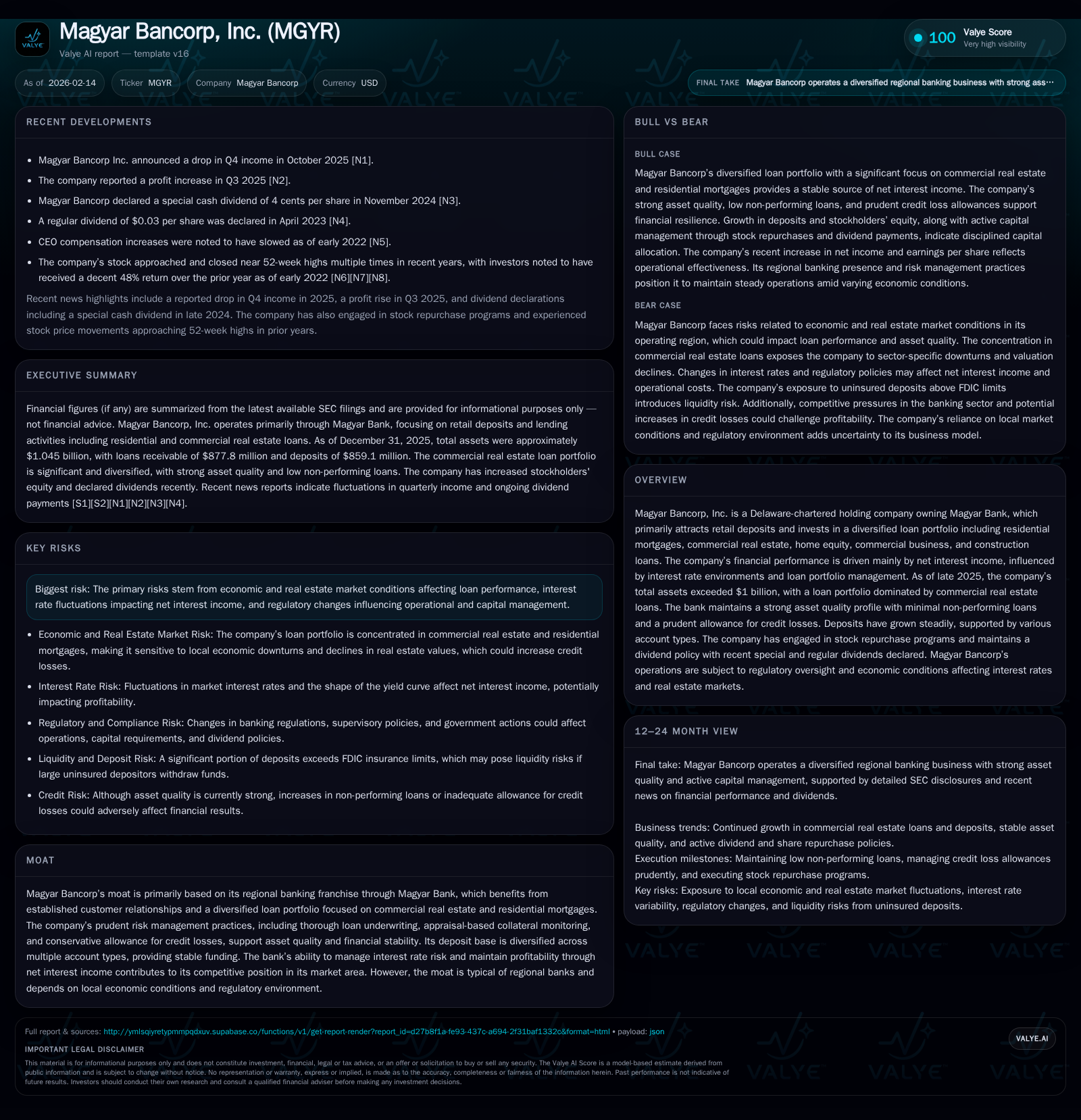
Magyar Bancorp, Inc., through its subsidiary Magyar Bank, has demonstrated consistent asset expansion, led primarily by growth in commercial real estate loans that now constitute over 60% of the loan portfolio. The bank’s core earnings engine—net interest income—remains sensitive to interest rate movements and Treasury curve shifts, necessitating active asset-liability management. Capital deployment strategies including stock repurchases and dividends underscore financial discipline, while credit quality stays robust amid evolving economic and regulatory environments. Though its regional scope poses inherent limitations, Magyar Bancorp’s established customer relationships, diversified funding base, and conservative risk controls form a solid foundation for navigating future uncertainties.
A Closer Look at Magyar Bancorp’s Regional Moat
Magyar Bancorp’s underlying strength emanates from its wholly owned subsidiary Magyar Bank’s deep-rooted presence within its regional market. This franchise benefit springs from cultivated customer relationships that fuel a steady inflow of retail deposits across various account types. Unlike some peers seeking rapid expansion, Magyar prioritizes balanced portfolio diversity—spanning residential mortgages, commercial real estate (CRE), home equity lines, commercial business loans, and construction financing—as noted in their latest analyses [valye_report_excerpt].
Though such a moat is not unique among regional banks, Magyar's conservative underwriting standards act as a buffer against cyclical shocks. Rigorous collateral appraisals and careful allowance provisioning together support loan quality stability. The bank’s deposit base is notably stable due to this diversification, providing a dependable funding source amid competitive pressures.
Despite these advantages, the moat’s geographic limitation to New Jersey markets inherently curbs dramatic scale advantages or national footprint influence. This localized focus makes the company somewhat more sensitive to regional economic health but enables nuanced understanding of local lending dynamics.
Navigating Asset Growth and Loan Portfolio Shifts
The company ended December 2025 with total assets crossing the $1 billion threshold — an approximate 4.8% rise in just three months from late September — underscoring a robust growth trajectory [S2]. This increase was driven primarily by gains in loans receivable complemented by upticks in interest-earning deposits and investment securities.
Loan receivables alone grew $18.9 million during Q4 2025 to $877.8 million with commercial real estate loans showing the most significant boost (+$15.7 million). Contrastingly, one-to four-family residential loans and commercial business loans registered modest decreases totaling nearly $2 million combined [S2]. This loan mix shift signals strategic emphasis on CRE while cautiously managing exposure in other segments.
At the same time, cash and cash equivalents surged over 380% quarter-over-quarter to $34.1 million, reflecting stronger deposit inflows offsetting loan growth requirements [S2]. Such liquidity swings demonstrate the bank’s balancing act between deploying capital into earning assets and maintaining ready funding buffers.
The Central Role of Commercial Real Estate Loans
Commercial real estate loans remain Magyar Bancorp's cornerstone exposure at approximately 62.5% of total loans as of December 31, 2025 [S2]. Detailed breakdowns reveal allocations across various property types: retail (7.9%), hotel/motel (13.7%), professional offices (6.4%), and office spaces (around 3%)—illustrating a diversified collateral base within CRE.
Within this sector, owner-occupied properties constitute a smaller share than non-owner occupied counterparts; for example, retail owner-occupied loans are about $43 million compared to total retail CRE exposures just above that level [S2]. This distinction matters because non-owner occupied properties often present higher vacancy or valuation risk during downturns.
This loan concentration demands heightened scrutiny concerning underwriting discipline and ongoing collateral valuations given CRE market cyclicality—especially relevant under current economic uncertainty [valye_report_excerpt]. Nonetheless, proactive monitoring frameworks and conservative allowances have maintained minimal non-performing loans thus far.
Managing Interest Rate Sensitivities and Net Interest Income
Net interest income (NII) remains the lifeblood of Magyar Bancorp’s profitability model — representing the margin earned between interest income on assets versus interest expense on deposits and borrowings [valye_report_excerpt]. This metric is highly sensitive to prevailing interest rates and yield curve shapes.
In recent quarters, fluctuations in Treasury yields have impacted asset-liability timing mismatches as loans typically reprice slower than deposits or other liabilities. In particular, prepayment rates on mortgage-related assets affect the effective duration of earning assets—a key factor influencing NII variability [S1][S2].
Competitive pressures within their local deposit market further complicate margin compression risks but also incentivize efficient fund pricing strategies. Hence, Magyar’s ongoing challenge lies in optimizing balance sheet structure against rising or volatile rates without sacrificing credit quality or liquidity positions.
Capital Deployment: Stock Repurchases and Dividend Strategy
Capital stewardship has been deliberate: in April 2025 Magyar completed its fourth stock repurchase program acquiring all authorized shares at an average price near $12.23 per share [S1]. Shortly after, it initiated a fifth buyback authorization encompassing up to approximately 323,547 shares aimed at flexible corporate use cases including supporting employee plans.
Alongside share repurchases, dividend distributions have reflected steady commitment with periodic special dividends complementing regular payouts [valye_report_excerpt]. These moves convey confidence in underlying financial strength while providing shareholders tangible returns.
At September 30, 2025, the bank held around 617,797 treasury shares available for future deployment—a sizable reserve enhancing capital return flexibility [S1]. Such balanced approaches suggest management weighs both internal reinvestment opportunities against shareholder yield objectives prudently.
Risk Landscape: Economic Cycles, Regulatory Frameworks, and Credit Quality
Although management reports no material changes in risk factors as of their latest filings [S1], vigilance remains essential given persistent risks embedded within their operational context.
Economic conditions particularly tied to local real estate markets bear directly on loan performance probabilities; any downturn affecting CRE valuations could trigger credit stress scenarios requiring increased provisioning or write-downs [valye_report_excerpt][S2]. Interest rate volatility poses secondary threats through margin pressure or borrower repayment difficulties.
Regulatory oversight under New Jersey banking authorities frames dividend policies and capital adequacy parameters influencing strategic flexibility [S1]. Emerging regulatory adjustments or tightening could impose constraints on capital deployment or risk appetite going forward.
Maintaining low levels of non-performing loans coupled with conservative allowances highlights disciplined credit work but does not eliminate cyclical vulnerabilities inherent in their concentrated portfolio composition.
Financial Health Metrics: Profitability and Liquidity Snapshot
Decisive evidence of operational soundness includes reported net income of approximately $3.1 million as of December 31, 2025 [F1] — signaling sustained profitability amidst asset growth phases.
Liquidity reserves are equally robust with cash and equivalents standing near $34 million end-of-year [F1], providing comfortable cushions against unexpected depositor withdrawals or lending opportunities requiring rapid funding deployment.
These metrics collectively depict an institution adept at managing capital flows prudently while generating consistent earnings from core lending activities in its specialized niche.
Outlook: Strategic Positioning Ahead of Market Changes
Forward-looking statements caution that results may fluctuate materially due to shifting economic variables such as interest rates trajectories or changes within local CRE markets [S2]. Management underscores the importance of remaining adaptive yet conservative amid these uncertainties.
Given its historical discipline — especially around underwriting rigor and cautious allowance provisioning — Magyar Bancorp appears positioned for measured growth rather than aggressive expansion. This posture reflects confidence tempered by experience navigating regional banking cycles under varied conditions.
In essence, the company seems set to continue leveraging its entrenched regional positioning while carefully modulating risk exposures inherent to concentrated commercial real estate lending amidst evolving macro-financial dynamics.
This analysis synthesizes publicly available information without expressing a view on securities transactions. It aims solely to provide insight into Magyar Bancorp's business model and financial condition based on filings as of early 2026. Investors should consider additional data sources when forming comprehensive evaluations.
Disclaimer: This is research-only, informational analysis and not investment advice. It may include AI-generated interpretation and general industry context. Always verify important details using primary sources.

Comments