
Timken Co: Engineering Legacy and Global Scope Steer Aftermarket Resilience Amid Tariff Challenges
Timken’s centennial expertise in engineered bearings and broad industrial motion portfolio underpin a durable competitive position despite recent tariff-driven headwinds.
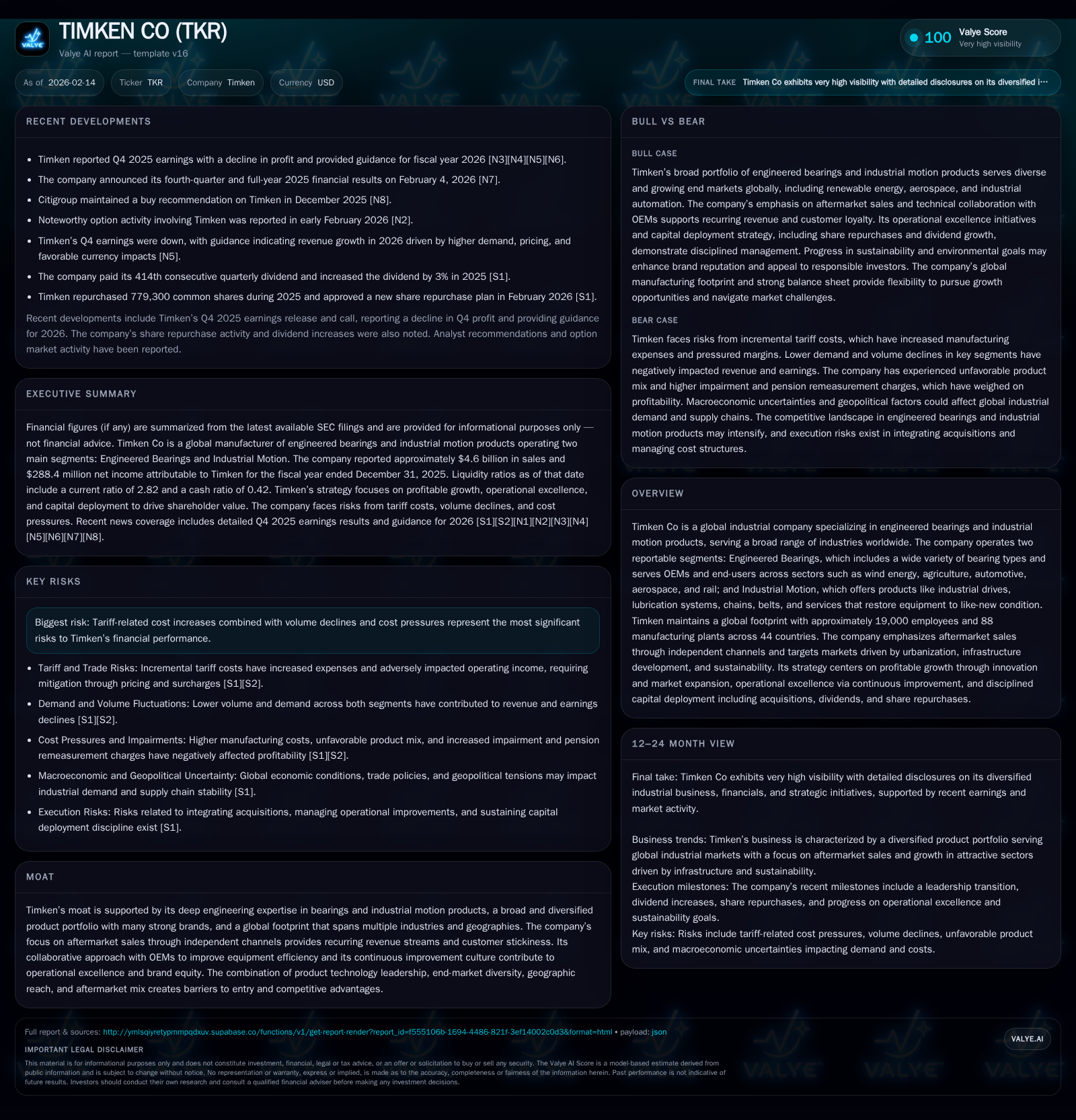
With over a century of pioneering engineering in bearing technology, Timken Co leverages a dual-segment business model spanning Engineered Bearings and Industrial Motion products to serve diverse global markets. Its extensive manufacturing footprint across 44 countries and emphasis on aftermarket sales channels create recurring revenue streams and customer loyalty that buffer against cyclical industrial softness. Recent Q4 2025 earnings revealed margin pressures from tariffs and volume declines, but management’s strategy centered on innovation, operational excellence, and disciplined capital deployment aims to propel profitable growth. Leadership changes, notably the appointment of a CEO with deep automation and materials expertise, signal a potential inflection toward enhanced product evolution aligned with emerging industrial demands.
A Legacy Forged in Bearings: Timken’s Historical Engineering Edge
Timken Company’s origins trace back over a century as a pioneer in bearing technology that transformed heavy industry efficiency worldwide. At its core lies unquestioned engineering mastery, particularly in tapered roller bearings—a product category where Timken invented foundational designs still pervasive today. This technical know-how extends across diverse bearing types such as spherical, cylindrical roller bearings, plain bearings, metal-polymer variants, thrust ball bearings, and specialized mounted units. Operating under iconic brands including Timken®, GGB®, and Fafnir®, the company’s reputation is intertwined with trust in product reliability and precision.
This historical depth serves as more than legacy branding; it underpins an R&D-led moat where proprietary expertise drives continual advances. The firm’s collaborative approach with OEMs—to co-engineer solutions meeting demanding applications—builds entrenched customer relationships difficult for competitors to disrupt. Such breadth of engineering capabilities across multiple bearing families anchors Timken’s authority beyond commodity components into high-value differentiated offerings [S2][valye_report_excerpt].
Dissecting Timken’s Dual Engines: Engineered Bearings vs. Industrial Motion
Timken structures its operations into two reportable segments that complement one another: Engineered Bearings and Industrial Motion. The former encompasses an extensive range of bearing designs supplying both OEM manufacturers and direct end-users globally. This segment spans critical industries including wind energy, agriculture, automotive, aerospace, railroads, metals mining, construction equipment, food processing, and more. By addressing complex application requirements through customization and innovation, Engineered Bearings maintains strong demand despite industrial cyclicality.
The Industrial Motion segment broadens Timken's exposure into precision drivetrain components such as industrial drives, chains, belts, lubrication systems, couplings, brakes/clutches as well as related aftermarket services focused on equipment refurbishment to "like-new" condition. These products underpin mission-critical systems across automation sectors (solar energy installations to packaging lines), transportation (passenger rail/marine), medical devices manufacturing, agriculture/turf care machinery among others [S2][valye_report_excerpt].
Together these segments provide revenue diversity—Engineered Bearings capturing original equipment build cycles supplemented by Industrial Motion’s sticky maintenance-driven aftermarket demand—resulting in resilience against sector-specific downturns.
Global Footprint and Diversification: Strength in Market Reach
Timken boasts an expansive global network composed of approximately 19,000 employees operating out of 88 manufacturing plants strategically located across 44 countries—including major hubs in the United States, China, India, Romania among others [S1][valye_report_excerpt]. Remarkably, the vast majority of these facilities are owned by the company rather than leased—a factor contributing to operational control and asset stability.
This extensive manufacturing base enables localized supply chain advantages: reduced freight time/costs to key customers across continents; agility in responding to regional market dynamics; and mitigation of geopolitical or trade disruptions via geographic diversification. These capabilities align well with end markets driven by urbanization trends and infrastructure development internationally.
The company's sales presence complements manufacturing reach through numerous administrative offices and distribution centers worldwide. Together this network supports seamless customer engagement—from product customization at design stages to efficient aftermarket service delivery [S1].
Financial Pulse Check: Navigating Q4 2025 and FY2026 Guidance
Timken reported Q4 2025 earnings reflecting significant margin pressures attributable mainly to escalating tariff costs alongside volume softness impacting profitability [N2][N3][N4]. Net income totaled approximately $288 million for the fiscal year ended December 31, 2025 [F1]. While revenue figures indexed broadly stable compared to prior year periods per standard filings [F1], headline profit contraction highlighted sensitivity to input cost inflation.
Management attributed softened Q4 performance partly to external macroeconomic factors including tariff escalations that compressed gross margins despite internal continuous improvement initiatives. Volume decreases were noted across some end-markets due to weak industrial capex spending during the quarter.
Looking ahead in FY2026 guidance commentary released alongside the earnings announcement suggests cautious optimism but acknowledges ongoing uncertainties from geopolitical tensions influencing commodity prices and supply chain costs [N4]. Nevertheless, the company underscores commitment toward disciplined cost management practices aiming to restore margin profiles over time.
Aftermarket Dependence: The Recurring Revenue Advantage
A distinguishing feature underpinning Timken's valuation moat lies in its strategic focus on aftermarket sales routed primarily through independent distribution channels [valye_report_excerpt]. This model fosters enduring partnerships beyond initial OEM installations by addressing equipment lifecycle needs—replacement bearings or refurbishing worn machinery components.
Customer loyalty induced by switching costs related to reconfiguring suppliers or warranty continuity consolidates recurring revenue streams that buffer demand volatility inherent in new equipment cycles. Independent channel dynamics enhance broad market access without costly captive selling models enabling scale efficiencies.[S2]
Such aftermarket emphasis remains integral as end-use operators prioritize uptime reliability amid growing automation complexity—areas where Timken offers proven technical service support.
Tariffs and Volume Pressures: Balancing Costs and Demand
Tariff-related import duties on raw materials or component parts represent a tangible threat eroding Timken’s cost structure competitiveness [valye_report_excerpt][S1]. The Q4 earnings call revealed management grappling with these headwinds while volumes softened due to weakened overall industrial activity [N4].
Yet Timken’s continuous improvement culture underpins efforts to partially offset tariff burdens through efficiency gains—process optimizations intended to reduce waste or scale benefits from integrated procurement strategies.[N4]
Optimizing product mix toward higher-value applications may provide margin cushioning if low-end commoditized segments experience even greater pressure. Balancing elevated input costs while sustaining customer price acceptance remains a delicate act for management.
Leadership in Transition: Impact of Recent Executive Changes
In September 2025 Lucian Boldea assumed the CEO role bringing prior experience leading Honeywell’s industrial automation and materials businesses—a legacy resonant with Timken’s technology-driven aspirations [S1].
Boldea’s background suggests potential strategic accelerations around digitizing product lines or deploying advanced materials science initiatives aligning well with evolving demands for smarter motion solutions in energy-efficient applications or next-gen manufacturing equipment.
Early indicators post-transition include reinforcing innovation-focused cultures along with continued emphasis on customer collaboration formerly emphasizing operational excellence complemented by growth initiatives leveraging his honeywell pedigree.[S1]
Growth Strategy Blueprint: Innovation, Operational Excellence, and Capital Deployment
Timken articulates its corporate mission through three strategic pillars: Profitable Growth via market expansion exploiting materials science know-how; Operational Excellence emphasizing relentless efficiency improvements; Capital Deployment targeted at maximizing shareholder value through R&D investments plus prudent M&A or share repurchases [S2][valye_report_excerpt].
R&D fuels differentiation especially within engineered bearings tailored for challenging environments requiring durability combined with friction management intelligence—a hallmark capability enabling robust competitive positioning.
Operational rigor manifests via continuous improvement frameworks driving waste elimination while preserving agility amid complex global supply chains—a necessity given current geopolitical turbulence.
Capital allocation balances reinvestment with return-of-capital considerations demonstrating financial discipline without sacrificing innovation boosts necessary for long-term sustainability.
Risks on the Horizon: What Could Disrupt Timken’s Moat?
Although no material changes have emerged regarding risk factors since prior disclosures [S1], tariffs feature prominently as an ongoing concern given their direct impact on cost inflation potentially compressing margins further if sustained or expanded.
Other vulnerabilities include geopolitical tensions disrupting supply chains (China-U.S. trade friction) or raw material price spikes notably steel alloys critical for bearing production.
Competitive forces exert pressure from both established global peers advancing their own technology stacks plus smaller niche innovators targeting specialized segments potentially eroding market share over time.
Moreover regulatory or environmental shifts imposing stricter compliance requirements could escalate operational expenses subjecting profitability resilience to test [valye_report_excerpt][S1].
Market Sentiment: Analyst Upgrades and Market Activity Insights
Following Q4 earnings release Keybanc upgraded Timken (TKR) citing belief that underlying structural strengths overshadow near-term margin pressure concerns [N6]. This upgrade signals investor confidence pitched towards recovery fuelled by strategic initiatives including leadership transition benefits.
Options market data exhibiting noteworthy call activity further suggests seasoned institutional investors hedging directional momentum while expecting volatility resolution favorable toward Timken shares [N7].
Such external endorsements reinforce narrative that while current challenges depress headline figures transiently, intrinsic business quality supported by durable aftermarket streams remains intact.
This analysis is based on publicly available information including SEC filings as of February 14, 2026 and relevant news reports cited herein. It is intended solely for informational purposes without any recommendation regarding investment decisions.
Disclaimer: This is research-only, informational analysis and not investment advice. It may include AI-generated interpretation and general industry context. Always verify important details using primary sources.

Comments