
Portsmouth Square Inc: Navigating Concentrated Hotel Operation Amid San Francisco Market Pressures
A deep dive into Portsmouth Square’s challenges and dynamics as a single-property hotel operator facing local market risks, ownership concentration, and financial constraints.
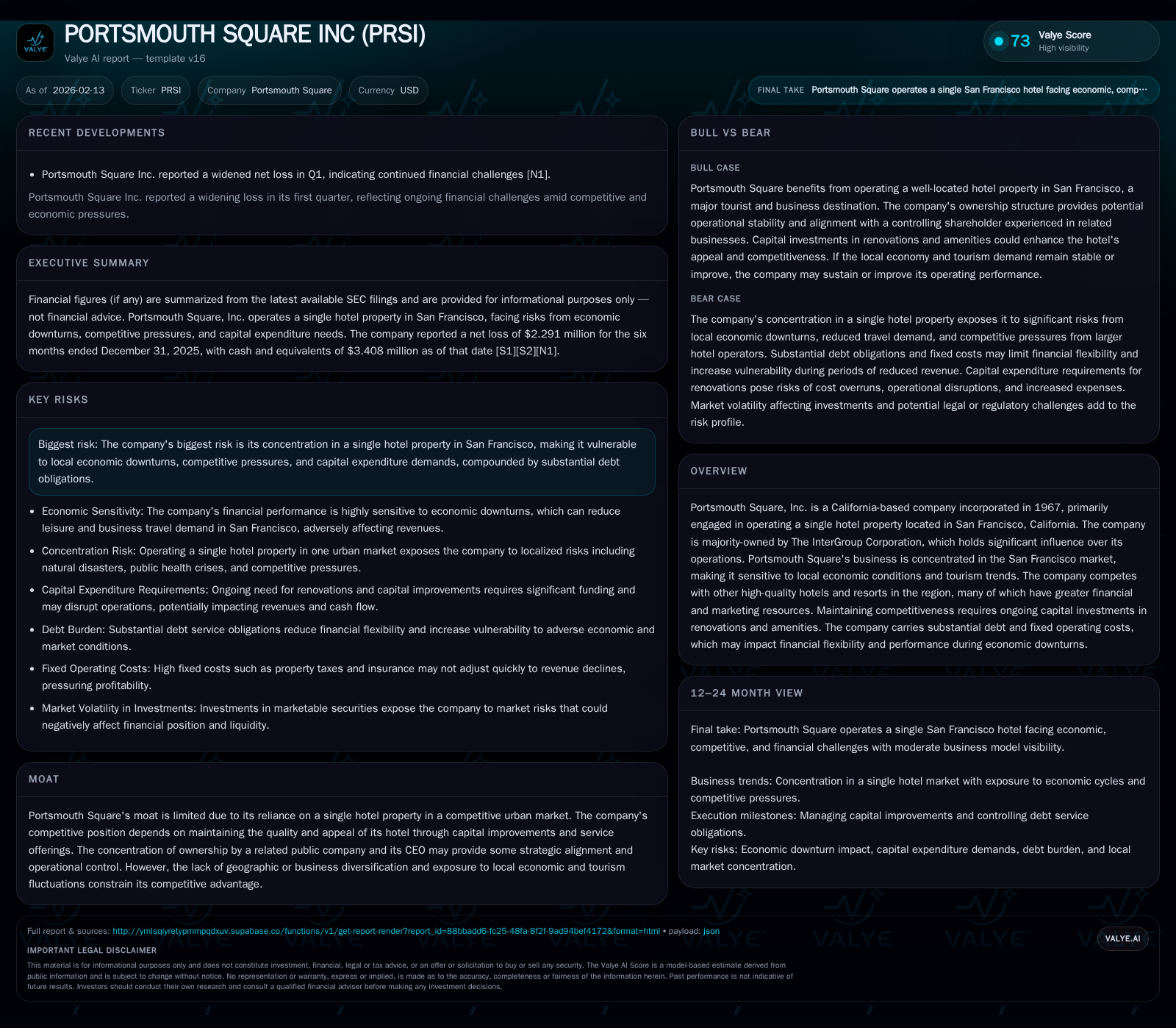
Portsmouth Square Inc., anchored by one hotel property deeply embedded in San Francisco’s urban hospitality scene, contends with inherent vulnerabilities stemming from its concentrated asset base. Heavy debt loads, stiff competition from larger hotel groups, and the city’s fluctuating economic and tourism environment complicate its operating landscape. Ownership by The InterGroup Corporation provides strategic cohesion but also concentrates governance control. Future resilience hinges on balancing capital investment demands with volatile revenue realities in a highly competitive and localized market.
Legacy in the Heart of San Francisco: Portsmouth Square’s Singular Asset
Established in 1967, Portsmouth Square Inc. stands as a testament to steadfast commitment in the San Francisco hospitality market through ownership and operation of a singular hotel property. This focused approach offers advantages—familiarity with local customer bases, operational consistency, and brand identification within a dynamic urban environment. Yet, this concentrated footprint inherently ties Portsmouth’s fate tightly to the economic health and tourism viability of San Francisco itself. The lack of geographic diversification amplifies risks associated with regional economic fluctuations, regulatory shifts, or unexpected disruptive events such as natural disasters or health crises that could impair travel demand.[S1]
For a company built around one asset, maintaining relevance is paramount; every operational hiccup or drop in occupancy has material financial implications. The gold-standard location provides an initial moat through desirability and access to the city’s steady flow of visitors. However, without a portfolio to spread risk or offset downturns elsewhere, Portsmouth faces amplified exposure when San Francisco’s hospitality market softens.
Ownership Concentration: Strategic Ally or Control Risk?
Ownership is markedly consolidated: The InterGroup Corporation holds approximately 75.9% of Portsmouth's common stock as of mid-2025. At the helm is John V. Winfield, who not only serves as CEO of Portsmouth but also controls about 70.1% of InterGroup's shares while directly owning roughly 2.5% of Portsmouth stock.[S1] This vertical integration creates strong alignment in corporate strategy between Portsmouth and its controlling shareholder group.
From a governance perspective, such insider control can be a double-edged sword. It facilitates rapid decision-making free from dispersed shareholder friction which might otherwise impede essential capital projects or strategic pivots. Conversely, it raises questions around minority shareholder influence and the potential for conflicts where dominant owners prioritize broader group interests over Portsmouth-specific considerations.[S1] Nonetheless, for a single-property operator requiring nimble responses to market changes, this form of ownership concentration may foster decisive leadership.
Local Market Dynamics: The San Francisco Hospitality Ecosystem
San Francisco remains one of the nation’s most vibrant yet complex hospitality markets. Its status as an international business hub coupled with strong tourism draws underpins persistent demand for overnight accommodations. However, local economic cycles reverberate intensely at places like Portsmouth where all operations are city-bound.[S1]
The company notes that conditions such as shifts in corporate travel budgets—often trimmed first during financial uncertainty—as well as discretionary leisure travel substantially impact demand.[S1] Moreover, localized challenges like housing affordability concerns affecting workforce availability or urban regulatory changes can indirectly pressure operating costs.
Competition thrives in this ecosystem; not only must Portsmouth contend with national hotel chains boasting expansive marketing power but also boutique operators innovating with thematic experiences tailored to discerning travelers.[S1] Occupancy rates fluctuate with broader tourism trends globally—a reality exposing Portsmouth to volatility despite its localized operation.
Debt and Financial Structure: Navigating Fixed Costs in Volatile Times
Financially, Portsmouth grapples with pronounced leverage that compounds risk in revenue downturns. While exact debt figures are not extensively detailed here, commentary on "substantial debt" paired with fixed operating costs illustrates narrow earnings flexibility.[S1]
This indebtedness strains cash flow resilience especially amid events like recessions which reduce business travel and consumer discretionary spend significantly.[S1] Supporting this precarious position is net income trending negative as of the end of 2025 (-$2.29 million), alongside modest cash reserves ($3.4 million).[F1]
Given that lodging businesses often operate on thin margins further stressed by seasonal fluctuations, debt servicing consumes resources that might otherwise be allocated towards renovations or marketing enhancements vital to staying competitive.
Competitive Landscape: Facing Giants and Boutique Rivals
Operating within San Francisco’s premium hospitality tier places Portsmouth against formidable opponents ranging from global franchises wielding vast capital pools to niche boutique hotels differentiating through unique guest experiences.[S1]
Large chains leverage loyalty programs, integrated technology infrastructure, multi-property economies of scale, and aggressive pricing strategies—advantages difficult for smaller single-asset entities to match comprehensively.[S1] Simultaneously, boutique competitors cultivate strong emotional appeal through curated aesthetics or targeted amenities which resonate well with certain traveler segments.
Portsmouth must thus continuously monitor competitors’ expansion plans or facility renovations which can quickly shift market share dynamics if unmet locally.[S1]
Capital Investment Imperatives: Staying Relevant in a Changing Market
In hospitality—especially within competitive urban centers—an evergreen challenge lies in upkeep and modernization of physical assets. For Portsmouth’s lone hotel property requiring regular capital outlays to refurbish rooms, update common areas, revamp technological amenities or enhance food & beverage offerings represents significant recurring expenditure.[valye_report_excerpt][S1]
This need is both opportunity-laden and fraught: timely investment can elevate guest satisfaction scores leading to higher occupancy/pricing power; missed upgrades risk eroding brand perception. However, balancing these imperatives against constrained cash flows intensified by debt pressure necessitates judicious prioritization.[S1]
Economic Headwinds: Tourism, Recession Risks, and Consumer Behavior
Macro-level forces cascade sharply down to affect local hotel operators like Portsmouth Square Inc. The specter of U.S.–global recession looms repeatedly among disclosed risks,[S1] fueling cautious corporate travel budgets alongside more risk-averse consumer spending behavior impacting leisure travel.
Furthermore, discretionary nature of luxury accommodations means demand elasticity can yield outsized revenue swings during downturns when consumers prioritize essential expenditures over premium lodging.[S1] Compounding vulnerability are unpredictable geopolitical issues or public health events potentially curbing cross-border travel into key gateway cities like San Francisco.
These factors culminate into a challenging operating backdrop demanding agile cost management without compromising guest experience excellence vital for long-term loyalty.
Balancing Act: Strategic Focus Versus Geographic Diversification
Portsmouth Square’s reliance on one geographic locale exemplifies an intentional focus delivering operational expertise yet concentrating exposure risks unique to that market.[valye_report_excerpt][S1]
While diversification across multiple regions could dilute localized shocks embodying natural disaster impacts or city-specific economic contractions,[analysis] it might conversely dilute managerial attention and elevate overhead complexities.
For smaller companies under tight financial constraints such as Portsmouth—coupled with ownership concentration providing unified but insular strategic direction—maintaining their core asset may carry pragmatic merits despite elevated risk profile.[analysis]
Future Outlook: Potential Pathways and Strategic Reflections
Looking forward, Portsmouth Square confronts a multifaceted challenge: sustaining competitiveness within an intensively contested urban hospitality space while managing elevated leverage amid uncertain macroeconomic conditions.[valye_report_excerpt][S2]
Strategic pathways likely revolve around optimizing capital allocation for incremental upgrades (to keep pace with rival offerings), leveraging the close-knit governance model for swift decision-making, pursuing marketing initiatives aligned with evolving guest expectations, or cautiously exploring adjunct revenue streams linked directly or tangentially to its core facility.
Expansion beyond San Francisco remains speculative given resource constraints but could represent a longer-term hedging strategy should ownership appetite shift toward diversification.[analysis]
Ultimately resilience will depend on effectively balancing the immediacy of maintaining asset quality against prudent financial stewardship underpinned by acute awareness of external environment shifts impacting San Francisco's lodging ecosystem.
Disclaimer: This analysis presents factual information synthesized with industry context for informational purposes only. It is not intended as investment advice nor endorsement of any security or company strategy.
Disclaimer: This is research-only, informational analysis and not investment advice. It may include AI-generated interpretation and general industry context. Always verify important details using primary sources.

Comments