
InterGroup Corp: Examining the Singular Hotel Asset Amid San Francisco Hospitality Challenges
A focused analysis on InterGroup’s flagship Hilton hotel under Portsmouth subsidiary reveals operational resilience and financial constraints within a concentrated portfolio.
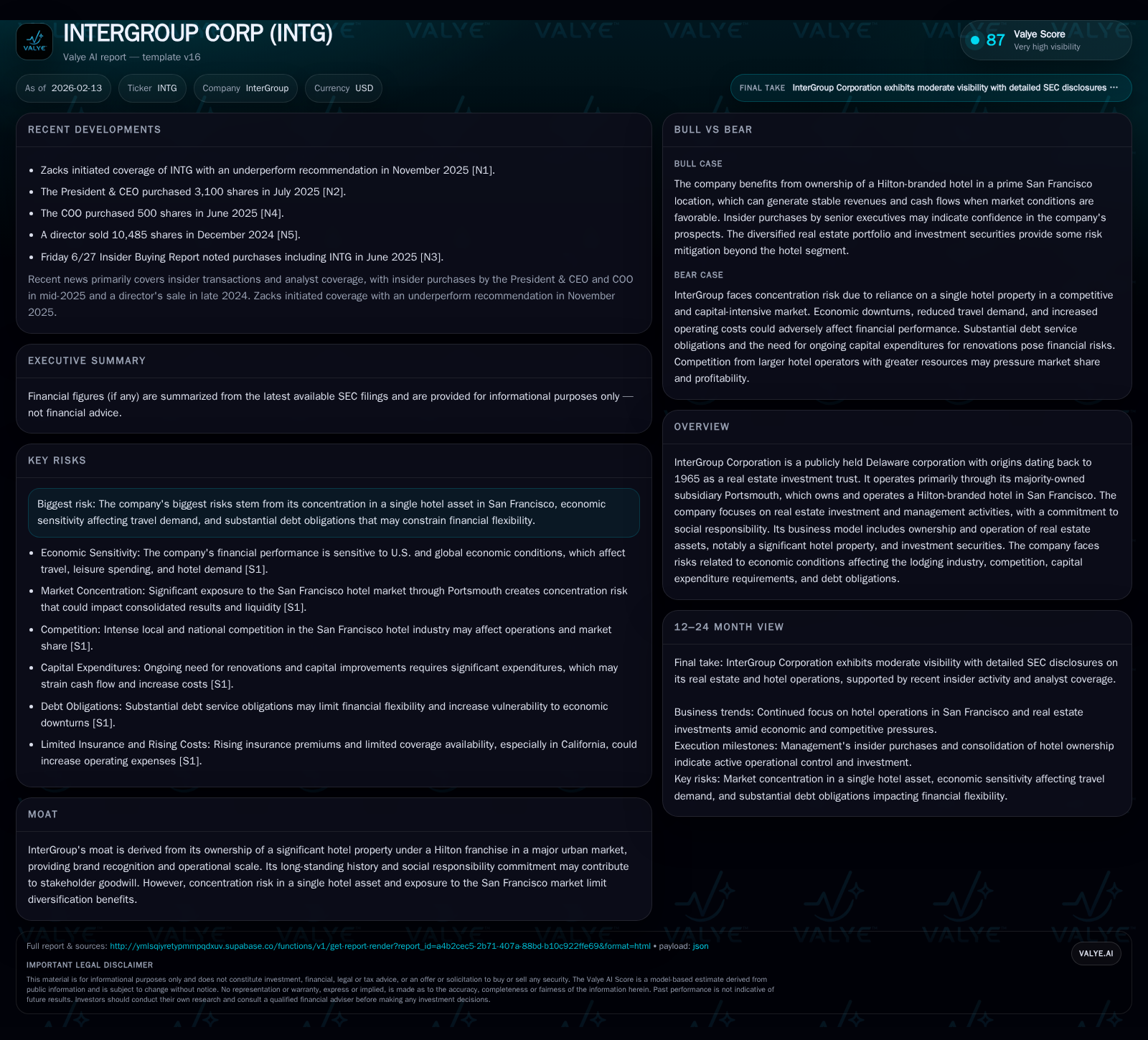
InterGroup Corporation, originating from a 1965 REIT, centers much of its revenue and cash flow on its majority-owned Portsmouth subsidiary’s Hilton San Francisco Financial District hotel. This asset is both a source of operational scale and significant concentration risk, embedded in a capital structure with lender-controlled cash flows and recent refinancing efforts. The dynamics of San Francisco’s hospitality market—lingering effects of travel recovery, local economic factors, and competition—test the asset's performance. Concurrently, InterGroup maintains a corporate identity rooted in social responsibility, influencing strategy beyond pure profit motives. While diversification across other real estate assets exists, the stakes tied to the hotel’s success underscore strategic vulnerabilities amid macroeconomic uncertainties.
The Legacy and Evolution of InterGroup Corp
InterGroup Corporation traces its roots back to 1965 with its predecessor entity Mutual Real Estate Investment Trust (M-REIT), which was publicly listed from 1966 onward. In 1985, reflecting shifting strategic ambitions and external regulatory landscapes around housing, the company transitioned from a REIT structure into a Delaware corporation. This restructuring enabled an expanded investment mandate beyond strictly housing-related holdings while preserving the foundational commitment to social responsibility. Originally focused on providing affordable housing regardless of race—a progressive stance during its inception—the company broadened its mission post-1985 to encompass wider social impact aligned with shareholder value creation [S1].
This evolution underscores InterGroup's dual identity: a firm balancing traditional real estate interests with socially conscious governance. Its trajectory reveals a sustained effort to intertwine ethical commitment with prudent asset management, which continues to permeate strategy today.
Portsmouth Square and the Hilton — Anatomy of a Dominant Asset
At the operational core lies Portsmouth Square Inc., an entity in which InterGroup holds approximately 75.9% ownership as of mid-2025 [S1]. Portsmouth wholly owns the Hilton San Francisco Financial District hotel—a substantial 544-room property situated at 750 Kearny Street. This hotel forms the company's flagship asset and represents a significant chunk of consolidated operating revenues and cash flows.
The hotel operates under a Hilton franchise agreement providing brand recognition that aids customer loyalty and aligns operational protocols with international standards. Despite these advantages, cash generated by Portsmouth is subject to lender-controlled accounts–meaning that funds collected are managed through lockbox structures limiting discretionary distribution up to achieving certain debt service coverage ratios (DSCR). Portsmouth has not paid dividends upstream for over ten years due primarily to these constraints [S1].
Strategically, management continues capital preservation initiatives such as deferral of non-essential capital projects alongside measured investments—for instance converting former administrative spaces back into guest rooms, enhancing revenue-generating capacity. In fiscal year 2025 alone, the hotel invested around $2.25 million into property enhancements even amid broader cost-control efforts [S1].
Financial Footing: Capital Structure and Liquidity Constraints
In March 2025, Portsmouth finalized a pivotal refinancing of its senior mortgage loan which refined maturity timelines and lowered interest expenses—from an earlier rate of approximately 12% down to about 9%, accompanied by amendments extending unsecured related-party lines up to $40 million maturing in July 2027 [S1]. These adjustments reflect proactive liability management aiming for stability amidst uncertain lodging sector dynamics.
However, resultant lender-imposed covenants mean that until certain DSCR thresholds are consistently met across consecutive quarters, operating cash flows remain locked in specialized accounts controlled by lenders for expenses like taxes, insurance, debt service, and furniture/fixtures replacement reserves [S1]. This structure effectively silo’s Portsmouth’s cash resources restricting InterGroup Corp.’s access for general corporate needs.
Consolidated liquidity metrics illustrate this bifurcation: unrestricted cash approximated $5 million at mid-2025 plus restricted reserves nearing $10 million—funds largely inaccessible outside defined uses. Marketable securities diminished compared to prior periods possibly reflecting allocations toward debt reduction or investment elsewhere [S1], while parent-level cash & equivalents stood near $6.5 million by late 2025 [F1].
Such financial architecture demands careful balancing acts from management—preserving solvency at the hotel subsidiary layer while sustaining broader corporate flexibility.
Navigating the San Francisco Hospitality Market Headwinds
San Francisco hospitality markets have encountered pronounced turbulence post-pandemic due to multiple factors:
- A slower-than-expected rebound in business travel segments critically affects convention bookings—a key revenue driver for large downtown hotels like Portsmouth’s Hilton [S1].
- Municipal concerns including public safety perceptions impact city-wide visitor appeal complicating marketing outreach efforts.
- Competitive intensity remains high as boutique hotels with unique themes carve niche preferences among travelers challenging more standardized offerings characteristic of Hilton-branded properties.
- Discretionary leisure spending remains vulnerable amid lingering economic unease affecting occupancy rates and achievable average daily room rates (ADR) [S1].
While some recovery is evident relative to pandemic lows, this mixed backdrop results in volatility over revenue forecasts complicating budgeting accuracy.
Concentration Risk: Pros, Cons, and Strategic Implications
InterGroup is not solely leveraged on this one asset; it holds a diversified portfolio involving multi-family residential buildings and commercial real estate plus some investment securities. Yet the Hilton San Francisco Financial District clearly weighs heavily on the consolidated profile as much of the company’s lodging exposure is funneled through Portsmouth [S1].
Advantages here include:
- Presence in one of America’s premier urban centers enhances brand prominence.
- Franchise affiliation boosts standardized quality assurance attracting loyal customer segments.
However:
- Geographic concentration exposes earnings cycle sensitivity tied directly to San Francisco macro conditions including local economic health and tourism trends.
- Events unique to San Francisco — ranging from natural disasters (earthquakes) to municipal policy shifts — could disproportionately influence this asset’s operating results adversely impacting overall company performance.
Hence concentration introduces idiosyncratic risk layers not easily mitigated by broader diversification strategies within current holdings.
Social Responsibility Beyond Real Estate Ownership
Since inception, InterGroup has embraced social responsibility not merely as rhetoric but embedded throughout capital deployment decisions shaping long-term vision [S1]. Initially directed towards racial equality in affordable housing availability during civil rights movements’ peak era, this ethic has evolved toward inclusive social impact investing paradigms transcending mere financial returns.
This philosophy influences governance practices whereby operational choices consider stakeholder welfare broadly—including employees, community relations around properties like Portsmouth’s southwestern urban site—and sustainable development metrics ensuring ethical footprints endure alongside profitability imperatives.
Such ideological continuity forms a crucial dimension distinguishing InterGroup from conventional property management companies less attuned to socio-cultural stewardship ambitions.
Competitive Landscape: Standing out in Crowded Streets
Within San Francisco's competitive fabric lie multiple upscale lodging alternatives ranging from branded hotels operated by large public entities investing aggressively in renovations to boutique establishments projecting artisanal charm targeted at discerning travelers who prioritize curated experiences over chain-standard amenities [S1].
Competitors’ renovation cycles often include expanding food & beverage options or introducing lifestyle-oriented retail environments integrated into their properties—something increasingly demanded by post-pandemic guests seeking contactless yet engaging stays. Against such competition, Portsmouth's Hilton faces pressures requiring agile marketing initiatives paired with capex plans carefully balanced against constrained liquidity positions [S1].
Typical competitive battles extend beyond mere room inventory into experiential offerings necessitating continuous innovation despite capital restrictions.
Management's Strategy Under Scrutiny: Adaptations and Initiatives
Fiscal discipline dominates management priorities given current market realities. Cost-control measures feature prominently:
- Selective service reductions curtail operating expenses without derailing guest satisfaction excessively.
- Vendor renegotiations secure more favorable contract terms stabilizing controllable costs.
- Deferred non-essential capital projects preserve cash reserves amidst ongoing renovation programs aimed at converting administrative space back into rentable rooms incrementally enhancing revenue base [S1].
These initiatives demonstrate a tactical approach focused on maintaining liquidity buffers while selectively investing in asset quality enhancements intended to hold market positioning ahead of anticipated travel normalization phases.
Macroeconomic Crosscurrents Influencing Demand Dynamics
Broader economic context sets an unpredictable stage influencing customer behaviors fundamental to hotel demand:
- Threats of U.S. or global recession prompt corporations globally to curtail business travels reducing group meetings adversely affecting bulk bookings at large urban hotels such as the Hilton San Francisco Financial District.
- Consumer discretionary spending undergoes contractions during slowdowns suppressing leisure trip frequencies further detracting from occupancy levels [S1].
- Inflationary pressures reciprocally squeeze disposable incomes limiting upward pricing power yet increasing fixed cost burdens squeezing margins tighter.
Such macroeconomic pressures inject additional layers of demand volatility necessitating scenario-planning readiness within management discussions aligning operational pivots accordingly.
Looking Ahead: Forecasting Risks and Opportunities
Looking forward, key risks revolve predominantly around San Francisco market-specific factors constraining operational upside:
- Continued dependence on pace-of-business-travel recovery leaves revenues vulnerable if economic headwinds persist longer term.
- Municipal issues related to public safety or regulation could dampen traveler influx diminishing yield opportunities further.
- Borrowing conditions though improved still impose debt service covenants constraining flexibility for growth capital deployment or dividend distributions [S1][F1].
Conversely potential opportunities exist:
- Leveraging strong Hilton brand equity can stabilize occupancy among loyal customer segments even during downturns when competitors suffer erosion,
- Incremental diversification outside hospitality through multi-family residential portfolio may provide steadier income streams offsetting cyclicality inherent in lodging assets,
- Emphasizing sustained social responsibility can build goodwill enhancing community relations bolstering long-term value creation narratives supporting investment appeal.
An evolving strategy blending careful risk management with selective capex investments coupled with active monitoring of tourism industry indicators will be essential for navigating uncertainties successfully.
Disclaimer: This analysis is provided solely for informational purposes derived from publicly available information including SEC filings dated September 2025 and February 2026. No endorsement or investment advice is intended or implied.
Disclaimer: This is research-only, informational analysis and not investment advice. It may include AI-generated interpretation and general industry context. Always verify important details using primary sources.

Comments