
O-I Glass, Inc.: Navigating Cost Restructuring and Market Pressures in Glass Container Manufacturing
O-I Glass balances operational adjustments with market challenges amidst its Fit to Win strategic overhaul.
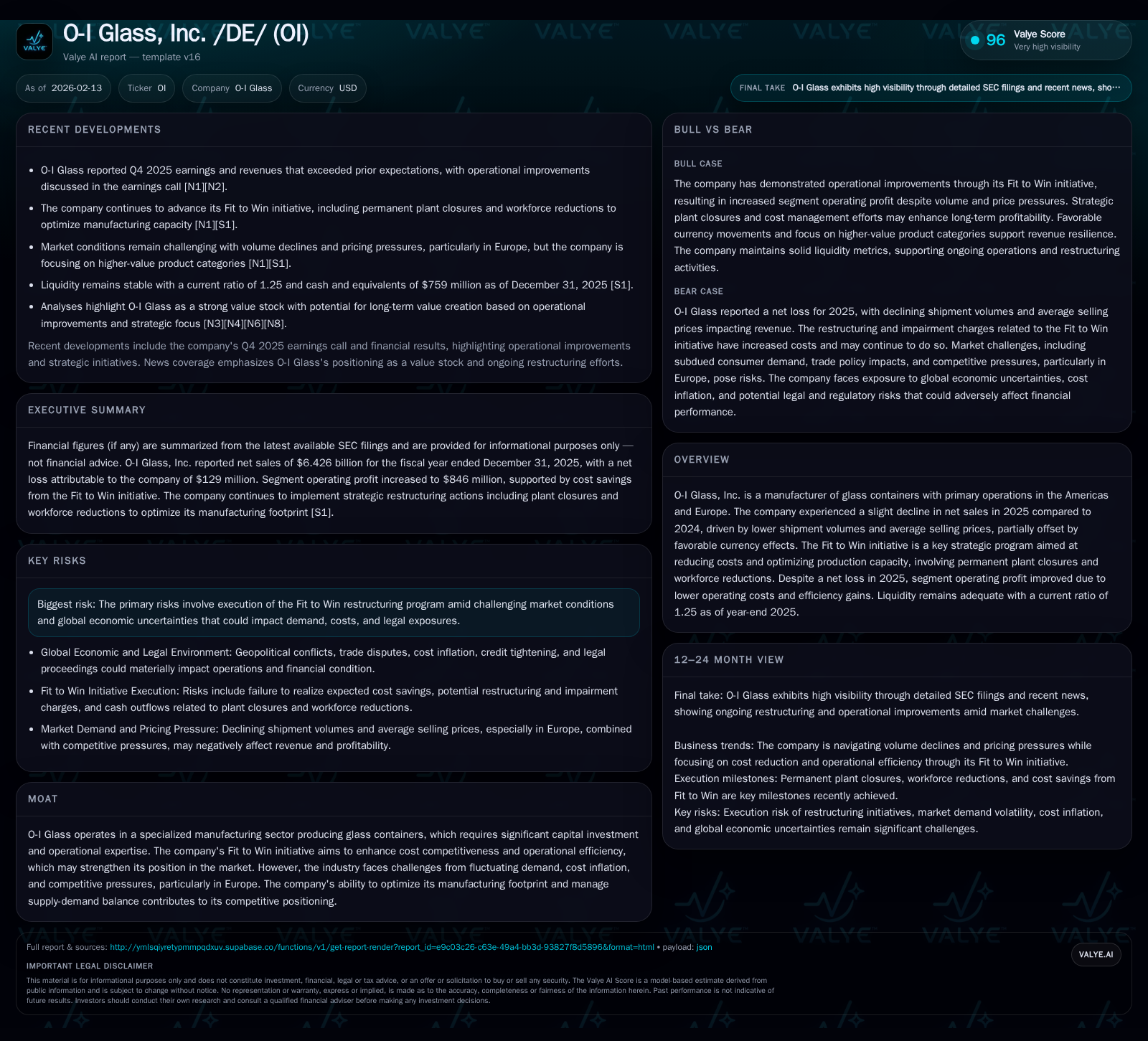
O-I Glass, Inc. operates as a leading manufacturer of glass containers primarily across the Americas and Europe. In 2025, the company faced a modest decline in net sales driven by lower shipment volumes and average selling prices, yet improved segment operating profit due to cost efficiencies from its Fit to Win initiative. The business continues grappling with industry headwinds including fluctuating demand, cost inflation, and shifting product mix dynamics. Its liquidity position remains solid despite incurring a net loss for the year. Execution risk around restructuring and macroeconomic uncertainties loom as key concerns for near-term performance.
Overview of O-I Glass's Business Model and Market Position
O-I Glass, Inc., trading under the ticker OI, is one of the foremost manufacturers of glass containers with significant operational footprints in both the Americas and Europe. Given the specialized capital-intensive nature of glass manufacturing—where expertise in furnace operation, quality control, and materials science is critical—O-I holds a strategically important position in this niche sector. The company's customers span diverse end markets including premium spirits, food packaging, non-alcoholic beverages, ready-to-drink products, as well as traditional beer and wine categories.
Though the market for glass containers is relatively stable due to packaging’s essential role in consumer goods, it faces ongoing pressures: fluctuating demand driven by consumer trends and trade policies, input cost volatility notably energy and raw materials, and regulatory developments affecting cross-border trade.
Financial Performance Highlights from 2025
According to O-I’s most recent annual report filed in February 2026 [S1], net sales for the full year 2025 totaled $6.43 billion—a 2% decline compared to $6.53 billion in 2024. This contraction was primarily attributable to approximately a 3% reduction in shipment volumes (down roughly 2.5% excluding divestitures) combined with lower average selling prices which together reduced revenue by about $186 million before being partially mitigated by favorable currency translation that added $112 million.
A deeper dive reveals a nuanced shift in shipment mix: while mainstream beer and wine shipments contracted notably—affected by factors such as U.S. policy changes impacting Mexican imports—the company saw resilience or growth in higher value-added categories like premium spirits, food-related containers, non-alcoholic beverages, and ready-to-drink formats.
Segment operating profit improved materially by $98 million from 2024’s $748 million to $846 million in 2025. This was driven predominantly by operational efficiencies derived from the Fit to Win program alongside lower overall operating costs, although partially offset by pricing pressures (lower net prices after adjusting for inflation) and tempered volumes. Notably, operating costs benefitted from some favorable discrete items plus temporary curtailments in European production aimed at balancing supply-demand mismatches and reducing inventory build-up.
Despite these operational gains at the segment level, O-I posted a net loss attributable to shareholders of $129 million (versus $106 million loss in prior year), reflecting increased restructuring charges amounting to $443 million (versus $206 million before), slightly higher interest expense ($341 million vs. $335 million), along with other retained corporate expenses [S1].
The Fit to Win Strategic Initiative: A Closer Look
At the heart of O-I’s corporate strategy is the Fit to Win program launched around 2024. This multifaceted initiative aims squarely at enhancing long-term profitability through cost management, efficiency improvements, manufacturing footprint optimization including permanent furnace closures and plant shutdowns.
Key aspects include:
- Permanent closure of select production plants deemed nonstrategic or underperforming,
- Workforce reductions aligned with streamlined operations,
- Shifts toward manufacturing lighter-weight bottles and smaller format offerings responding to evolving customer preferences,
- Margins improvement through continuous productivity programs.
The program represents both an opportunity for sustainable margin enhancement but also a source of near-term execution risk given potential disruptions from plant closures and workforce changes. Further complicating this is the challenging global economic environment which poses risks on demand elasticity and cost structure stability.
Market Dynamics Impacting O-I Glass
Demand Trends
O-I operates across mature beverage categories where volumetric growth tends to be modest but product innovation (e.g., premiumization) fuels price mix gains. The past year saw uneven demand patterns—premium spirits showed robustness whereas mainstream beer segment declines reflected shifting consumer habits compounded by inventory corrections linked with U.S.-Mexico trade policies.
Pricing & Cost Inflation
The company experienced a decline in average selling prices partly attributed to competitive pressures exacerbated by inflations on input costs such as energy—a major driver for glass melting furnaces—and raw materials like silica sands. Regulatory tariff changes globally add unpredictability around pricing power.
Geographic Nuances
While Americas slightly benefited from currency tailwinds boosting reported revenues amidst volume weakness, European operations faced temporarily curtailed production volumes as part of inventory management strategy under Fit to Win execution.
Liquidity and Balance Sheet Positioning
At December 31, 2025, O-I held cash & cash equivalents of approximately $759 million against current liabilities of about $2.09 billion resulting in a current ratio of roughly 1.25 [F1]. While not overly liquid by some standards, this ratio indicates reasonable capacity to meet short-term obligations.
The company also deals with significant long-term indebtedness typical for capital-intensive industrial businesses; ongoing refinancing activity has involved incremental finance fees impacting interest expenses moderately upwards year-on-year.
Risks Highlighted in Recent Filings
O-I’s updated SEC filings underscore several salient risks [S1][S2]:
- Execution uncertainty surrounding Fit to Win restructuring efforts including timely realization of intended cost savings amidst workforce adjustments,
- Global macroeconomic factors such as recessionary pressures potentially reducing consumer demand,
- Exposure to fluctuations in commodity costs (energy/labor/materials) that may erode margins if not adequately passed through,
- Trade policies introducing tariffs or restrictions that could disrupt supply chains or diminish market access,
- Legal contingencies including environmental liabilities tied historically to manufacturing operations,
- Credit market tightening possibly impacting availability/cost of capital for company or its customers/suppliers,
- Volatility affecting pension plan valuations requiring additional funding contributions.
Industry Context—Glass Packaging Sector Challenges & Opportunities (Analysis)
The glass container industry remains subject to structural pressures including competition from alternative packaging materials like plastic or aluminum cans—often more cost-effective or lightweight but sometimes less sustainable environmentally depending on geography.
Environmental regulations increasingly incentivize recyclable packaging solutions; here glass enjoys advantages due to its infinite recyclability potential which can bolster demand particularly among premium brands emphasizing sustainability credentials.
Technological advancements targeting energy efficiency within furnaces present ongoing opportunities for cost containment albeit requiring capital investment which firms like O-I must judiciously manage amid thin margins.
Supply-demand balance periodically experiences disruption due to shifts in consumer preferences or geopolitical events impacting raw material sourcing or logistic networks.
Recent Market Sentiment & Analyst Commentary (News Highlights)
Articles published early February 2026 highlight mixed investor perspectives on OI stock’s momentum characteristics [N4][N12] alongside recognition of its perceived value proposition rooted in ongoing Fit to Win benefits [N5][N6]. Earnings results notably beat consensus estimates for Q4 2025 [N2], reinforcing operational progress despite broader headwinds noted during full-year disclosures [N1].
Upgrades from financial institutions suggest cautious optimism predicated on successful restructuring execution balanced against structural margin challenges [N13]. Yet analyst discourse consistently emphasizes execution risk amid uncertain global trade landscapes raising flags about near-term earnings volatility.
Outlook Considerations and Strategic Positioning Going Forward (Analysis)
As O-I Glass moves further into its Fit to Win journey beyond 2025, critical success factors will hinge upon:
- Effective project management minimizing disruption associated with plant closures,
- Maintaining customer retention while realigning product portfolio toward more profitable segments,
- Leveraging technological initiatives improving furnace efficiency,
- Navigating macroeconomic turbulence without excessive margin erosion,
- Retaining sufficient liquidity flexibility as debt maturities evolve,
- Monitoring regulatory environments especially pertaining to carbon emissions or trade tariffs.
The company's commitment to sustainability messaging around glass packaging recyclability may also unlock new market segments or partnerships aligning with consumer demand trends favoring eco-friendly products.
Conclusion
O-I Glass finds itself at a pivotal juncture characterized by proactive restructuring efforts aimed at solidifying long-term competitiveness against a backdrop of mixed volume trends and margin pressures. While near-term losses reflect associated costs from these initiatives coupled with macro risks, reported improvements in segment profitability demonstrate underlying operational leverage potential once cost savings fully materialize.
The complex interplay between legacy operational burdens and strategic reinvention creates execution challenges but also offers a pathway towards improved financial health if managed adeptly amid continuing industry evolution.
Disclaimer: This analysis is provided solely for informational purposes reflecting publicly available data as of early 2026 without regard to individual investment objectives or advice solicitation. It does not constitute investment advice or recommendations regarding any securities discussed herein.
Disclaimer: This is research-only, informational analysis and not investment advice. It may include AI-generated interpretation and general industry context. Always verify important details using primary sources.

Comments