
Track Group, Inc.: Navigating the Interplay of Patented GPS Innovations and Financial-Legal Challenges
An in-depth analysis of Track Group’s patented technologies set against a backdrop of mounting debt and ongoing litigation risks.
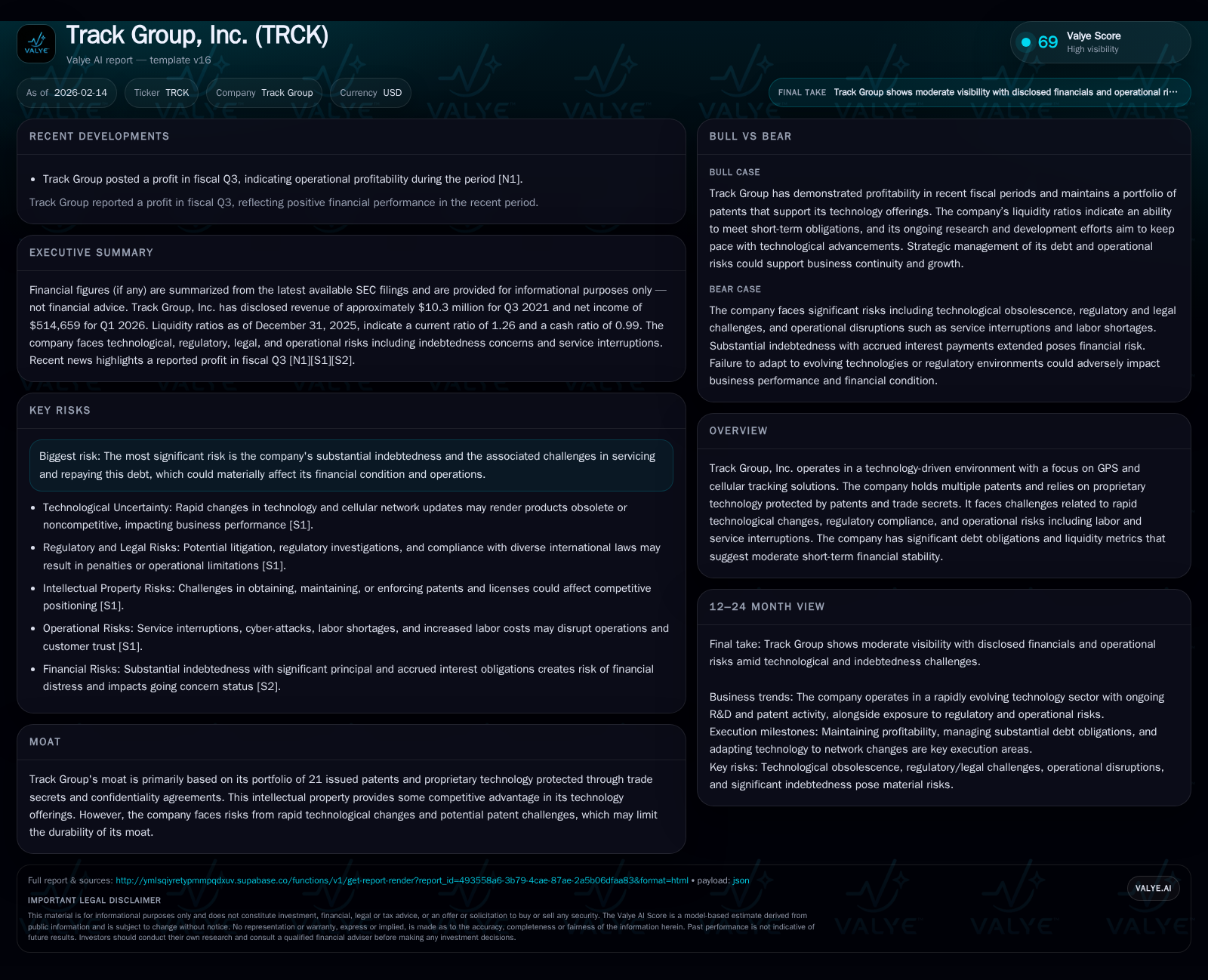
Track Group, Inc. stands at a crossroads where its portfolio of 21 patents and proprietary GPS tracking technologies serve as both its competitive core and vulnerability amid swiftly evolving telecom landscapes. Despite technical leadership, substantial indebtedness—highlighted by $42.9 million principal due in 2027 and accrued unpaid interest—and persistent legal disputes cast shadows over its operational prospects. The company’s strategic office footprint adjustments and regulatory compliances further complicate the terrain. How Track Group maneuvers through these intertwined technological, financial, and legal pressures will decisively shape its medium-term viability.
Patents and Proprietary Tech: The Heartbeat of Track Group’s Moat
At the core of Track Group’s value proposition lies its intellectual property fortress comprising 21 issued patents alongside trade secrets rigorously safeguarded by confidentiality agreements [S1]. These patents underpin its differentiated GPS and cellular tracking solutions designed for electronic monitoring applications. This patent portfolio forms the backbone of its competitive moat by legally shielding unique technological features from direct replication.
However, the durability of this moat faces intrinsic headwinds characteristic of fast-evolving technology sectors. The company explicitly acknowledges risks that patents might be invalidated or circumvented given complex enforcement challenges [S1]. Iterative advancements by competitors could also render certain core technologies obsolete if Track Group’s own innovation cadence lags. This dual vulnerability imposes continuous pressure on R&D effectiveness — failure to maintain technological leadership risks erosion of market exclusivity.
Moreover, GPS tracking technology inherently suffers physical constraints such as dependence on "line-of-sight" satellite signals limiting accuracy in urban canyons or indoor environments [S1]. Cellular network upgrades further require device redesigns — the recent U.S. phase-out of 3G necessitated costly compatibility updates illustrating fast obsolescence risks embedded even within patented platforms.
Financial Tightrope: Navigating Debt and Liquidity Concerns
Track Group’s balance sheet reveals a substantial debt load that poses critical near-term challenges. As per the latest quarterly filing dated February 13, 2026, principal outstanding debt to Conrent totals $42.9 million—all due in 2027—with accrued unpaid interest at $3.38 million as of December 31, 2025 [S2]. Notably, Conrent has granted extensions on interest payments but future demands for immediate repayment or inability to refinance would have material adverse consequences for operations and solvency.
On the liquidity front, current assets stand modestly above current liabilities ($10.48 million vs. $8.32 million), yielding a current ratio around 1.26 [F1]. While this suggests some short-term financial stability adequate to meet immediate obligations, it offers limited margin for unforeseen expenses or working capital fluctuations amid operating pressures.
Given these figures alongside prior instances of extended interest deferrals—the company is navigating a tightrope between sustaining ongoing business functions and addressing creditor expectations without incurring covenant breaches or jeopardizing continuing as a going concern [S2]. Operational flexibility is correspondingly constrained which may affect investments in innovation or market expansion.
Legal Storm Clouds: Litigation Risks and Their Implications
Track Group’s electronic monitoring devices have attracted multiple legal challenges centered on product liability and negligence claims spanning several plaintiffs [S1]. Cases such as Kevin Barnes v. Track Group resulted in insurer-funded settlements at immaterial amounts avoiding protracted litigation costs while other suits including Michael Matthews v. Track Group remain active but stayed pending criminal proceedings.
Newer complaints filed as recently as late 2025 allege injury from device malfunctions or erroneous incarcerations tied to monitoring failures [S1]. Though no loss accruals have been made yet following consultation with legal counsel—reflecting early procedural stages—the specter of increased settlements or judgments remains an operational risk.
Beyond direct financial costs, these lawsuits introduce reputational risks that could undermine customer trust especially given sensitive nature of electronic tracking used within criminal justice systems. Regulatory scrutiny linked to these claims could amplify penalties or operating constraints if compliance lapses are alleged.
Operational Footprint: Office Leases and Strategic Realignment
Track Group operates across several leased premises with varying lease terms indicative of strategic positioning decisions [S1]. Its headquarters occupies roughly 5,600 square feet at Naperville, Illinois with lease extended through August 31, 2027 at $12,000 monthly base rent plus CAM charges.
A larger facility located in Indianapolis spans nearly 11,770 square feet leased from January 2025 through December 2029 commanding similar monthly rental payments reflecting sustained regional operations focus.
Conversely, a smaller Utah office (1,500 sq ft) remains on a month-to-month lease since expiration in August 2018 with minimal monthly payments indicating flexible usage possibly for specific functional purposes.
Noteworthy is the November 2024 sale of its Chilean subsidiary along with associated office space (2,200 sq ft), signaling a contraction or refocusing away from Latin American operations [S1]. This divestiture may reflect cost optimization amid constrained cash flows or strategic realignment towards core geographies.
Technology Risks: Innovation Versus Obsolescence
The relentless evolution of telecommunications infrastructure presents complex technological risks for Track Group’s product suite [S1]. Key dependencies on cellular network standards expose devices to forced upgrades; for example widespread discontinuation of legacy 3G services compelled costly reengineering efforts to preserve functionality.
Similarly, GPS technology intrinsically requires unobstructed satellite signals limiting reliability indoors or dense urban settings—a fundamental limitation outside the company’s control but impactful on product competitiveness [S1].
Research & development endeavors must thus constantly anticipate future network protocols (e.g., emerging LTE enhancements or next-gen wireless standards) ensuring seamless device compatibility while improving accuracy and energy efficiency to retain market relevance.
Failure to efficiently innovate could lead not only to customer attrition towards superior alternatives but also make existing patent protections less defensible if underlying technologies become outdated.
Regulatory Terrain: Compliance Challenges Across Jurisdictions
Operating internationally across multiple regulatory frameworks subjects Track Group to expansive compliance requirements spanning export controls, antitrust statutes, taxation regimes, environmental mandates including electronics disposal laws—plus environmental regulations around recycling programs [S1].
Potential investigations loom as authorities oversee adherence to these diverse rules; infractions could trigger penalties materially affecting earnings or operational continuity.
Such regulatory complexity raises barriers to swift market entry or product innovation particularly when approvals or certifications span multiple countries each with distinct procedures—a notable overhead impacting timelines and costs.
Given ongoing litigation attracting attention from regulatory bodies there exists an intertwined risk compounded by governance failures or non-compliance exacerbating reputational damage alongside fiscal ramifications.
Market Positioning: Competitive Landscape and Industry Dynamics
Though detailed competitor data is unavailable here, the disclosed risk factors imply that Track Group competes within an intensely innovative niche where rival firms invest heavily in advanced tracking solutions often protected by their own patent filings [S1].
Counter-patent challenges constitute tangible threats capable of diluting exclusive rights underpinning Track Group’s product differentiation.
The company’s continued reliance on proprietary IP as opposed to commoditized hardware necessitates agile adaptation; incumbents failing to modernize rapidly risk displacement by disruptive entrants offering superior accuracy or lower-cost alternatives leveraging emerging telecom architectures.
Hence, preserving market share depends not only on patent defense but on proactive R&D execution aligned tightly with evolving customer demands driven by judicial monitoring agencies requiring dependable performance under stringent compliance rules.
Forward Outlook: Balancing Innovation, Debt Repayment, and Risk Management
Looking ahead, Track Group must orchestrate a delicate balance among advancing its tech capabilities while simultaneously managing severe debt service obligations confronting a $42.9 million principal maturity within two years plus accrued interest burdens [S2].
Negotiations with creditor Conrent offer some breathing room but unresolved risk remains if refinancing fails causing liquidity crises risking going-concern viability.
Parallel defense against multifaceted litigation requires vigilant legal strategy minimizing financial drains alongside safeguarding corporate reputation vital for contract retention.
Operational adjustments such as shedding non-core assets exemplified by Chilean subsidiary divestiture reflect cost-conscious measures possibly aimed at reallocating capital towards core tech investments enabling faster adaptation to cellular network changes preventing obsolescence [S1].
Scenario-wise: if technological breakthroughs align with successful creditor arrangements and favorable legal outcomes coincide—Track Group can stabilize maintaining relevance within high-barrier niche markets; conversely failure on any front portends sustained financial strain accompanied by eroding competitive advantage compromising long-term survival.
This analysis synthesizes information from publicly filed SEC documents complemented by contextual industry understanding without offering investment advice. Readers should consider official filings as definitive sources for factual details pertaining to Track Group’s business condition.
Disclaimer: This is research-only, informational analysis and not investment advice. It may include AI-generated interpretation and general industry context. Always verify important details using primary sources.

Comments