
Navigating Regulatory Complexity and Financial Fragility at Hongchang International
Hongchang International’s intricate holding structure coupled with China’s uncertain regulatory environment forms the core challenge for its operational and financial sustainability.
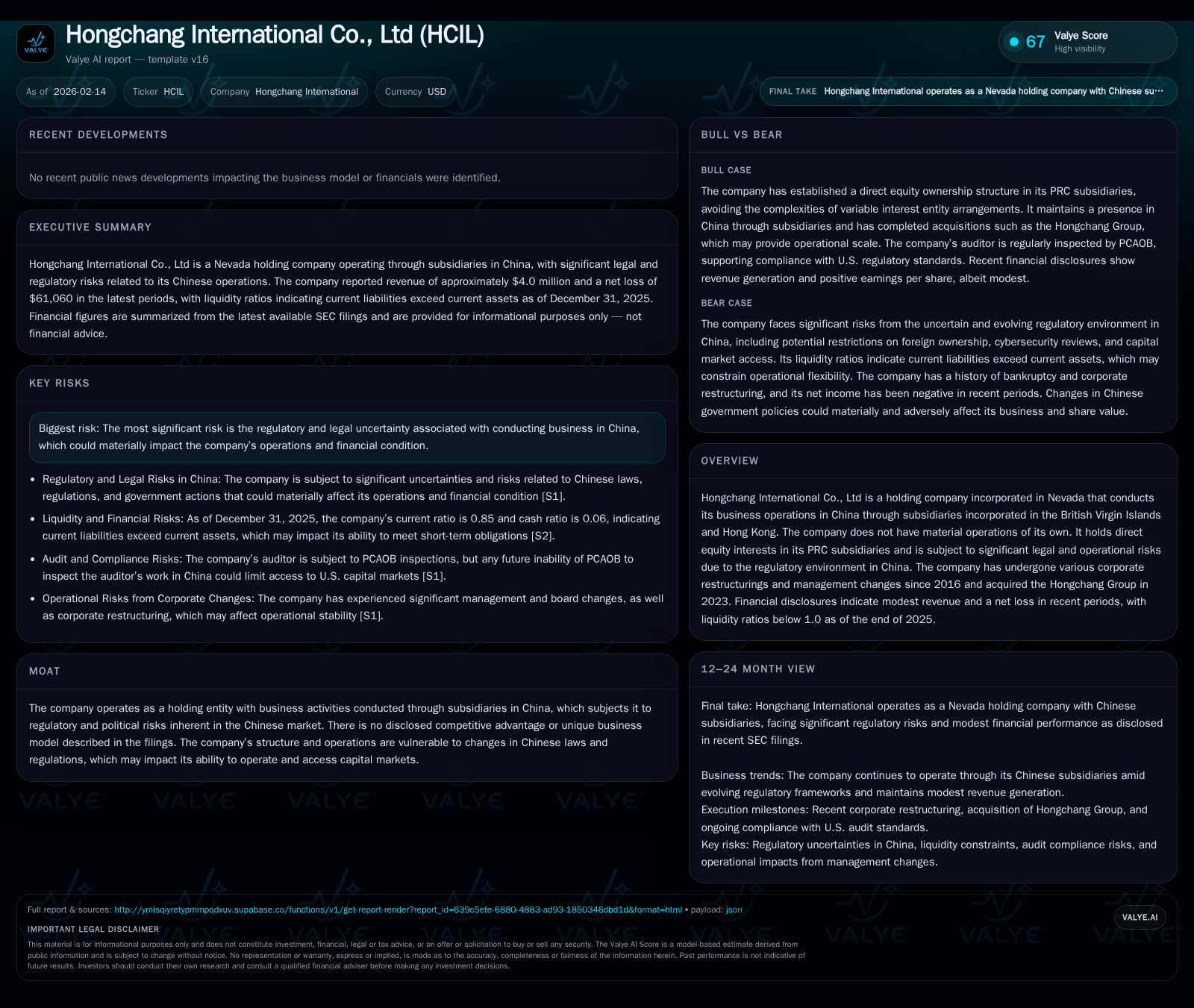
Hongchang International Co., Ltd operates through a multi-layered holding entity with subsidiaries primarily engaged in mainland China, exposing it to significant regulatory and legal risks inherent to the Chinese market. Despite modest revenues following its 2023 acquisition of Hongchang Group, the company struggles with narrow liquidity margins and ongoing net losses, reflecting operational vulnerabilities. The opaque and evolving Chinese legal landscape, combined with a lack of competitive differentiation, shadows its future prospects and complicates investor assessments.
A Complex Holding Web: Hongchang’s Corporate Structure Unveiled
Hongchang International Co., Ltd presents itself primarily as a holding company domiciled in Nevada, yet its operational footprint lies predominantly within mainland China through a constellation of subsidiaries based in the British Virgin Islands (BVI) and Hong Kong. This layered structure positions the company at an intersection of multiple legal regimes and introduces complexity around governance and oversight.
Distinctly, unlike many China-focused firms seeking indirect control via Variable Interest Entities (VIEs), Hongchang exercises direct equity ownership over its PRC subsidiaries. This ownership model ostensibly simplifies certain contractual uncertainties linked with VIE arrangements; however, it does not insulate the firm from severe regulatory vagaries endemic to foreign-invested enterprises in China. The cross-jurisdictional design may obfuscate transparency for investors, complicate compliance coordination, and heighten exposure to changes in foreign investment regulations.
In sum, Hongchang's corporate architecture reflects a common approach among companies operating within China's nuanced market access framework but simultaneously compounds risks related to governance clarity and regulatory shifts [S1], [valye_report_excerpt].
Regulatory Quicksand: The Chinese Legal Landscape’s Grip on HCIL
The overarching challenge faced by Hongchang arises from navigating China's evolving legal framework—a system grounded primarily on codified statutes rather than judicial precedent. While reforms since 1979 have incrementally improved protections for foreign investment, the legislative environment remains fragmented. Laws and regulations often carry ambiguities where enforcement relies heavily on local governmental discretion and policy shifts that are not always transparent or timely communicated.
Recent years have seen Beijing intensify scrutiny on overseas-listed Chinese companies under directives aiming to bolster securities market integrity via enhanced cross-border supervision. This creates an additional layer of uncertainty for companies like Hongchang which operate within sensitive industry verticals subject to sudden regulatory interventions.
Moreover, China’s government maintains broad authority to influence business conduct to align with political or social priorities—a factor that adds a dynamic risk not typically quantified in conventional financial metrics. Such interventions could arrive abruptly, potentially jeopardizing operational legitimacy or constraining capital raising activities abroad [S1], [S2], [valye_report_excerpt].
Financial Fragility Amid Uncertainty: Dissecting Recent Numbers
Turning from structural risks to financial realities reveals a portrait of fragility undergirded by modest scale. For the fiscal year ending December 2025, Hongchang generated approximately $4.0 million in revenue coupled with operating losses extending into negative territory EBITDA margins. Notably, net income figures reflect losses persisting through at least September 2024.
A critical red flag emerges from liquidity metrics — the current ratio stands at roughly 0.85 (current assets of about $8.18 million against current liabilities near $9.68 million). Cash reserves measured approximately $550 thousand as of year-end 2025 highlight constrained buffers against immediate obligations.
This tight solvency profile suggests limited runway for absorbing shocks whether from market volatility, unforeseen regulatory compliance costs, or integration expenses linked to recent acquisitions [F1], [S2]. Operational resilience appears muted without material scale or diversified income streams.
The Strategic Impact of Hongchang Group Acquisition in 2023
Although details remain sparse, the acquisition of the Hongchang Group marks a pivotal moment in the company's strategic trajectory. Typically, such consolidations aim to broaden market presence or diversify offerings; however, without clear disclosure on revenue contribution or cost synergies post-acquisition, evaluating its net effect is challenging.
Timing-wise, this move coincides with an increasingly hostile regulatory environment in China toward foreign-listed entities—a factor that may exacerbate integration complexities or stretch compliance capabilities.
Therefore, while potentially offering growth avenues, the acquisition inherently introduces execution risk alongside increased exposure to shifting legal conditions [valye_report_excerpt].
The Invisible Moat: Does Regulatory Risk Undermine Competitive Position?
In investor communications and filings, Hongchang does not articulate proprietary advantages or differentiated business models that typically characterize enduring competitive moats. Instead, its primary exposure remains tethered closely to external factors—namely governmental policies and enforcement practices.
This absence of an intrinsic moat implies susceptibility to sector-wide disruptions without fallback defenses anchored in brand strength, technology leadership, or unique intellectual property.
Thus, any protective barrier against competition appears overwhelmed by systemic country risk rather than company-specific attributes—a critical perspective when assessing long-term viability [valye_report_excerpt].
Capital Constraints and Liquidity Struggles: Gauging Financial Health
From a capital management standpoint, liquidity signals warrant heightened caution. With current liabilities outpacing current assets by nearly $1.5 million and relatively low cash balances under six figures (adjusted for currency translation nuances), operational flexibility suffers.
Such constraints could limit agility in responding to abrupt compliance mandates or seizing strategic opportunities requiring capital expenditure.
Moreover, subsidiaries' reliance on upstream funding amidst uncertain repatriation conditions adds layers of complexity impacting working capital dynamics across the group structure [F1].
Looking Ahead: The Crucial Unknowns in Policy and Market Access
Looking forward underscores the critical unknowns enveloping Hongchang's prospects. China's policy direction continues characterized by opacity with sporadic yet impactful interventions across multiple sectors.
The company's narrative acknowledges possible scenarios where heightened restrictions might curtail its ability to maintain listings abroad or access international capital markets effectively—outcomes with profound valuation ramifications.
While precise impacts are unpredictable given China's evolving stance on foreign exchange controls and overseas investment facilitation measures, prudence dictates ongoing vigilance toward regulatory developments that may redefine operating parameters [S1], [S2], [valye_report_excerpt].
Investor Takeaways: Balancing Risk versus Opportunity in HCIL
For market participants contemplating exposure to Hongchang International Co., Ltd., evaluation transcends standard financial metrics into realms dominated by geopolitical nuance and legal complexity.
The company's modest operational scale coupled with significant sovereign risk demands a calibrated understanding of suitability aligned with individual risk tolerances and time horizons.
Fundamentally opaque reporting structures combined with uncertain governance dynamics necessitate careful due diligence beyond headline revenue or acquisition announcements.
Investors must reconcile potential upside from tapping into China's sizeable markets against real downside risks emanating from abrupt policy shifts capable of undermining asset values swiftly.
This analysis is prepared solely for informational purposes based on publicly available data as of early 2026 and does not constitute investment advice. Readers should conduct their own assessments considering their specific circumstances.
Disclaimer: This is research-only, informational analysis and not investment advice. It may include AI-generated interpretation and general industry context. Always verify important details using primary sources.

Comments