Eli Lilly & Co: Deep Dive into a Pharmaceutical Powerhouse’s 2025 Performance and Pipeline
Eli Lilly delivered robust 2025 results fueled by blockbuster drugs, innovative pipeline progress, and strategic AI investments in a competitive pharma landscape.
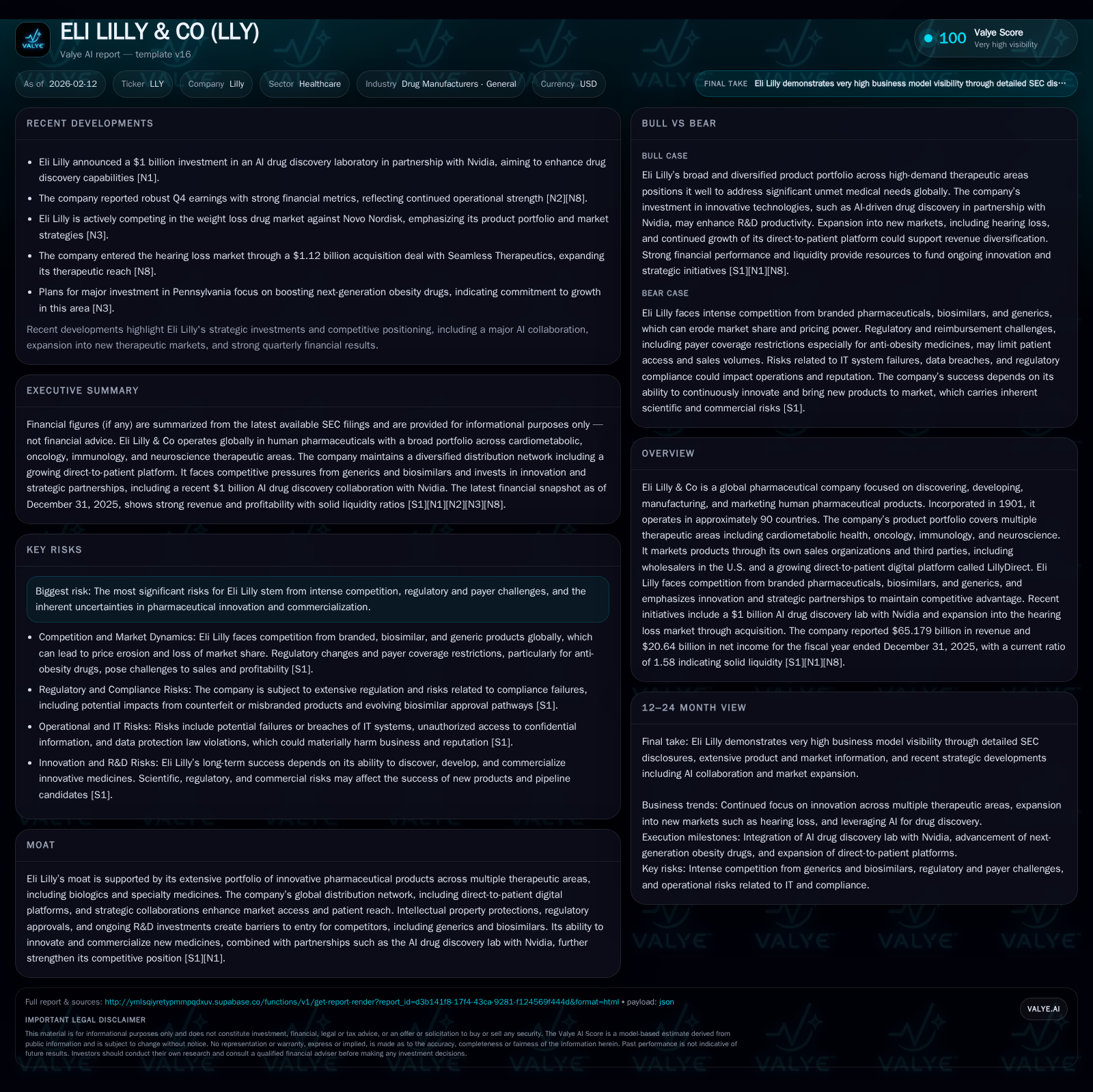
In 2025, Eli Lilly & Co reported remarkable financial growth driven primarily by increased volumes of key cardiometabolic drugs Mounjaro and Zepbound. The company’s diversified portfolio spans cardiometabolic health, oncology, immunology, and neuroscience with several late-stage pipeline candidates. Strategic moves, including a $1 billion AI drug discovery partnership with Nvidia and expansion into novel markets like hearing loss, underscore Lilly's commitment to innovation. Despite strong momentum, risks inherent to pharmaceutical R&D and regulatory complexities remain significant considerations.
Introduction
Eli Lilly & Company has solidified its position as a global pharmaceutical leader through consistent innovation across multiple therapeutic areas including cardiometabolic health, oncology, immunology, and neuroscience. Founded in 1901, the company operates in roughly 90 countries and deploys a diverse commercial strategy that includes proprietary sales forces alongside third-party wholesalers and cutting-edge digital platforms such as LillyDirect.
This comprehensive review unpacks the firm’s recent financial results for fiscal year 2025, evaluates the strengths of its product portfolio and clinical pipeline, assesses strategic initiatives such as AI partnerships for drug discovery, and explores the principal challenges facing the business amid an evolving healthcare environment.
Financial Performance Highlights of 2025
Eli Lilly’s fiscal year 2025 performance was marked by extraordinary top-line growth with revenues reaching $65.179 billion—a sharp increase of 45% compared to prior year levels. This surge was largely volume-driven by blockbuster cardiometabolic drugs Mounjaro (tirzepatide) and Zepbound (approved for obesity and obstructive sleep apnea). Though realized prices declined modestly over the period—partly due to competitive pressures—their impact was outweighed by expanding patient demand.
Net income nearly doubled year-over-year to $20.64 billion owing principally to healthier gross margins. However, this was partially offset by intensifying investments in marketing, selling expenses, and research & development activities which reflect Lilly’s commitment to sustaining long-term growth through innovation. Earnings per share rose commensurately from $11.71 to $22.95 diluted [S1][F1].
Liquidity remains strong with cash and equivalents standing at approximately $7.27 billion at year-end alongside a conservative current ratio close to 1.58—providing balance sheet flexibility amid rising sectoral costs.
Product Portfolio Strength: Blockbusters Leading Growth
Cardiometabolic Brands Driving Volume
Mounjaro is pivotal to Eli Lilly’s revenue expansion. This dual glucose-dependent insulinotropic polypeptide (GIP) and glucagon-like peptide-1 receptor agonist is approved for type 2 diabetes in adults—and now also pediatric populations—and obesity treatment outside the U.S., with ongoing Phase 3 trials in additional indications such as heart failure with preserved ejection fraction (HFpEF), metabolic dysfunction-associated steatotic liver disease (MASLD), obstructive sleep apnea (OSA), osteoarthritis pain, peripheral artery disease, stress urinary incontinence, and cardiovascular outcomes trials.
Zepbound complements this portfolio as an anti-obesity agent targeting adults who are overweight or obese with associated comorbidities; it further addresses moderate to severe OSA cases when used alongside lifestyle interventions.
Other cardiometabolic candidates like insulin efsitora alfa and orforglipron hold promise pending regulatory approvals across major geographies.
Immunology Advancement
Mirikizumab (Omvoh) has received approvals for Crohn's disease management across the U.S., EU, and Japan—solidifying presence in inflammatory bowel diseases. Lebrikizumab is advancing through Phase 3 trials for allergic rhinitis (AR) due to perennial allergens as well as chronic rhinosinusitis with nasal polyps (CRSwNP).
Neuroscience Innovations
Alzheimer’s disease remains a high-priority focus where donanemab (Kisunla) has secured approvals for early-stage disease intervention internationally. Robust Phase 3 studies continue exploring efficacy in pre-clinical Alzheimer’s scenarios while other molecules such as brenipatide target alcohol use disorder.
The acquisition of Adverum Biotechnologies brought Ixo-vec into Lilly’s fold addressing wet age-related macular degeneration via gene therapy approaches currently undergoing late-stage evaluation.
Oncology Pipeline Expansion
Recent FDA approvals for imlunestrant (Inluriyo) addressing ER+, HER2-, ESR1-mutated advanced breast cancer and pirtobrutinib (Jaypirca) against chronic lymphocytic leukemia exemplify successful targeted therapy developments.
Phase 3 trials for next-generation oncology candidates including olomorasib for KRAS G12C+ non-small cell lung cancer (NSCLC) plus sofetabart mipitecan for platinum-resistant ovarian cancer—both granted Breakthrough Therapy designation—signal robust future potential.
Innovation via AI Partnerships
Acknowledging the accelerating role of artificial intelligence in drug discovery processes, Eli Lilly announced a groundbreaking joint venture with Nvidia establishing a $1 billion AI-powered R&D laboratory designed to enhance molecule identification efficiency. This venture aims not only to speed up traditional timelines but also improve predictive modeling accuracy surrounding candidate viability early in development—a recognized bottleneck within pharma innovation cycles [N14][S1].
While early operational results remain proprietary, this collaboration reflects broader industry trends embracing computational biology tools to complement bench science.
Commercial Strategy & Market Reach
Eli Lilly sells products directly through internal sales organizations supported by wholesalers domestically while expanding its reach internationally through partnerships tailored to region-specific healthcare frameworks.
Notably innovative channels include LillyDirect—a direct-to-patient digital platform bolstering patient engagement around chronic conditions favoring convenience-focused care delivery models amidst evolving healthcare consumer behavior.
Furthermore, geographic breadth spanning approximately ninety countries cushions exposure against localized market disruptions while enabling scale efficiencies tied to supply chain management and regulatory expertise.
Strategic Acquisitions & New Markets
The company continues selectively acquiring firms or technologies that extend its footprint into adjacent therapeutic areas or promising fields such as hearing loss therapies—demonstrating strategic diversification away from dependence solely on historically strong cardiometabolic franchises.
This expansion aims to capture unmet medical needs associated with aging populations globally alongside growing demand in sensory impairment treatments—a trend underpinned by demographic shifts and rising healthcare expenditure allocation towards quality-of-life improvements.
Competitive Landscape & Risks
Despite notable successes, Eli Lilly confronts substantial challenges common throughout Big Pharma:
- Intensifying competition from biosimilars erodes exclusivity windows impacting mature products.
- Generic entrants pressure pricing dynamics especially outside protected patent periods.
- Regulatory authorities maintain stringent efficacy/safety standards prolonging approval durations or triggering label modifications.
- Payer negotiations impose price controls or restrict patient access which influences commercial uptake trajectories.
- The ever-present risk that late-stage pipeline projects may falter or produce suboptimal returns given variable clinical trial outcomes or unexpected safety signals.
- Potential intellectual property litigation requiring resource allocation towards defense efforts affecting timelines/resource deployment.
- Operational risks linked to manufacturing complexities particularly concerning biologics requiring specialized capabilities.
- Macro factors such as geopolitical tensions impacting supply chains and currency fluctuations influencing reported earnings.
Management acknowledges these hurdles explicitly emphasizing balanced R&D resource allocation alongside prudent business development decisions aiming at sustainable portfolio replenishment [S1].
Outlook & Conclusion
Eli Lilly's trajectory entering mid-decade appears robust marked by strong revenue performance powered principally by leading cardiometabolic assets expanding into innovative indications complemented by promising late-stage clinical programs spanning high-growth therapeutic segments including oncology and neuroscience.
The strategic embrace of novel technologies like AI-enhanced drug discovery coupled with expansion into new domains signals resilience against traditional patent cliffs facing legacy pharmaceuticals.
Nonetheless, execution risks inherent in pharmaceutical R&D combined with external pressures around regulation and pricing require continued vigilance by leadership as they seek sustainable profit generation balanced against substantial reinvestment demands.
Overall, Eli Lilly remains emblematic of a diversified pharmaceutical innovator successfully navigating both cyclical industry headwinds and structural transformation opportunities shaping modern healthcare paradigms.
Disclaimer: This report is prepared solely for informational purposes based on publicly available data from SEC filings and news sources; it does not constitute investment advice.
Disclaimer: This is research-only, informational analysis and not investment advice. It may include AI-generated interpretation and general industry context. Always verify important details using primary sources.

Comments