
IF Bancorp’s Leadership Changes and Profit Growth Amidst Sparse Disclosures
An in-depth look at IF Bancorp’s recent executive transitions alongside its sequential quarterly profit rise, navigating limited public data to understand financial stability prospects.
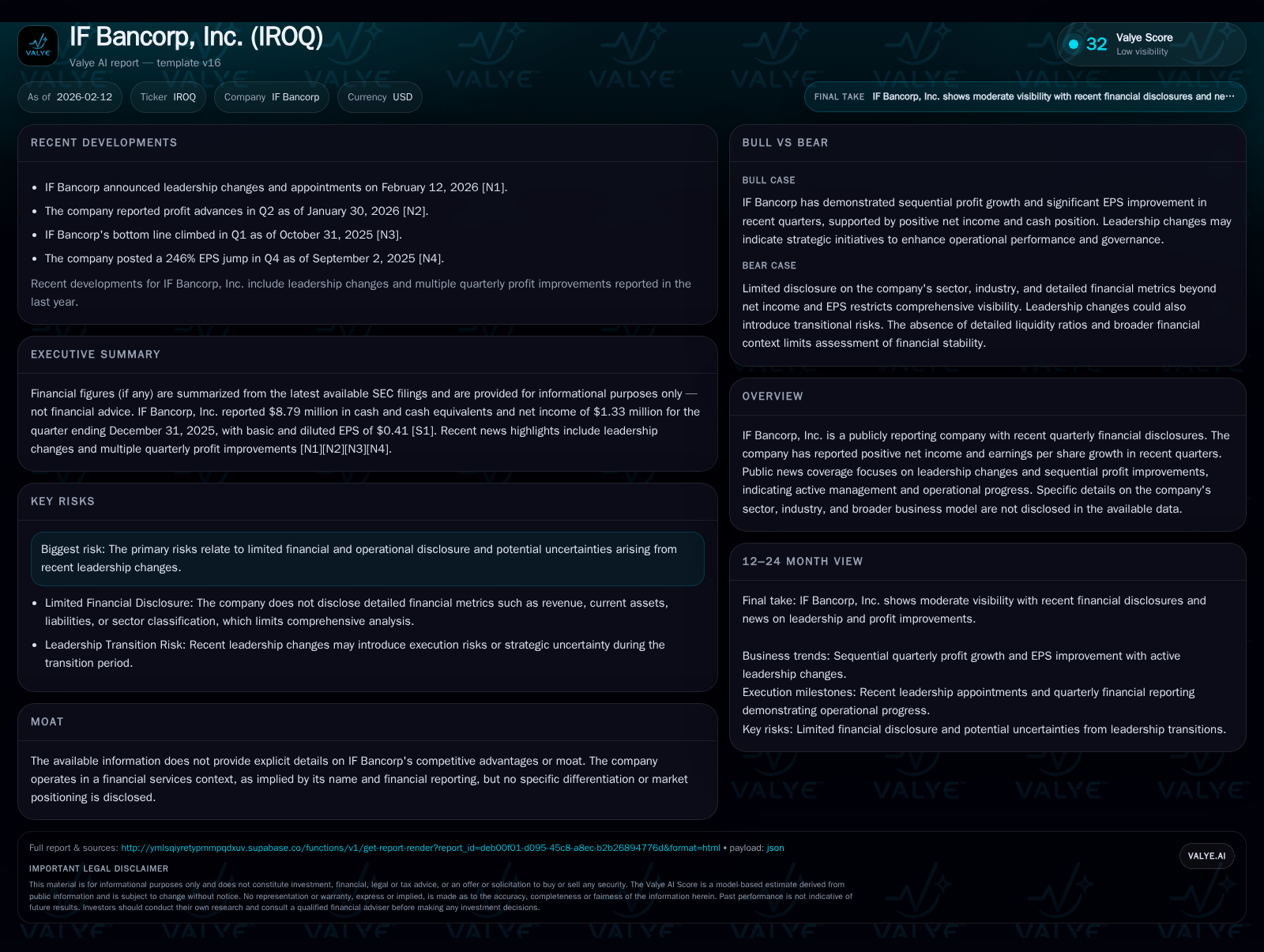
IF Bancorp, Inc. has reported encouraging sequential gains in net income and EPS growth amid recent changes in its leadership team. While the company’s name and financial filings point to a financial services orientation, detailed operational and sector disclosures remain minimal, complicating full assessment. The company maintains solid liquidity, which mitigates some risks arising from opaque disclosure and management shifts. This analysis explores how these dual narratives — evolving governance and profit momentum — frame the firm’s current standing and challenges.
Leadership Changes Signaling New Strategic Directions
The start of 2026 ushered in notable leadership appointments at IF Bancorp, Inc., as publicly disclosed on February 12 [N1]. Such shifts often herald new strategic orientations or governance emphases that can materially affect performance trajectories. Though specifics on the roles or backgrounds of incoming executives remain scarce, the announcement's timing aligns closely with the company’s reported profit improvement for Q2, suggesting an active management footprint aiming to recalibrate operational dynamics.
Leadership turnover in financial entities frequently responds to evolving market conditions or internal assessments of growth avenues. For IF Bancorp, these new appointments presumably reflect an intent to consolidate gains from recent profit advances while navigating uncertain industry landscapes compounded by minimal external visibility into the company's precise market positioning. This confluence points to a cautious yet potentially constructive phase for corporate stewardship.
Quarterly Financial Performance: Under the Hood of Profit Advances
The company’s most recent filed quarter confirms a net income tally of $1.328 million as of Q2 ending December 31, 2025 [F1][N2]. This figure underscores a positive sequential trend relative to prior periods—an encouraging sign in an environment where many smaller financial players grapple with margin pressures. Alongside net income growth, earnings per share metrics have similarly improved though exact EPS numbers are undisclosed; their upward trajectory complements headline profitability.
This profit rise hints at better operational leverage or possibly refined underwriting or credit management practices typical in banking-like enterprises. However, without detailed revenue streams or expense breakdowns, dissecting drivers behind this managed profit uptick remains speculative beyond acknowledging effective cost control or moderate revenue expansion.
Decoding the Financial Disclosures: What the Numbers Reveal—and What They Don’t
The Q2 10-Q filing dated February 12, 2026 provides comprehensive compliance with SEC reporting mandates but offers limited insight beyond fundamental financial statements [S2]. Key omissions include an absence of sector-specific taxonomy or industry classification that would aid analysts in benchmarking performance against peers. Moreover, granular disclosures around segments—be it loan portfolios, deposit bases, fee generation, or geographic concentrations—are not present.
While this procedural adherence ensures baseline transparency, it leaves significant questions unanswered about the company's core operations. For instance, without knowing whether IF Bancorp focuses on commercial banking, mortgage lending, community banking, or specialized finance niches limits contextual understanding essential for deeper fundamental analysis.
Liquidity Profile and Capital Position: An Anchor Amidst Uncertainty
One pillar of financial stability discernible from the filings is IF Bancorp’s liquidity posture. At year-end 2025, cash and cash equivalents stood at approximately $8.79 million [F1][S2]. This sizeable liquidity pool offers tangible resilience when layered against potential operational headwinds introduced by management transition risks or opaque business conditions.
Strong immediate liquidity typically reflects prudent treasury management—a valuable attribute for smaller banks or financial firms navigating uncertain markets or awaiting clearer strategic directions. Although capital adequacy ratios or risk-weighted asset info are not specified here, this cash buffer alone improves confidence regarding short-term solvency amid information deficits.
Operational Highlights and Industry Context: Reading Between the Lines
IF Bancorp’s moniker strongly implies engagement within a banking or financial services context; however, specific activity domains remain hidden outside general inference [valye_report_excerpt]. Common for similarly sized regional or specialty finance institutions might be involvement in lending (consumer, small business), deposit taking, or asset management activities underthe complex regulatory umbrella shaping US banks.
Absent explicit moat descriptions or competitive advantage indicators suggests IF Bancorp operates within standard service parameters without dominant scale advantages or unique proprietary technologies frequently responsible for entrenched market positions. Instead, its path might focus on niche customer relationships or localized market service excellence—a common scenario for small-cap banking entities striving for growth amidst large incumbents.
Risks Rooted in Disclosure Gaps and Management Flux
The most pronounced risk vectors incorporate uncertainties from incomplete disclosures combined with leadership turnover dynamics [valye_report_excerpt][N1]. Opaque reporting hampers external stakeholder ability to precisely ascertain asset quality trends, capital sufficiency depth, or revenue durability factors—crucial elements especially within credit-sensitive financial firms.
Leadership transitions naturally introduce execution risk relating to strategic continuity and operational discipline consistency. Any lapses could disproportionately affect entities lacking robust institutional footprints akin to IF Bancorp’s profile here. Moreover, absent an explicit moat or competitive buffer raises vulnerability concerns should adverse market conditions intensify.
Investors face compounded challenges deciphering value propositions given limited data granularity paired with natural volatility accompanying governance shifts.
Forward-Looking Considerations and Market Sentiment
Sequential profit gains coupled with proactive leadership moves offer plausible grounds for measured optimism regarding IF Bancorp’s near-term outlook [N2][N1]. Should new executives successfully steer operational enhancements while broadening revenue streams within their niche markets, ongoing profitability could solidify further.
Market sentiment likely reflects this balancing act—rewarding visible earnings improvements yet discounting valuation multiples due to lingering opacity around long-term strategy clarity and risk exposure profiling. Continued transparent communication regarding strategic plans and performance drivers would be critical to nurturing increasing investor confidence over time.
Valuation Perspectives in Light of Recent Developments
Price action noted in regulatory footnotes indicates shares traded within a range roughly from $24.35 up to $26.96 over the last year [S2]. These levels appear consistent with a security reflecting incremental fundamental progress while factoring informational inadequacies limiting price appreciation scope.
Given absent industry peer benchmarks here and no detailed segment economics disclosed in filings [F1], valuation must rest predominantly on observable profit trends and liquidity strength rather than traditional multiples reliant on comprehensive disclosure sets.
Accordingly, any assessment requires cautious calibration acknowledging upside potential accompanying operational improvements tempered by disclosure limitations constraining fully informed analysis.
Disclaimer: This report is for informational purposes only and does not constitute investment advice or a recommendation to buy or sell securities. The analysis is based solely on publicly available information as of the dates cited.
Disclaimer: This is research-only, informational analysis and not investment advice. It may include AI-generated interpretation and general industry context. Always verify important details using primary sources.

Comments