
CSX CORP: Navigating Operational Pressures and Regulatory Risks through Infrastructure and Modernization
CSX leverages an extensive rail network moat and strategic fleet investments to address recent operational strains and evolving regulatory challenges shaping its forward path.
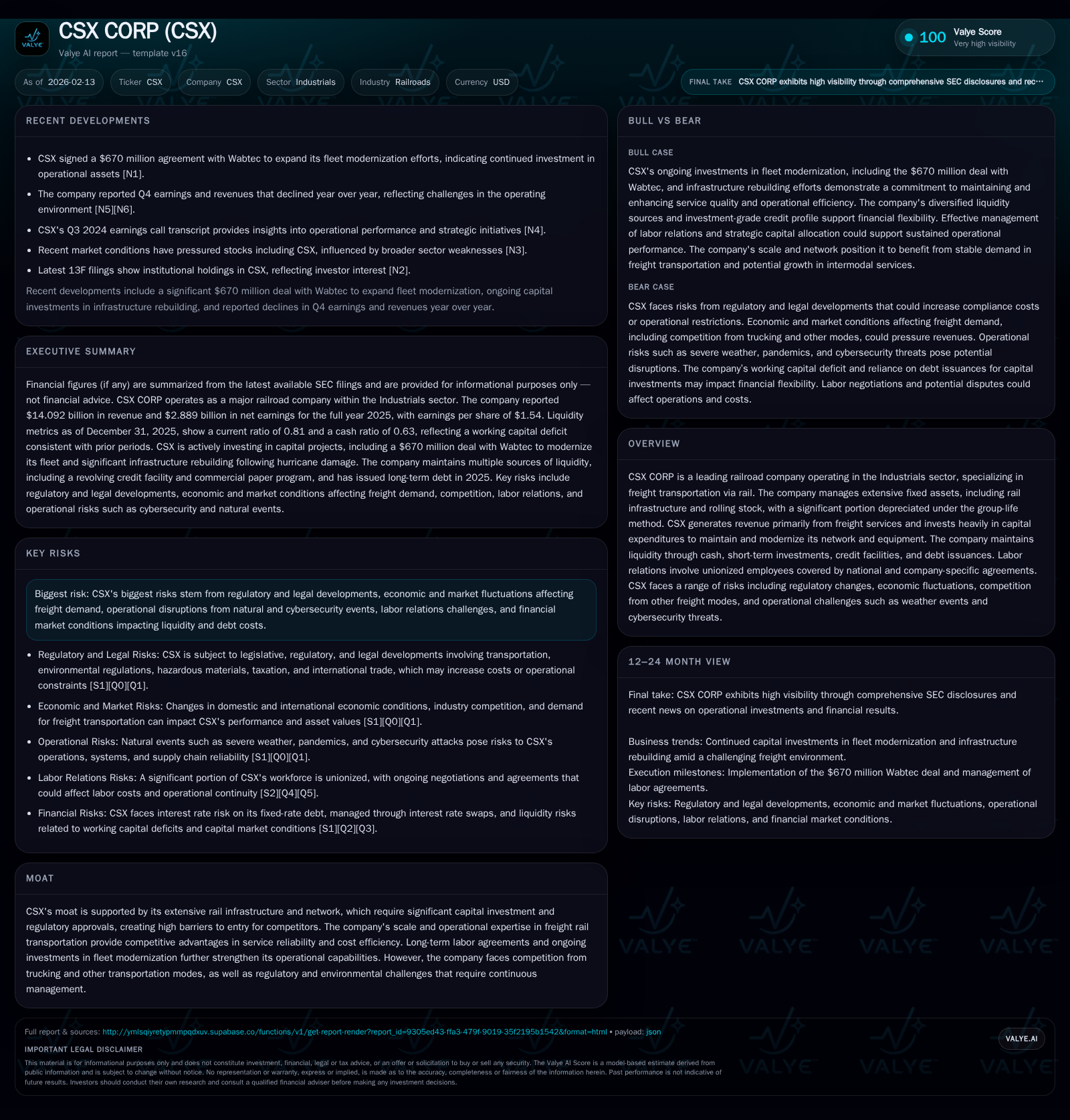
CSX CORP remains anchored by its formidable rail infrastructure, a capital-intensive moat that underpins reliable service and cost advantages in freight transportation. The latest quarterly results reveal pressure on revenues and margins amid softer demand and competitive headwinds, yet management’s commitment to fleet modernization, including a $670 million accord with Wabtec, reaffirms a focus on long-term operational resilience. Liquidity remains adequate with diversified funding sources supporting ongoing capital expenditures and share repurchases. Regulatory complexities around hazardous materials transport and cybersecurity threats add layers of risk, while labor relations maintain relative stability. In facing increasing intermodal competition, CSX’s strategic outlook balances investment in productivity enhancements against a challenging macro environment.
CSX's Competitive Moat: Infrastructure as a Fortress
At the core of CSX's enduring competitive advantage lies its extensive rail infrastructure — a sprawling network whose scale demands massive capital commitments both upfront and ongoing. This network embodies a formidable barrier to entry for potential competitors due to prohibitive costs associated with acquiring rights-of-way, constructing rail lines, and establishing intermodal terminals. The company's significant fixed assets base supports not only operational scale but also service reliability essential to maintaining key customer relationships.
Capital expenditures have traditionally concentrated on sustaining track quality, signal systems, and fleet viability under methods like group-life depreciation [S1]. These investments foster efficiency versus alternative freight modes such as trucking — an industry characterized by lower fixed costs but higher variable expenses. By leveraging this durable asset base, CSX can offer competitive long-haul pricing supported by economies of scale.
Operating efficiencies are further enhanced by the company’s expertise in network optimization that orchestrates train scheduling, terminal operations, and asset utilization. Such capabilities reinforce a moat that rivals cannot easily replicate without incurring multi-year lead times and regulatory hurdles.
Decoding the Latest Earnings: Performance Under Pressure
The most recent Q4 2025 financials presented a challenging picture; revenues declined year-over-year along with compressed profit margins [N2][N3][N4][N5][N7][N8]. Weaker volumes were attributed partly to cyclical softness affecting core commodity sectors like automotive components and intermodal shipments. Management commentary during earnings calls suggested demand headwinds coupled with freight rate pressures exerted downward influence despite some service enhancement initiatives.
Margin contraction was exacerbated by higher costs related to fuel surcharges, inflationary wage pressures, and certain weather-related reconstruction expenses notably at the Blue Ridge subdivision following Hurricane Helene [S2]. Such factors tempered operating leverage typically afforded by fixed overheads inherent in railroad businesses.
This earnings backdrop reveals the tension between macroeconomic sensitivities impacting freight volumes and CSX’s underlying structural strengths enabling it to sustain cash flows even under stress. Investors gleaned mixed messages as share repurchase programs continued albeit at moderated levels reflecting cautious capital deployment amidst uncertainty.
Fleet Modernization: Strategic Capital Deployment
A centerpiece of CSX’s growth strategy is its commitment to fleet renewal — aimed at improving fuel efficiency, reliability, and overall productivity. The recently announced $670 million agreement with Wabtec underscores this strategic priority [N9][S2]. This substantial contract will facilitate upgrading locomotives with advanced technology packages featuring enhanced emissions controls as well as improved diagnostic capabilities enabling predictive maintenance.
Capital expenditure budgets remain consistent at approximately $2.5 billion annually focused on both sustaining infrastructure integrity and enabling profitable growth opportunities through service enhancements [S2]. Balancing these competing demands requires rigorous prioritization; fleet modernization efforts represent an optimum lever since equipment improvements translate into better asset velocity and reduced downtime.
By investing proactively in locomotive technologies aligned with tightening regulatory emission standards and operational data analytics integration, CSX positions itself favorably versus peers who may lag in adopting next-generation efficiencies.
Liquidity and Capital Structure: Navigating Financial Flexibility
As of late 2025, CSX reported $618 million in cash plus access to revolving credit facilities totaling $1.2 billion without outstanding borrowings under that line [S2]. Additionally, a commercial paper program backed by these facilities provides flexible short-term funding capabilities.
The issuance of $600 million in long-term debt during 2025 expanded total liabilities but matched rising property assets driven by capital projects [S2][F1]. Despite a working capital deficit near $455 million primarily reflecting timing dynamics between current liabilities ($3.13B) and current assets ($2.55B), overall liquidity adequacy appears solid given strong operating cash flow generation.
Share repurchase activity remained notable with $1.3 billion used through Q3 2025 alongside dividends totaling $730 million signaling balanced shareholder returns [S2]. Maturity profiles suggest manageable refinancing risk absent sharp interest rate shifts; nevertheless, embedded interest rate swaps hedge exposure related to floating rate debt components emphasizing prudent financial management [S1].
Regulatory Landscape and Risk Management
Navigating an intricate regulatory framework constitutes an ongoing challenge for CSX. Multiple federal agencies govern diverse aspects ranging from economic oversight (Surface Transportation Board) to safety (Federal Railroad Administration), security (Transportation Security Administration), environment (EPA), alongside state regulators [S1].
Legislative developments potentially impacting tariffs or route access could constrain pricing flexibility or restrict market reach. Particularly sensitive are hazardous materials transport regulations mandating high safety standards coupled with increasing scrutiny following high-profile accidents.
Noncompliance risks encompass fines or litigation costs that would strain operational budgets while damaging corporate reputation. Proactive compliance programs aim to mitigate these exposures but increasing legislative complexity heightens monitoring costs. Notably, proposed restrictions on hazardous material transit corridors could lead to longer routes elevating operating expenses [S1].
Operational Challenges: Cybersecurity and Weather Impact
CSX’s dependence on IT systems across operations creates significant vulnerability. Cybersecurity incidents targeting critical infrastructure have risen in sophistication—ranging from ransomware attacks to data breaches jeopardizing safety-critical control systems [S1]. As part of U.S. critical infrastructure, CSX faces elevated threat levels necessitating substantial cybersecurity investments beyond insurance coverage limits.
In parallel, severe weather events have imposed tangible costs—an example being the prolonged reconstruction of the Blue Ridge subdivision after Hurricane Helene which accounted for over $500 million in spending including prior year impact [S2]. Such natural hazards disrupt supply chains causing customer dissatisfaction while inflating maintenance budgets above normalized levels.
These challenges underscore the imperative for resilience planning integrating IT security protocols with physical infrastructure hardening strategies designed to maintain continuity under adverse conditions.
Labor Relations and Workforce Considerations
CSX operates within a heavily unionized labor environment governed by national agreements supplemented by company-specific contracts [S1][S2]. Historically stable relations minimize strike risks but wage inflation pressures remain salient amid strong labor markets nationally.
Retention of qualified staff across operational domains is critical given specialized skill requirements unique to railroading. The company's proactive engagement through collective bargaining aims at balancing cost containment with workforce satisfaction—mitigating operational interruptions associated with disputes or turnover.
Future labor negotiations warrant close monitoring considering industry-wide trends towards automation adoption that could alter job compositions potentially triggering resistance within union ranks.
Market Positioning Amidst Intermodal Competition
While CSX holds significant share in rail freight markets, it confronts robust competition from trucking firms offering flexible point-to-point solutions favored for shorter hauls or expedited deliveries [S1]. This modality threat intensifies especially where highway infrastructure improvements reduce transit times narrowing service gap advantages historically held by railroads.
Furthermore, passenger rail initiatives encroaching on shared tracks or corridors introduce capacity constraints limiting freight throughput potential—a dynamic that could erode volume growth if unaddressed.
Consolidation within trucking also influences pricing dynamics as larger fleets leverage scale economies potentially exerting downward pricing pressure further challenging freight rail margins. Nonetheless, CSX’s scale along key industrial corridors coupled with service reliability buttresses its ability to maintain competitive relevance.
Long-Term Growth Drivers and Strategic Outlook
Looking ahead, sustained investment in fleet modernization aligned with growing regulatory expectations around sustainability forms a central growth axis for CSX [N9][S2][F1]. Embracing technologies enabling cleaner emissions alongside digitally-enabled asset management will likely drive incremental productivity gains supporting profitability amidst fluctuating demand patterns.
Economic sensitivity remains a double-edged sword; recessionary pressures dampen volumes but infrastructure spending or reshoring trends could lift freight requirements over time—introducing cyclical variability necessitating agile operational adjustments.
Moreover, environmental regulation trajectories incentivize modal shifts towards less carbon-intensive options which may favor rail provided performance metrics continue improving relative to highways.
CSX's strategic execution focusing on asset renewal, regulatory compliance robustness, cyber-physical resilience measures alongside sound labor relations poises it well within a complex operating landscape filled with evolving risks yet marked by structural growth opportunities.
This analysis synthesizes publicly available information without providing investment advice or recommendations. Readers should consider official filings and disclosures alongside independent research when assessing company prospects or risks.
Disclaimer: This is research-only, informational analysis and not investment advice. It may include AI-generated interpretation and general industry context. Always verify important details using primary sources.

Comments