
GrafTech International: Navigating Cyclical Headwinds with Vertical Integration Strength
An in-depth look at GrafTech’s operational moat, recent financial challenges, and prospects amid volatile steel industry demand.
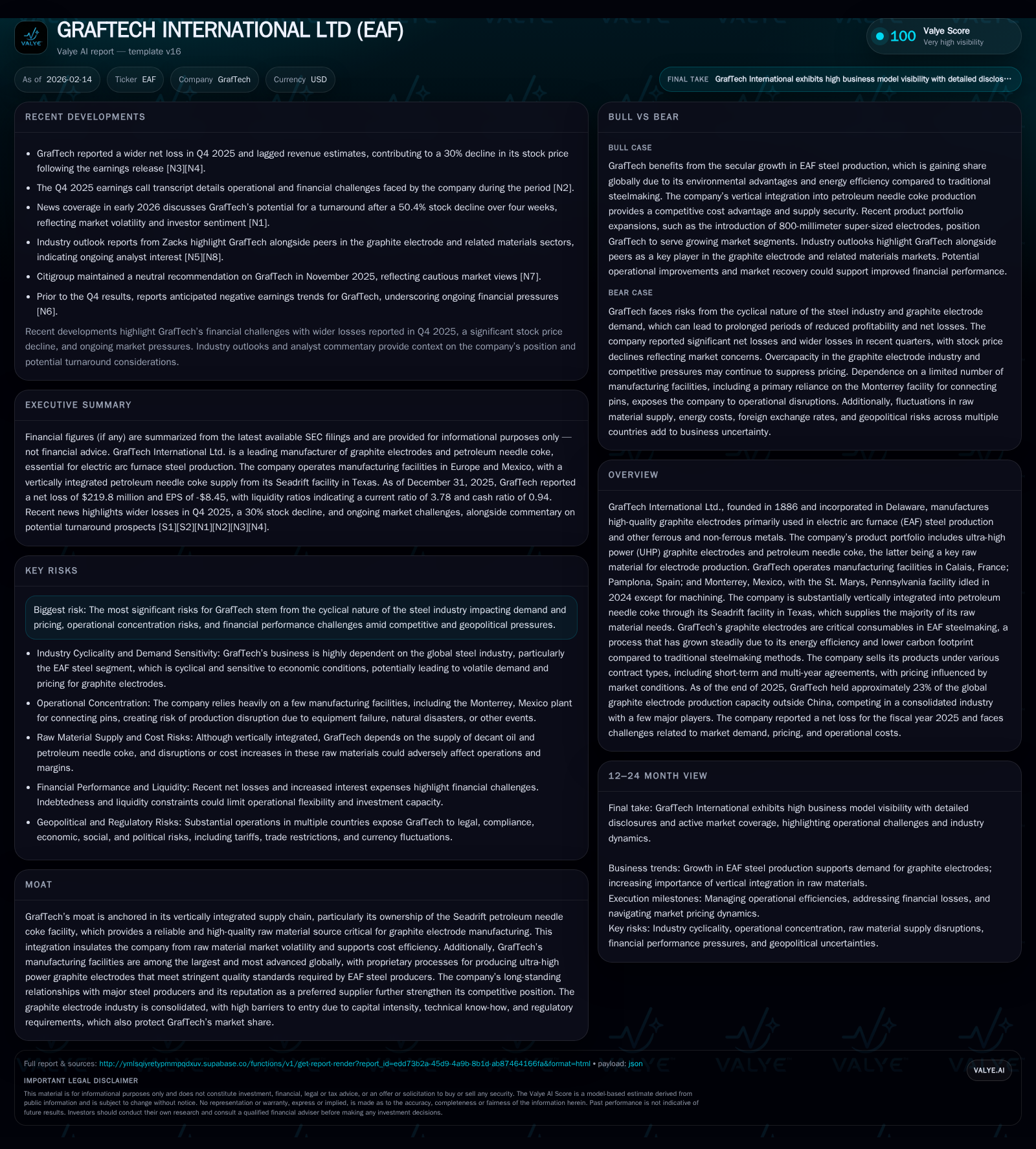
GrafTech International, a dominant global supplier of graphite electrodes, faces earnings pressure from cyclical steel market softness and declining graphite electrode prices. Its distinctive vertical integration through petroleum needle coke production historically underpins cost resilience and supply security amid industry volatility. While Q4 2025 saw a significant net loss reflecting ongoing demand weakness and pricing erosion, the company’s advanced manufacturing footprint and long-standing customer relationships provide strategic advantages. Risks tied to steel-sector cyclicality, pricing volatility, and geopolitical factors loom large. Analyst commentary signals cautious optimism for recovery should market dynamics improve or operational adjustments materialize.
GrafTech’s Operational Backbone: Vertically Integrated Supply Chain
Founded in 1886, GrafTech International stands out as the only large-scale graphite electrode manufacturer with substantial vertical integration into its key raw material—petroleum needle coke—via its Seadrift facility in Texas [S1]. This strategic asset anchors the company’s moat by ensuring a reliable and high-quality needle coke supply that is critical to producing ultra-high power (UHP) graphite electrodes used primarily in electric arc furnace (EAF) steelmaking.
Given that needle coke accounts for a significant portion of electrode raw material costs, GrafTech's internal production shields it from the extreme price volatility often seen in external supply markets. This not only enhances cost stability but also mitigates risks associated with global supply chain disruptions—a notable advantage amid recent challenges faced by commodity suppliers worldwide. The vertically integrated model contrasts with competitors reliant on third-party needle coke sources, often exposed to fluctuating availability and rising input prices.
By controlling the upstream petroleum needle coke operation alongside downstream electrode manufacturing, GrafTech can better align quality standards and production timing—critical factors given the technical complexities of UHP electrode fabrication [S1]. This synergy supports both operational efficiency and customer assurance in stable product performance.
Decoding the Financial Toll: Latest Earnings and What They Reveal
The company reported a staggering net loss of approximately $220 million for Q4 2025 [F1][N2], underscoring the intensity of headwinds faced during this period. The loss surpasses some historical troughs aligned with prior steel industry downturns but remains symptomatic of deep cyclical pressures.
Revenue shortfalls coincide with both subdued volumes in EAF steel production as well as sustained weakness in realized graphite electrode prices, which averaged around $4,100 per metric ton for 2025—significantly down from peaks near $6,200 per metric ton recorded at earlier points [S1][N2]. Additionally, higher fixed costs relative to output exacerbated operating leverage effects.
The Q4 earnings call transcript reveals management articulating cautious positioning amidst soft customer demand from sectors like automotive and construction, which typically amplify economic cycle sensitivity [N1]. Investor reaction has been severe: shares declined roughly 30% following the disclosure [N5].
This financial setback fits into a pattern where traditional EAF-related consumables suppliers experience amplified earnings volatility owing to the industry's capital-intensive nature and sensitivity to steelmaking activity swings.
Market Cyclicality and Steel Industry Dynamics Impacting Demand
EAF steel production—the primary end market for GrafTech’s electrodes—is inherently cyclical due to its dependence on general industrial demand drivers such as infrastructure investment, machinery manufacturing, automotive production, and appliance sectors [S1]. Macroeconomic slowdowns cascade to reduced scrap availability or diminished new steel orders, curtailing furnace operation rates.
Following surges driven by favorable energy costs and environmental regulations prompting shifts from blast furnace to EAF technologies globally, recent years have seen moderation amid trade tensions and softening of construction activity in major markets [S1]. These factors compress electrode consumption volumes.
Furthermore, while EAF furnaces consume less energy per ton compared with traditional methods — underpinning growth incentives — their usage still closely tracks overall economic health. Consequently, cyclical downturns propagate demand shocks for consumables like graphite electrodes faster than some longer-lived capital equipment segments.
The Pricing Paradox: Graphite Electrode Price Trends Versus Raw Material Costs
Graphite electrode pricing dynamics over the past decade reflect pronounced boom-and-bust cycles. After record highs near 2018 due to needle coke constraints combined with global rationalization of electrode capacity, spot prices have declined steadily since early 2023 amid easing market tightness [S1][N2]. As of year-end 2025 spot prices hovered near $4,100/MT on average—down sharply from previous highs.
This price retreat coincides with persistent industry overcapacity conditions that continue to pressure margins despite reduced production levels globally [S1]. At the same time, needle coke supply conditions have improved moderately but remain a cost-sensitive factor given their share of total electrode manufacturing expenses.
The interlinked nature means that even marginal increases in needle coke prices can significantly compress spreads if electrode prices do not keep pace. Such margin squeeze complicates efforts by companies like GrafTech to sustain profitability without risking volume losses through aggressive price hikes that customers may resist [S1][N6].
Manufacturing Footprint and Capacity Strategy
GrafTech currently operates major manufacturing facilities located in Calais (France), Pamplona (Spain), and Monterrey (Mexico), collectively offering approximately 178 thousand metric tons (MT) of annual graphite electrode capacity [S1]. The scaling across multiple continents supports logistical flexibility catering to global EAF producers.
The idling of the St. Marys plant (Pennsylvania) except for machining functions since 2024 signals a strategic response to moderated demand levels through prudent capacity rationalization. Such moves help manage fixed costs below breakeven utilization levels.
This footprint optimizes proximity to key customers while concentrating advanced UHP electrode processes at modernized sites well positioned technologically [S1]. Balancing capacity utilization against cyclical fluctuations remains an operational challenge but is necessary given large capital intensity involved in graphite electrode fabrication.
Moat in Focus: Proprietary Processes and Customer Relationships
GrafTech’s competitive advantage flows beyond vertical integration into specialized manufacturing processes that yield ultra-high power electrodes meeting stringent electrical conductivity and durability requirements critical for efficient EAF operations [S1].
Producing electrodes up to 800 mm diameter with weights exceeding several metric tons involves proprietary technology encompassing precise material blending—including high-grade petroleum needle coke—and advanced firing techniques ensuring product consistency under extreme heat loads.
These capabilities narrow entry barriers because they require intricate know-how coupled with scale economies—factors binding major steel producers who rely on continuous supply reliability to maintain furnace uptime. This dynamic has cultivated long-term contracts and preferred supplier status across global mini-mill operators central to modern EAF proliferation [S1].
Such built-in customer loyalty forms a vital pillar supporting resilience amid shifting market conditions.
Risks Ahead: Industry, Operational, and Competitive Threats
GrafTech faces pronounced risks primarily stemming from its concentrated exposure within the cyclical global steel sector heavily dependent on EAF growth trends [S1]. Sharp downturns in demand can swiftly erode sales volume and price realizations simultaneously—as witnessed recently—challenging margin sustainability.
Industry-wide overcapacity exacerbates these pressures by fueling price competition. Moreover, any inability to pass increasing input costs such as those related to petroleum needle coke would further compress profitability margins.
Operational risks include reliance on a limited number of manufacturing sites focused around Europe and Mexico plus the single vertical integration asset at Seadrift exposing the company to regional disruptions or regulatory changes.
Geopolitical uncertainties affecting raw material sourcing or transport logistics could induce cost shocks or supply interruptions complicating planning horizons. Concentration risks also arise since major end customers belong principally to automotive or construction sectors sensitive to economic cycles [S1].
Lastly, technological innovation or alternative materials emerging could disrupt existing demand patterns although no imminent substitutes currently exist at commercial scale given unique graphite properties required.
Pathways to Recovery: Analyst Perspectives and Turnaround Potential
Despite recent setbacks characterized by a >50% share price decline over four weeks early this year [N4], some analyst views suggest plausible recovery scenarios anchored on normalizing global EAF steel production coupled with structural supply discipline reducing overcapacity.[N6] Enhanced operational efficiencies through continued facility modernization or further rationalization may also restore margin profiles gradually.
Potential price stabilization bolstered by upward needle coke cost pass-through negotiations represents another lever supporting earnings rebounds if market conditions allow selective price increases without significant volume losses.[N4]
Nevertheless, analysts advise caution given persistent macroeconomic uncertainties affecting core end markets plus unresolved competitive challenges.[N6] Near-term improvements require sustained improvements in order intake from key industries whereas longer-term success will depend on maintaining technological leadership combined with supply chain robustness afforded by GrafTech’s unique integration model.
Disclaimer: This analysis is for informational purposes only based on publicly available information as of February 14, 2026. It does not constitute investment advice or recommendations regarding GrafTech International Ltd. Investors should conduct their own due diligence before making any decisions.
Disclaimer: This is research-only, informational analysis and not investment advice. It may include AI-generated interpretation and general industry context. Always verify important details using primary sources.

Comments