
DraftKings at a Crossroads: Evaluating Growth Amid Market and Regulatory Headwinds
DraftKings faced investor pushback after Q4 2025 earnings and 2026 revenue outlook misses, raising questions about its growth sustainability in a dynamic regulatory environment.
Following a sharp decline in share price triggered by a Q4 earnings and revenue shortfall, DraftKings finds itself confronting significant market skepticism regarding its ability to sustain growth amid intensifying competition and complex regulatory challenges. Despite reporting positive net income and improved adjusted EBITDA in 2025, the company missed top-line expectations, stirring debate on the durability of its technological moat and user engagement strategies. Navigating a fragmented U.S. regulatory landscape and evolving consumer behavior will be critical as DraftKings pushes forward with jurisdictional expansion and product innovation while managing profitability pressures.
Market Reaction and Immediate Investor Sentiment
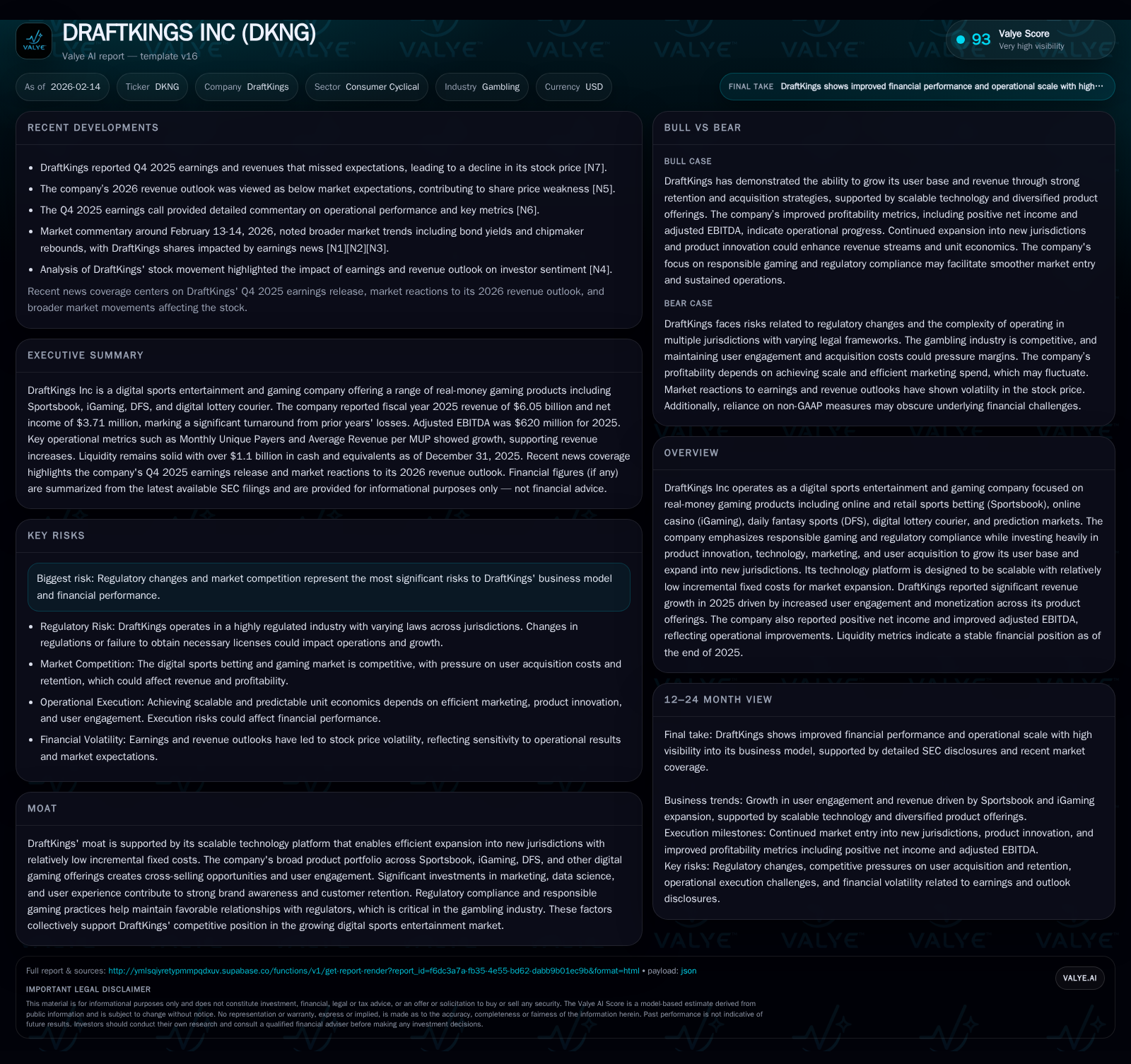
DraftKings entered early February 2026 facing a stark negative market response following its Q4 2025 earnings announcement. The company’s reported revenue and forward guidance for 2026 came in below expectations, triggering a swift selloff that underscored investor skepticism about the sustainability of previously rapid growth trajectories [N1, N3, N9]. Headlines captured this shift succinctly – "DraftKings Falls After 2026 Revenue Outlook Misses Expectations" [N1] typified the tone dominating trading desks. The share price dip was notable not only for its magnitude but for revealing cracks in confidence amid broader tech sector volatility driven by macroeconomic concerns such as interest rate adjustments and AI adoption anxieties affecting tech/media stocks generally [N7, N8]. This convergence of external sentiment and internal performance shortfalls set the stage for nuanced scrutiny: Can DraftKings maintain momentum in an increasingly crowded digital entertainment landscape compounded by thorny regulatory environments?
Unpacking Q4 2025 Earnings: Revenue, Profitability, and User Engagement
The quarterly financials revealed a mixed picture. DraftKings posted positive net income of approximately $3.7 million for full-year 2025—a milestone following years of losses—and improved adjusted EBITDA margins hinting at operational leverage materializing with scale [F1]. Yet revenues came underwhelming relative to analyst models, with the top line below estimates amid slower-than-expected user monetization or engagement lifts [N2, N4, N5]. The disconnect between profitability signs and revenue shortfalls invites deeper examination. Management commentary indicated that while user base growth continues, recent headwinds such as promotional cost increases or retention dynamics tempered revenue acceleration. Importantly, underlying trends in active users across Sportsbook, iGaming, DFS segments provided some offsetting confidence; enhanced product offerings fostered stickiness even if monetization lagged slightly behind projections.
The Moat Under Pressure: Technology, Cross-Selling, and Competitive Landscape
DraftKings has long touted its scalable technology platform enabling swift market entry at relatively low incremental fixed costs—a decisive advantage facilitating multi-state launches [valye_report_excerpt.moat]. Its diversified product suite spanning Sportsbook betting to daily fantasy sports enriches cross-selling capabilities that drive user engagement depth. Significant investments in data science sharpen personalized offers supporting retention and brand resonance. However, competition is intensifying not only from direct digital rivals but also from broad entertainment substitutes competing for consumer time wallets—including streaming services and traditional sports viewing experiences [S1]. The company’s moat must endure not merely technological prowess but adaptivity to shifting consumer preferences for real-money gaming vis-à-vis expanding entertainment options. Moreover, increasing marketing spend necessary for sustained customer acquisition pressures financial efficiency.
Regulatory Winds: Navigating Risks and Compliance Challenges
Regulatory complexity remains an existential variable shaping DraftKings’ operating model. The U.S. sports betting market is inherently fragmented by state-level legislation requiring individual licenses often contingent on partnerships with local casinos or tribal entities [S1]. This patchwork regulatory fabric imposes compliance burdens along with uncertainty concerning pace of legalization or changes to tax regimes that may impact profitability. DraftKings invests heavily in managing these relationships and ensuring adherence to evolving rules designed to reinforce responsible gaming—a critical component preserving regulator goodwill crucial for license renewals or expansions [valye_report_excerpt.risks]. Yet given ongoing legislative flux nationally (and potential international complications), forecasting growth from jurisdictional expansion carries inherent risk.
Scalability and Profitability: Analyzing Unit Economics and Margin Trends
Central to DraftKings’ thesis is its scalable technology setup enabling deployment across new states with limited fixed cost step-ups—variable expenses mainly tied to marketing and support functions driving initial user acquisition efforts [valye_report_excerpt.overview]. The company targets replicable state-level unit economics through maturation of markets whereby contribution margins improve as user bases grow beyond critical mass reducing incremental marketing intensity per user acquired. Early-stage jurisdictions exert margin pressure due to promotional expenses heavy on front-loaded customer incentives required to build “skin-in-the-game” loyalty in competitive markets. Over time though management anticipates consolidation of revenue streams alongside slower cost increases sustained by technology scalability improvements fostering margin expansion trajectory.
Growth Strategies: Expansion into New Jurisdictions and Product Innovation
The growth playbook hinges on capturing newly legalized markets promptly supported by aggressive marketing campaigns designed to reach users keen on real-money sports betting or iGaming experiences [valye_report_excerpt.overview]. Simultaneously DraftKings channels resources into product innovation—launching features aimed at enhancing engagement frequency such as personalized bets or augmented reality experiences within fantasy sports dimensions—leveraging its data analytics capabilities for deeper merchandising effectiveness [S1]. Initial quarter losses by design reflect significant upfront investment weighting towards establishing first-mover advantage or critical market mass which can later translate into organic retention-driven growth.
Liquidity and Financial Health: Assessing Balance Sheet Strength
As of end-2025 balance sheet snapshots indicate liquidity is sound albeit tight relative to ongoing investment needs: cash & equivalents stand at roughly $1.13 billion against current liabilities around $1.76 billion yielding a current ratio of ~1.03—a narrow buffer suggesting careful working capital management will remain necessary as expansion efforts continue [F1]. The company reports stable financing conditions overall but must prudently allocate resources balancing capital deployment for marketing/user acquisition against operational cash flows awaiting realization.
Risk Factors in Focus: Competition, Consumer Behavior, and Legal Uncertainties
DraftKings confronts an array of material risks detailed extensively within SEC filings underscoring their potential magnitude:
- Intense competition both from established casino operators digitally investing aggressively plus emerging entrants stretching innovation boundaries.
- Consumer discretionary spending shifts impacting gaming budgets amid economic cycles could dampen demand unexpectedly.
- Dependence on third-party platforms (Apple/Google) for app distribution exposes risks if policies change limiting access or advertising reach.
- Cybersecurity threats remain salient given substantial personal data custody; breaches could impair reputation leading to user attrition.
- Reliance on casino/tribal partners presents counterparty risk complicating jurisdictional expansions.
- Regulatory landscape unpredictability especially concerning taxation changes or slowed legalization progression may stymie growth plans. Collectively these underscore the business sensitivity to multiple exogenous factors necessitating robust risk mitigation frameworks aligned with compliance commitments [S1, valye_report_excerpt.risks].
Valuation Considerations: Weighing Growth Potential Against Emerging Risks
Post-earnings market reaction reflects the challenge pricing presents when layering operational progress against uncertain top-line dynamics plus regulatory complexity [N1, N3]. Investors must triangulate between DraftKings’ evident technological capability gains and solidification of its brand against evolving macro risks including competitive pressures diminishing pricing power or consumer engagement intensity. Liquidity positioning allows runway for strategic initiatives but underscores necessity for sustainable profitability improvements beyond early-stage market subsidies [F1]. While the path towards replicable unit economics holds appeal structurally—the timing around maturation per jurisdiction remains elusive amid legislative uncertainties potentially affecting valuation premia assigned by market participants sensitive to execution timing gaps.
This analysis is intended solely to provide a comprehensive overview grounded in current public disclosures without offering any investment advice or recommendations. Readers should conduct independent due diligence considering their specific informational needs before forming judgments about DraftKings Inc.
Disclaimer: This is research-only, informational analysis and not investment advice. It may include AI-generated interpretation and general industry context. Always verify important details using primary sources.

Comments