
Bread Financial Holdings: Fortifying Capital, Compliance, and Operational Resilience in Credit Services
A comprehensive analysis of Bread Financial’s capital strength, regulatory navigation, and risk management as it adapts to evolving credit industry dynamics.
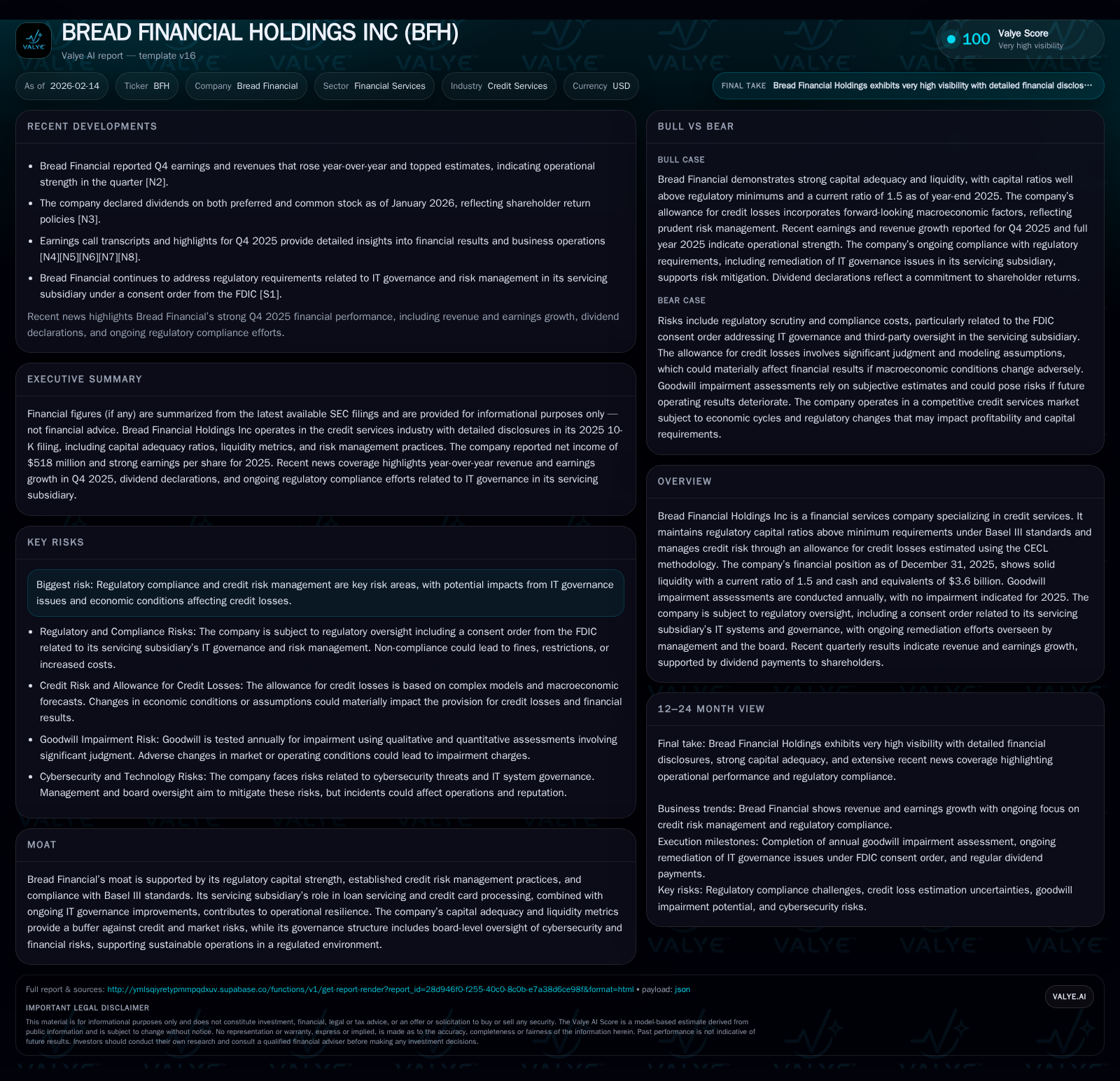
Bread Financial Holdings maintains a resilient capital foundation under Basel III standards, supporting disciplined credit growth while navigating regulatory scrutiny. The company’s recent earnings demonstrate robust revenue expansion alongside prudent credit risk management via CECL provisions and a strong liquidity profile. Ongoing remediation related to its servicing subsidiary’s IT governance reflects vigilance in operational controls. Board-level focus on cybersecurity and risk oversight fortify its governance framework amid marketplace pressures from peers and macroeconomic uncertainties.
Navigating the Capital Strength: Basel III Compliance as a Competitive Moat
Bread Financial Holdings (NYSE: BFH) anchors its competitive position on a robust capital structure that comfortably surpasses Basel III regulatory mandates. As of December 31, 2025, the company reported a Common Equity Tier 1 (CET1) capital ratio of 13.0%, well above the minimum requirement of 4.5% [S1]. Similarly, the Tier 1 capital ratio at 13.4% doubles the baseline regulatory floor of 6%. These metrics extend beyond compliance thresholds, forming a critical moat that bolsters risk tolerance in underwriting credit products.
This elevated capitalization underpins Bread Financial's capacity to absorb economic shocks without compromising lending appetite or liquidity management. By maintaining Total Risk-Based Capital at 16.8%—more than twice the mandated 8%—the firm demonstrates conservative risk-weighted asset exposure control, crucial for cyclical resilience in financial services. Such prudence is not merely regulatory formality but strategically fortifies Bread Financial's ability to pursue measured growth opportunities while weathering adverse macroeconomic swings [valye_report_excerpt.moat][F1][S1].
Earnings Performance Under the Microscope: Decoding Q4 2025 Surprises and Trends
In the latest reported quarter ending December 2025, Bread Financial delivered revenue and net income beats relative to consensus forecasts [N2][N3]. Total revenues rose year-over-year, reflecting increased penetration in consumer credit services and sustained loan servicing volumes. Key earnings call discussions highlighted disciplined expense management balanced against strategic investments driving customer engagement enhancements [N4][N8].
Beneath headline figures lies a nuanced story of quality growth: rising average loan balances combined with stable credit spreads augmented top-line gains while provisions for credit losses remained prudent under evolving CECL guidelines. Margins benefited from operating leverage as variable costs were contained relative to revenue expansion [N5][N7]. The sustainability of these trends will likely depend on continued economic stability and effective risk mitigation within lending portfolios.
Regulatory Oversight and Governance: Consent Orders and IT System Remediation
Bread Financial's servicing subsidiary is currently subject to a regulatory consent order addressing identified deficiencies in its information technology systems and governance frameworks [valye_report_excerpt.overview][S1 Item1 Business supervision]. This intervention underscores persistent challenges in aligning complex servicing infrastructures with stringent regulatory expectations.
Management has publicly committed to comprehensive remediation efforts encompassing system upgrades, enhanced controls, and improved data integrity protocols. Oversight responsibility rests with both executive leadership and Board committees tasked with monitoring progress against milestones. While no immediate impairment issues have been flagged from goodwill assessments related to these efforts, prolonged remediation could impact operational agility or attract further supervisory scrutiny if benchmarks are unmet.
Cybersecurity at the Forefront: Board-Level Risk Management & Leadership Profiles
Cybersecurity has emerged as a central pillar in Bread Financial’s enterprise risk architecture, recognized explicitly by the Board’s delegation of oversight duties to its Risk & Technology Committee [S1 Cybersecurity Governance section]. Regular reporting channels ensure that senior executives remain apprised of threat landscapes, incident responses, and mitigation effectiveness.
The Chief Information Security Officer (CISO), reporting directly to the Executive Vice President and Chief Technology Officer, brings over 25 years of cross-industry security experience—including highly regulated sectors—which bolsters the firm's defensive capabilities. Complementary roles such as the Chief Risk Officer (CRO) and Chief Operational Risk Officer (CORO) provide layered challenge functions ensuring cybersecurity strategies align tightly with financial risk objectives.
Such concentrated expertise at governance levels serves as a bulwark against emerging IT risks which are particularly salient given ongoing remediation needs within BFH’s servicing ecosystem.
Liquidity Cushion and Credit Risk Provisions: The CECL Methodology Advantage
Financial flexibility remains strong at BFH with a current ratio of approximately 1.5 as of year-end 2025, supported by $3.6 billion in cash and liquid equivalents [valye_report_excerpt.overview][F1]. This liquidity buffer acts as an essential safeguard amid episodic market volatility or transient funding disruptions common in credit service operations.
Proactive credit loss provisioning via the Current Expected Credit Loss (CECL) methodology enables more forward-looking allowances reflective of macroeconomic signals rather than solely historical loss experience. This nuanced approach enhances prudential management by potentially smoothing earnings volatility linked to credit events while preserving capital adequacy [valye_report_excerpt.moat].
Market Positioning Amid Industry Peers: Bread Financial’s Strategic Differentiators
Within an industry dominated by large-scale players such as American Express [N13], Bread Financial carves out differentiation through its bundled loan servicing capabilities combined with resilient credit card processing operations embedded within Comenity Bank subsidiaries.
Capital strength affords BFH latitude not just for regulatory compliance but also strategic responsiveness—a competitive edge when peers face tighter constraints or recalibrate portfolios under economic pressure [valye_report_excerpt.moat]. Moreover, ongoing investments in governance infrastructure signal commitment towards sustainable operational excellence setting BFH apart in execution reliability.
Risks on the Horizon: IT Governance Challenges and Macro Credit Pressures
While strides have been made to resolve IT governance shortfalls evidenced by the consent order, uncertainties remain around timelines for complete remediation and resultant reputational exposures [valye_report_excerpt.risks][S1 Risk Factors Cybersecurity sections]. Missed benchmarks could invite escalated regulatory intervention or impair customer trust.
Macro level economic variables also pose persistent threats; shifting conditions could exacerbate credit losses beyond CECL forecasts impacting earnings stability. The intersection between technology vulnerabilities and cyclical credit risks underscores complex risk interdependencies requiring vigilant oversight going forward.
Investor Returns and Dividend Policy: Signaling Confidence in Stability
Bread Financial’s consistent dividend distributions align with its narrative of judicious capital deployment amidst cautious optimism about future cash flows [valye_report_excerpt.overview][N6]. Dividends function as tangible tokens reinforcing shareholder confidence even as the company navigates sector headwinds.
The company’s approach suggests that stable investor returns are integral not only for attracting long-term capital but also as feedback mechanisms endorsing management’s stewardship priorities under uncertain economic cycles.
Looking Forward: Prospects for Growth, Compliance, and Operational Resilience
Synthesizing available data points reveals that Bread Financial Holdings stands fortified through exemplary capital sufficiency and sophisticated credit risk frameworks adaptive to current market realities [valye_report_excerpt.overview][N12][N14]. While operational challenges persist—particularly on IT governance fronts—the firm demonstrates transparent remediation efforts backed by informed board oversight.
Growth prospects hinge on sustaining underlying portfolio quality while leveraging technology enhancements fostered during remediation phases. This balancing act will be pivotal amidst intensifying competition and heightened regulatory vigilance shaping the credit services landscape.
Disclaimer: This analysis is provided for informational purposes only. It does not constitute investment advice or recommendations to buy or sell any securities. Readers should conduct their own research or consult professional advisors before making any investment decisions.
Disclaimer: This is research-only, informational analysis and not investment advice. It may include AI-generated interpretation and general industry context. Always verify important details using primary sources.

Comments