
CVRx, Inc.: Pioneering Neuromodulation Therapy for HFrEF Amidst Growth and Financial Challenges
CVRx is advancing Barostim therapy to address key gaps in heart failure treatment through innovative neuromodulation, navigating clinical, commercial, and financial dynamics.
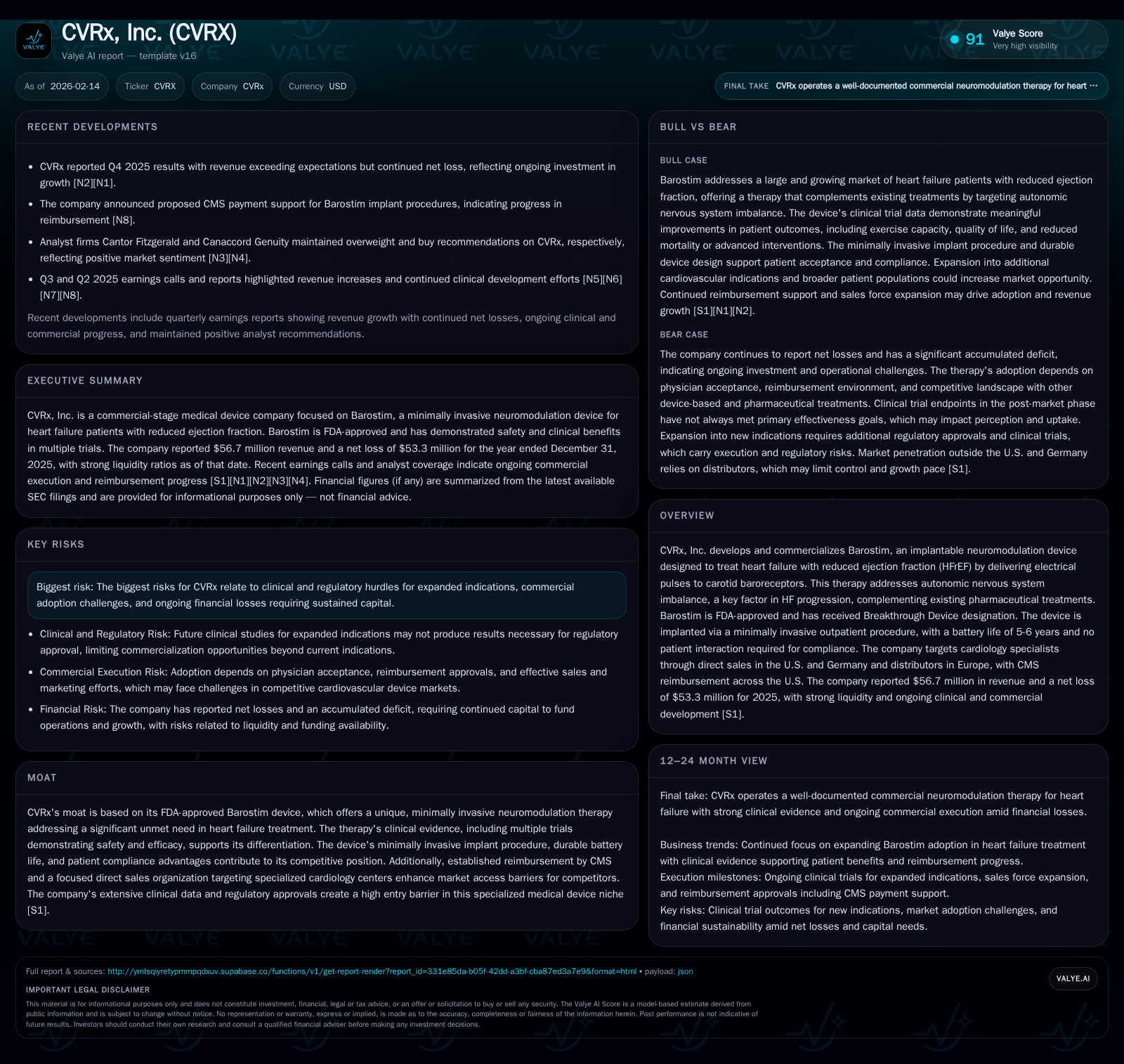
Heart failure remains a formidable cardiovascular challenge with high morbidity and mortality, especially for patients with reduced ejection fraction (HFrEF). CVRx’s FDA-approved Barostim device offers a novel approach by modulating autonomic nervous system imbalance via carotid baroreceptor stimulation, providing an alternative to existing therapies. Despite promising clinical validation and expanding commercial footprint generating $56.7 million revenue in 2025, the company faces ongoing losses and must manage regulatory and adoption hurdles to scale effectively. Its substantial liquidity positions it to pursue future growth opportunities while mitigating near-term risks.
Heart Failure’s Unmet Needs: The Clinical Challenge CVRx Targets
Heart failure (HF) casts a long shadow over cardiovascular medicine due to its vast prevalence and grim prognosis. An estimated 64 million individuals worldwide grapple with HF, including roughly 6.7 million in the United States alone [S1]. Among these patients, those suffering from heart failure with reduced ejection fraction (HFrEF), who comprise approximately 31% of the HF population, face significant mortality—about 75% succumb within five years following hospitalization for HFrEF [S1].
HFrEF is characterized by impaired contractility of the left ventricle leading to insufficient blood ejection to meet systemic demands. Patients endure debilitating symptoms such as extreme fatigue, breathlessness, swelling, and exercise intolerance that profoundly impair quality of life [S1]. Existing guideline-directed medical therapies (GDMT) predominantly focus on neurohormonal blockade but only partially address underlying pathophysiology. For patients who progress beyond pharmaceutical management, invasive devices or heart transplantation represent expensive, invasive last resorts [S1].
This backdrop underscores the critical need for innovative treatments that intervene earlier in the disease cascade with new mechanisms. CVRx has targeted this exact void with its Barostim device.
Barostim Therapy: Science, Innovation, and FDA Recognition
CVRx’s Barostim system introduces a breakthrough modality leveraging neuromodulation—a therapeutic frontier that modulates dysfunction at the level of the autonomic nervous system (ANS). The device electrically stimulates baroreceptors nestled within the carotid artery walls. These baroreceptors serve as sensors regulating cardiovascular autonomic tone [S1].
In heart failure patients, diminished baroreceptor signaling disrupts ANS balance leading to excessive sympathetic activation and maladaptive neurohormone release driving disease progression [S1]. Barostim counters this imbalance by restoring baroreflex activation therapy (BAT), effectively re-tuning autonomic outflow toward more physiological levels.
Importantly, Barostim serves as a complement—not replacement—for GDMT neurohormonal agents by engaging distinct therapeutic pathways. The device’s design favors a minimally invasive outpatient implantation procedure distinct from other implantables that often require entry into cardiac chambers or complex surgical settings [S1]. Once implanted, patients require no battery charging or active compliance management; the built-in battery lasts approximately five to six years before needing replacement [S1].
These features underpin Barostim’s differentiation. The FDA’s granting of both Breakthrough Device designation and subsequent full approval further validates its innovative profile and clinical potential [S1].
Clinical Evidence Underpinning CVRx’s Competitive Edge
Barostim’s clinical foundation includes multiple trials substantiating its safety profile and effectiveness in improving HF symptoms [S1]. Outcome measures demonstrated improvements in patient functional status alongside favorable biomarker changes linked to disease modulation.
Compared with other implantable cardiac devices used in HF—such as defibrillators or ventricular assist devices—Barostim uniquely addresses ANS dysfunction rather than direct mechanical or electrical cardiac intervention [S1]. This mechanistic novelty presents barriers to competition given the complexity of developing similarly targeted neuromodulatory therapies with demonstrated efficacy.
The accumulated clinical data thus provide a robust evidentiary moat supporting sustained commercial differentiation.
Commercial Footprint: Market Access and Sales Strategy Analysis
Commercially, CVRx has concentrated efforts on penetrating specialized cardiology segments where patient profiles align closely with Barostim's indication criteria [S1]. In the United States and Germany—a core early market—the company utilizes direct sales teams targeting electrophysiologists and heart failure specialists known to embrace innovative treatments [S1,N2]. Elsewhere across Europe, distribution partners augment regional reach for market expansion.
A critical enabler is Centers for Medicare & Medicaid Services (CMS) reimbursement throughout the U.S., which mitigates economic barriers for hospitals and physicians adopting Barostim therapy [S1]. This coverage catalyzes demand by aligning payer incentives with clinical innovation uptake.
Financially, CVRx achieved $56.7 million in revenue during fiscal year 2025 while outpacing consensus estimates despite ongoing net losses [F1,N2]. This revenue level signals meaningful commercial momentum though still reflects early-stage adoption versus peak market potential.
Financial Performance and Capital Dynamics in 2025
The company reported a net loss of $53.3 million in 2025 amid investment-heavy commercialization and continued R&D activities supporting expanded indications [F1]. Despite these operating losses reflective of growth-phase realities common in med-tech innovators pursuing pioneering fields, CVRx maintains a healthy liquidity position with cash & equivalents totaling approximately $75.7 million as of year-end 2025 [F1]. This liquidity affords operational runway sufficient for near-term strategic execution.
Recent earnings call commentary highlighted management's balanced approach prioritizing revenue growth while carefully managing cash burn rates consistent with scaling ambitions [N1]. Execution discipline will remain key given the capital-intensive nature of broader clinical trials and expanded commercial deployment.
Risks on the Horizon: Regulatory, Adoption, and Financial Considerations
Several risk vectors warrant close attention. Clinically, obtaining expanded regulatory approvals beyond current HF populations demands additional rigorous trials that carry timeline and outcome uncertainty [S1]. Clinician adoption may encounter inertia given entrenched treatment paradigms; convincing physicians to integrate novel neuromodulatory therapy requires persistent education efforts.
Financially, continued net losses necessitate access to capital markets to fund growth investments absent sustained positive cash flow generation [S1]. Economic conditions impacting funding availability could influence strategic flexibility. The combination of regulatory hurdles, physician adoption challenges, and funding needs defines a multifaceted risk landscape.
Outlook: Scaling Barostim and Potential Future Indications
Looking ahead, CVRx aims to deepen penetration within the sizeable $10.5 billion U.S. HFrEF prevalence market opportunity identified via epidemiological modeling [S1]. Expansion into related cardiovascular domains influenced by autonomic imbalance—such as hypertension or arrhythmias—or comorbidities like chronic kidney disease represent plausible extensions leveraging its neuromodulation platform expertise.
Management commentary intimates ongoing pipeline initiatives focused on broadening indications alongside refining cost-effectiveness through streamlined procedures or enhanced device durability [N1]. A calibrated balance between cautious optimism over transformative technology adoption versus realistic acknowledgment of near-term developmental complexity frames expectations.
Disclaimer: This analysis is intended solely for informational purposes reflecting known data as of February 2026 without any recommendation regarding securities transactions.
Disclaimer: This is research-only, informational analysis and not investment advice. It may include AI-generated interpretation and general industry context. Always verify important details using primary sources.

Comments