
Vishay Intertechnology 2025 Analysis: Resilience, Innovation, and Navigating Risks Post Earnings Miss
A comprehensive examination of Vishay Intertechnology's financial robustness, product advances, and risk exposures amid a challenging fiscal year.
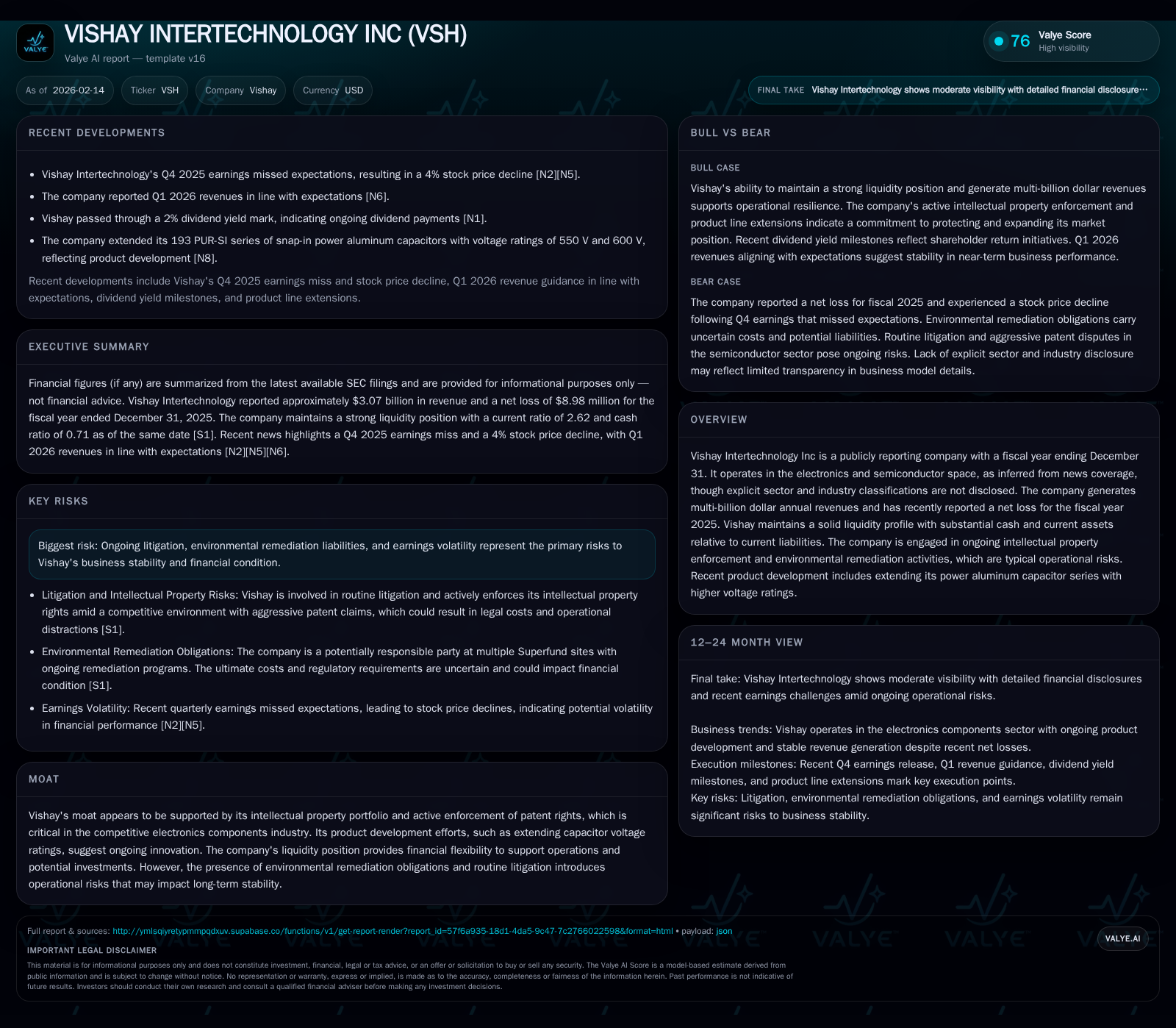
Vishay Intertechnology’s Q4 2025 earnings shortfall startled markets but belied its underlying financial strength, with $515 million in cash and a strong 2.62 current ratio cushioning operational turbulence. The company continues to advance its product lineup, notably extending its power aluminum capacitor series to higher voltage ratings, signaling sustained innovation in competitive semiconductor components. Its moat remains anchored in an active intellectual property defense strategy, though ongoing litigation risks and environmental remediation obligations persist as key operational challenges. Dividend yield enhancements have sparked investor interest as Vishay navigates toward cautious stability and potential growth in 2026.
Stock Performance and Earnings Shock: Dissecting the Q4 2025 Miss
Vishay Intertechnology’s fourth quarter of fiscal year 2025 came in below Wall Street expectations, marking a notable earnings miss that spurred an immediate share price dip of approximately 4% [N1]. According to the February earnings call transcript [N2], management attributed margin compression largely to heightened input costs and softer end-market demand across certain segments. Revenues reached $3.07 billion for the full year but were accompanied by a net loss of nearly $9 million [F1], reflecting episodic pressures on profitability.
Market reaction was swift; analysts voiced concerns over cyclical semiconductor demand softness while acknowledging the company’s resilience elsewhere [N3]. The mix of top-line stagnation combined with squeezed margins created palpable near-term uncertainty around Vishay’s growth trajectory.
Financial Fortitude: Liquidity and Balance Sheet Strength in Focus
Despite earnings volatility, Vishay boasts a solid balance sheet underpinning its continued operations through turbulent cycles. At year-end 2025, cash and cash equivalents stood at $515 million against current liabilities of roughly $720 million, resulting in a healthy current ratio of 2.62 [F1]. This liquidity cushion offers critical breathing room amid the loss-making year.
Their overall current assets tally nearly $1.89 billion compared to liabilities nearing $720 million [F1], indicating short-term financial obligations are well-covered without stressing working capital. Such robustness is notably advantageous given the semiconductor components sector’s inherent exposure to cyclical downturns and supply chain uncertainty [analysis].
Innovation in Power Components: Extending the 193 PUR-SI Capacitor Series
Technological relevance remains alive through Vishay’s product pipeline developments. A January announcement highlighted the extension of its flagship snap-in power aluminum capacitors under the 193 PUR-SI series introducing voltage ratings of up to 600 V [N9]. This feat boosts their portfolio where high-voltage reliability is essential for industrial and automotive applications.
Increasing voltage thresholds expands utility scope against competitive offerings — an important differentiator as end markets demand more resilient capacitors capable of handling escalating power densities. Such incremental innovation underscores Vishay’s commitment to sustaining technological leadership even amidst broader industry headwinds.
Intellectual Property as a Competitive Shield
Core to Vishay’s moat is an active intellectual property program that combines patent generation with diligent enforcement efforts [valye_report_excerpt]. Maintaining proprietary advantages provides a hard-to-replicate barrier especially in electronics components where marginal innovation can command significant pricing power.
The company’s recurring emphasis on enforcing IP rights serves not only as a revenue protectant but also signals to competitors the costliness of infringement attempts — creating both legal deterrents and revenue upside via licensing opportunities or settlements.
Navigating Litigation and Environmental Challenges
However, risks persist outside market fluctuations and innovation hurdles. Vishay faces ongoing litigation related both to intellectual property disputes and broader commercial claims alongside environmental remediation responsibilities [valye_report_excerpt]. Such factors represent operational risk vectors that may siphon resources or disrupt focus if intensified.
The most recent annual report filing reiterates these challenges as material ongoing concerns affecting financial condition [S1]. Although not new issues per se, they contribute unpredictability as associated costs or outcomes evolve over time.
Risk Factors Under the Microscope: What the SEC Disclosures Reveal
The company's latest regulatory disclosures indicate no material changes in its risk environment compared to prior quarterly updates [S1][S2]. Persistent themes include legal proceedings, environmental liabilities, commodity price volatility impacting margins, and macroeconomic uncertainties influencing demand.
This consistency suggests management perceives these threats as embedded structural risks rather than episodic surprises. Investors can thus interpret the volatility seen in earnings more as a reflection of cyclical pressures than emerging existential threats.
Dividend Yield Dynamics and Investor Sentiment
Despite operating losses, Vishay has attracted enhanced investor interest through its dividend dynamics. The stock recently surpassed a dividend yield level exceeding 2% [N5], positioning it as relatively attractive within industrial technology equities.
Options market commentary further showcases techniques like "YieldBoost" strategies targeting yield enhancements upwards of 24% using derivatives overlays [N8]. Such strategies appeal primarily to income-focused investors or traders looking for tactical exposure amid uncertain fundamental momentum.
These developments indicate layered market sentiment where income generation partially offsets caution around pure growth prospects.
Outlook for 2026: Market Position and Earnings Trajectory
Heading into early 2026, Vishay signals measured optimism with first-quarter revenues anticipated broadly in line with analyst consensus [N7]. Stability here could be interpreted as a baseline foundation post-2025 turbulence.
Coupled with continued product innovation—especially expanding capacitor voltage ranges—and strong liquidity buffers, Vishay appears set to weather ongoing macroeconomic headwinds while exploring avenues for renewed profitability.[valye_report_excerpt]
Nonetheless, vigilance remains warranted given the entrenched risks from litigation environments and environmental obligations embedded within operations.
This analysis integrates publicly available data up to February 14, 2026. It is intended for informational purposes only without any investment advice or recommendations. Readers should conduct their own due diligence before making decisions related to securities discussed herein.
Disclaimer: This is research-only, informational analysis and not investment advice. It may include AI-generated interpretation and general industry context. Always verify important details using primary sources.

Comments