
Ryan Specialty Holdings: Navigating E&S Market Leadership Amid Emerging Financial and Operational Challenges
An in-depth analysis of Ryan Specialty Holdings' dominant position in the complex E&S insurance space contrasted with recent earnings pressures and liquidity concerns.
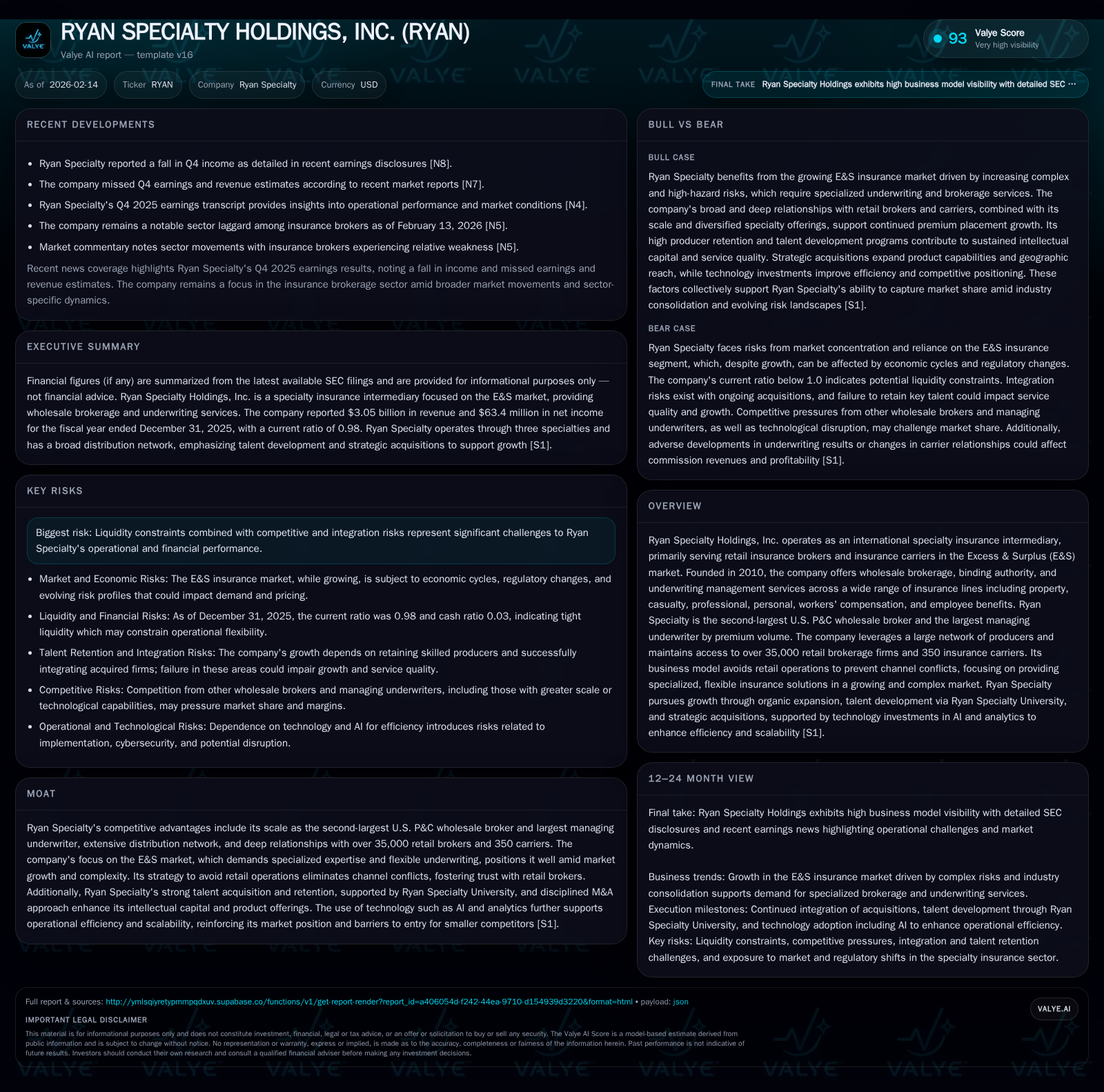
Ryan Specialty Holdings stands as a leading global specialty insurance intermediary, commanding scale and deep expertise within the challenging Excess & Surplus (E&S) market. Despite its solid competitive advantages—extensive broker and carrier networks, a pure wholesale channel approach, and accelerated talent development—the company’s fourth quarter 2025 results revealed notable revenue shortfalls and compressed margins. Amid liquidity constraints underscored by a sub-1 current ratio and elevated integration risks from acquisitions, Ryan faces mounting pressure to maintain growth momentum. The evolving regulatory environment, cyclicality of insurer capacity, and operational complexities further complicate execution. Yet, through focused technology adoption and a disciplined growth strategy, Ryan aims to uphold its moat while managing emerging financial headwinds.
Market Leadership Carved Through Specialized Expertise
Founded in 2010 by Patrick G. Ryan, Ryan Specialty Holdings has ascended to become a dominant force in the international specialty insurance intermediary space. Its particular concentration on the Excess & Surplus (E&S) market sets it apart—a segment characterized by complex, non-standard risks that demand bespoke underwriting expertise [S1]. As the second-largest U.S. P&C wholesale broker and largest managing underwriter by premium volume, Ryan Specialty services over 35,000 retail brokers and more than 350 carriers globally [S1][valye_report_excerpt].
Ryan’s business model is deliberately wholesale-focused; it eschews retail brokerage operations to prevent channel conflicts that can erode trust with retail partners—a strategic cornerstone since inception [S1]. This allows the firm to act as an effective intermediary providing access to specialized products often unavailable through traditional admitted markets. A large portion of premium volume stems from Lloyd’s of London syndicates within the E&S marketplace where flexible terms and conditions enable tailored risk solutions [S1].
This positioning creates a moat rooted in intellectual capital—deep underwriting expertise combined with longstanding relationships—and an unparalleled scale unmatched by most competitors [valye_report_excerpt]. The company promotes an ecosystem where retail brokers’ needs for challenging or hard-to-place risks are met with innovative offerings sourced through efficient wholesale channels.
Deep Dive into Fourth Quarter 2025 Earnings Performance
Ryan’s Q4 2025 earnings announcement revealed a mixed picture. Revenues totaled approximately $3.05 billion but fell short of consensus estimates [F1][N3]. Net income was reported at roughly $63 million—a decline highlighting margin pressures likely tied to operational headwinds such as softening market demand or heightened loss costs [N1][N10]. Commentary from the earnings call pointed to challenges related to integrating new acquisitions amid competitive pricing environments as well as transient macroeconomic factors affecting client activity levels [N1][N2].
Market reaction was muted but reflected growing investor caution given these earnings misses coupled with guidance tempered for upcoming quarters. The share price entered oversold territory shortly following the report as analysts weighed how sustainable growth would be under heavy new claim pressures and evolving market dynamics [N11].
Financially anchoring revenue with qualitative context reveals that while core underwriting fee income remains significant, incremental costs from talent acquisition, technology investments, and regulatory compliance impact bottom-line results. Moreover, volatility in premiums linked to cyclical insurer capacity shifts indicates that near-term earnings may continue facing headwinds.
The Strategic Advantage: Scale, Network, and No-Channel-Conflict Model
Ryan Specialty’s broad distribution network spanning tens of thousands of retail brokers and hundreds of carriers creates formidable barriers for newcomers attempting scale replication [S1][valye_report_excerpt]. Its strict refusal to engage directly in retail brokerage frees it from competing against clients for premium placement—this no-channel-conflict strategy earns substantial goodwill within an industry sensitive to trust and alignment.
Within the E&S domain—which accounts for most premiums placed—the ability to customize coverage with less regulatory constraint than admitted markets is a key differentiator [S1]. Competitors often lack either the scale or underwriting breadth necessary to fluidly navigate this market niche. This permits Ryan to tailor solutions across dozens of insurance lines: from property casualty and workers’ compensation to professional liability and employee benefits.
Consequently, clients find value in Ryan’s ability to bridge risk bearer capacity gaps while delivering specialized insights embedded in its underwriting models. This strategic advantage supports expanding relationships organically while providing avenues for inorganic growth via acquisitions.
Integrating Talent & Technology to Sustain Competitive Moat
Behind Ryan’s model is a deliberate investment in human capital fueled through Ryan Specialty University [S1][valye_report_excerpt]. This internal academy aims not only at recruiting top industry talent but also ensuring continuous learning on complex underwriting disciplines essential for managing E&S risks effectively.
Such focused talent development nurtures long-term retention critical for sustaining intellectual capital advantages—knowledge that underpins nuanced risk assessments unavailable at commodity brokers. Additionally, Ryan has ramped up integration of artificial intelligence (AI) tools and analytics platforms designed to improve pricing accuracy, loss forecasting, and operational efficiencies [S1]. These initiatives face their own risks around data quality and cyber vulnerabilities yet represent essential steps toward scaling without quality dilution.
Balancing technology adoption with human expertise keeps Ryan poised as both an innovator and trusted advisor—a hybrid capability increasingly demanded in specialty insurance markets.
Financial Health in Focus: Liquidity and Capital Structure Challenges
From a liquidity standpoint, Ryan Specialty faces notable constraints as indicated by its current ratio clocking in at just under one (0.98) at year-end 2025 [F1]. Current assets stood at around $5.06 billion against current liabilities of approximately $5.19 billion—a tight squeeze threatening short-term financial flexibility.
Cash on hand totals roughly $158 million but is modest relative to operating scale and funding needs. This liquidity pressure dovetails with broader concerns flagged in risk disclosures about potential adverse impacts from constrained capital availability on growth ambitions or strategic investments [S1]. Market observers have noted resultant heightened stock volatility reflecting these uncertainties compounded by cyclical shifts impacting revenue predictability [N11].[N9]
Compounding this scenario are sizeable maintenance costs related both to legacy debt obligations incurred during prior acquisitions as well as ongoing investment requirements for regulation compliance across various jurisdictions including Lloyd’s markets internationally [S1]. Liquidity challenges inevitably demand careful management lest they impede the speed or scope of future expansion initiatives.
Navigating Industry-Specific Risks and Market Cyclicality
Ryan operates amid numerous sector-specific uncertainties that could disrupt expected performance trajectories. Key risks include potential inaccuracies in underwriting models which might cause reputational damage or loss of carrier trust if risk evaluations prove flawed [S1]. Furthermore, fluctuating insurer capacity—often driven by external events such as catastrophic losses or reinsurance market tightening—can constrain available coverage options limiting transactional volume.
International operations expose Ryan to multiply layered regulatory environments with evolving legal frameworks often more stringent than U.S.-based counterparts—introducing compliance complexities that require dedicated resources [S1]. Additionally, residual fallout from recent pandemics continues shaping client behaviors, claims frequency patterns, and broader economic conditions feeding into cyclicality.
Finally, technological disruption represents a double-edged sword; while AI offerings enhance operational capability they simultaneously raise concerns about data privacy breaches or overreliance on imperfect algorithms [S1]. Collectively these factors compose a volatile backdrop where agility becomes paramount.
Competitive Landscape and Peer Earnings Context
Recent peer performance offers contrasting vantages illustrating sector heterogeneity. For example, Aon recently reported strong Q4 earnings surpassing estimates due in part to diversified service lines buffering insurance brokerage volatility [N5]. Meanwhile, broader insurance broker indices experienced marked sell-offs attributable partly to macroeconomic uncertainty plus AI-related fears impacting overall investor sentiment towards financial intermediaries [N6][N9].
Ryan’s relative underperformance can thus be seen not solely as company-specific but reflecting selective pressure within specialty wholesalers exposed primarily to E&S cycles where premium rate environments remain challenging. The company must continue emphasizing differentiation while monitoring shifting competitor strategies deploying digital platforms or product expansions urgently.
M&A Strategy: Growth Lever or Integration Pitfall?
Acquisition activity forms a key pillar underpinning Ryan Specialty’s growth roadmap aimed at broadening product offerings organically complemented with strategic inorganic moves [S1][valye_report_excerpt]. However risk disclosures explicitly caution against suboptimal evaluations or failures integrating acquired firms—factors which could undermine projected synergies or inflate costs if poorly managed.
The balance lies between leveraging acquisitions as accelerators versus burdening operational cohesion or diluting culture-induced competitive advantages fostered through internal talent programs like Ryan Specialty University. Historical headwinds evidenced in recent quarters underscore how integration complexity remains an active challenge requiring rigorous due diligence combined with robust post-merger integration protocols.
Monitoring how forthcoming deal pipelines align with core competencies will be critical for sustainable value creation beyond headline revenue additions.
Future Outlook: Balancing Growth Ambitions and Risk Management
Looking ahead, the path forward demands nuanced stewardship balancing continued penetration into evolving specialty lines alongside rigorous financial discipline addressing liquidity constraints highlighted at year-end 2025 [valye_report_excerpt][S1][N4]. Wall Street consensus anticipates earnings growth albeit tempered by caution reflecting operational complexities voiced during recent calls [N4].
Leveraging advanced analytics coupled with disciplined talent cultivation appears central to navigating product innovation cycles imperative given intensifying competition. International regulatory adaptability will likewise persist as both opportunity avenue—and potential cost center requiring vigilant oversight.
Ultimately Ryan Specialty's ability to sustain its leadership hinges upon advancing its trusted network-based platform while selectively scaling through accretive M&A conforms tightly with preserving corporate culture—elements foundational rather than supplementary.
Disclaimer: This analysis is provided for informational purposes only and does not constitute investment advice or recommendations regarding any securities mentioned herein.
Disclaimer: This is research-only, informational analysis and not investment advice. It may include AI-generated interpretation and general industry context. Always verify important details using primary sources.

Comments