
Eastman Chemical's Strategic Resilience Amid Softening Demand and Sustainability Innovations
Eastman Chemical's 2025 softness in sales contrasts with its robust innovation-driven and sustainability-focused growth approach.
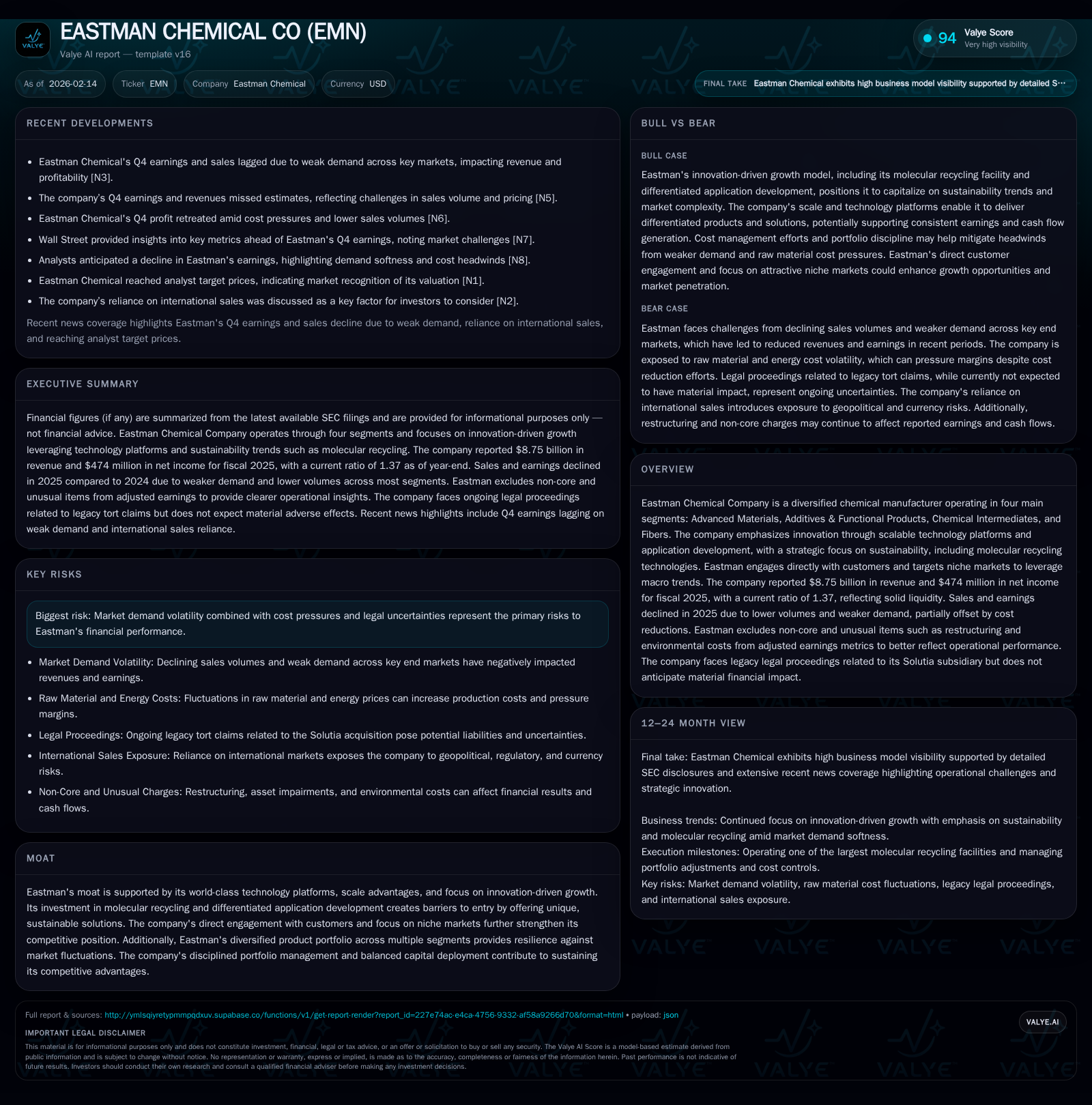
Eastman Chemical reported a decline in revenues and net income for fiscal 2025, reflecting weaker volumes amid broad demand softness. Despite this financial headwind, the company maintains a solid liquidity position and is doubling down on innovation, notably through molecular recycling technologies aimed at sustainable product cycles. Segment performance varied, with resilience seen in differentiated materials while fibers faced pressure. Eastman’s competitive moat stems from its technology platform, scale advantages, and customer intimacy, supporting its navigation through market volatility and regulatory challenges.
Navigating The Numbers: 2025 Fiscal Year In Review
Eastman Chemical’s fiscal 2025 wrapped with a palpable deceleration in top-line momentum. Revenues retreated to $8.75 billion, dragged by volume contractions as global end-market demand softened notably during the year’s latter half [F1][N1][N2]. This dip materially compressed net income to $474 million, reflecting both lower sales denominators and margin pressures despite management's ongoing cost containment initiatives. The fourth quarter magnified these challenges, with earnings and sales falling short of analyst consensus amid market-wide demand hesitations [N3]. Yet, a noteworthy caveat stands out: Eastman’s liquidity remains robust with a current ratio of 1.37, underscoring ample short-term financial flexibility—an important counterbalance amidst cyclical weakness [F1]. This duality between headline softness and balance sheet strength sets the stage for analysis beyond raw numbers.
Strategic Levers: Eastman's Innovation and Sustainability Playbook
Beyond immediate financials lies Eastman’s forward-looking strategy rooted deeply in innovation intrinsic to its survival in an increasingly competitive and commoditized chemical environment. Central to this is its leadership in molecular recycling—a technology platform aiming to close the loop on plastics lifecycle by chemically transforming waste polymers back into high-purity feedstocks suitable for new product generation. This circular approach aims not only to meet rising regulatory scrutiny but also capitalize on sustainable product demand from end-consumers increasingly attuned to environmental impact [valye_report_excerpt].
Molecular recycling is emblematic of Eastman’s broader strategy emphasizing scalable technology platforms coupled with differentiated application development. These initiatives elevate the company beyond commodity cycles and create tailored solutions that address niche markets’ complex needs more effectively than generic competitors could.
Segment Dynamics: Advanced Materials to Fibers Under The Microscope
Dissecting the operating segments reveals differentiated performance contours illuminating strengths and vulnerabilities across Eastman's portfolio. The Advanced Materials segment, leveraging specialized chemistries and custom formulations enables penetration of niche verticals—often insulated somewhat from pure volume swings thanks to higher switching costs for customers [valye_report_excerpt][S2]. Conversely, the Fibers business experienced pronounced headwinds from softer global apparel demand leading to volume contraction and pricing pressures compounded by input cost inflation.
Additives & Functional Products along with Chemical Intermediates segments balance cyclicality with moderate resilience tied to their diversified industrial applications. Collectively, these divisions exemplify Eastman's multi-pronged approach diversifying risk across markets while targeting segments aligned with macro trends such as sustainability and lightweight materials adoption.
Challenges And Risks: Market Volatility, Cost Pressures, and Regulatory Clouds
Despite strategic progress, material risks loom that Eastman must navigate carefully. Demand volatility directly impacts volume-sensitive chemicals sectors where inventory adjustments ripple quickly through revenue streams [valye_report_excerpt]. Rising raw material prices impose margin squeeze potential absent offsetting price pass-throughs.
On top of operational pressures stand legal uncertainties tied particularly to environmental liabilities. The company prudently excludes restructuring charges, non-recurring environmental costs (including those linked historically divested businesses), and unusual tax law impacts from adjusted earnings metrics to present clearer operational pictures yet these adjustments signal persistent underlying complexity [S2][S1]. These non-core expenses occasionally distort GAAP results but highlight the embedded nature of regulatory costs in chemical manufacturing.
The Moat That Matters: Technology, Scale, and Customer-Centricity
Eastman's defensive economic moat is multifaceted but fundamentally rooted in its proprietary technologies enabling unique product offerings difficult for commodity producers to replicate at scale. Its investments in molecular recycling exemplify barriers erected via both intellectual property and necessary capital expenditure.
Scale advantages further bolster cost competitiveness while direct customer engagement fosters tailored solutions enhancing switching costs—especially within niche industrial applications where product specification matters profoundly. This customer intimacy combined with balanced segment diversification mitigates volatility inherent in broad chemical commoditization.
Balancing Act: Capital Allocation and Portfolio Discipline
Eastman exhibits a disciplined capital allocation philosophy balancing investments into high-return innovative growth areas against prudent cost management across legacy operations. Selective divestitures or exits from non-core businesses demonstrate portfolio management rigor designed not just for short-term profit boosts but sustainable long-term value.
Such stewardship is critical as the company seeks to deploy capital efficiently amid evolving demand patterns while channeling funds into sustainability-enabling technologies positioned at the industry’s frontier.
Global Footprint: Insights Into International Sales Dependence
The company maintains meaningful international sales exposure that offers both opportunities for geographic diversification as well as risks related to currency fluctuation and geopolitical developments [N7]. While global presence smooths concentration risk profiles compared to purely domestic firms, it equally exposes Eastman to trade policy shifts or regional economic slowdowns impacting end-markets unevenly.
Managing this complexity demands nimble operational strategies including supply chain flexibility and regional market adaptations.
Earnings Adjustments: Parsing Non-Core and Extraordinary Items
Investors parsing Eastman’s earnings should give particular attention to the adjusted performance metrics excluding non-core costs such as restructuring charges tied to operational pivots or environmental remediation expenses arising from legacy asset portfolios [S2]. Additionally, recent unusual tax law changes introduced notable income tax provisions impacting reported profits temporarily.
These nuanced adjustments mean headline GAAP results may understate normalized earning power; hence understanding these carve-outs is vital for accurate operational appraisal.
Investor Takeaways: Valuation, Yield Potential, and Market Sentiment
From an investor standpoint, Eastman’s shares have recently surpassed key technical thresholds including crossing above the 200-day moving average signaling improved market sentiment [N10]. Furthermore, an elevated dividend yield north of 5% provides attractive income avenues amid uncertain cyclical backdrops—fuelling strategies like yield boosting using options instruments as detailed in recent analyst coverage [N9][N12].
Analyst target prices have been met or exceeded recently indicating calibrated optimism albeit tempered by awareness of ongoing headwinds [N6]. Overall valuation considerations hinge critically on confidence in Eastman’s ability to leverage innovation-led differentiation alongside managing cyclical market challenges prudently.
This memorandum synthesizes data derived from publicly available filings including the company's latest Form 10-K (filed February 2026), quarterly disclosures, as well as market analysis sourced from Nasdaq reports dated January-February 2026. The views expressed herein are solely analytical without investment guidance or recommendations. Readers should consult comprehensive filings and conduct independent due diligence prior to making decisions related to EMN securities.
Disclaimer: This is research-only, informational analysis and not investment advice. It may include AI-generated interpretation and general industry context. Always verify important details using primary sources.

Comments