
Rollins Inc Faces Liquidity and Earnings Challenges Amid Tech Market Volatility
Rollins Inc’s Q4 earnings miss and liquidity pressures unfold against widespread tech sector-driven market uncertainty.
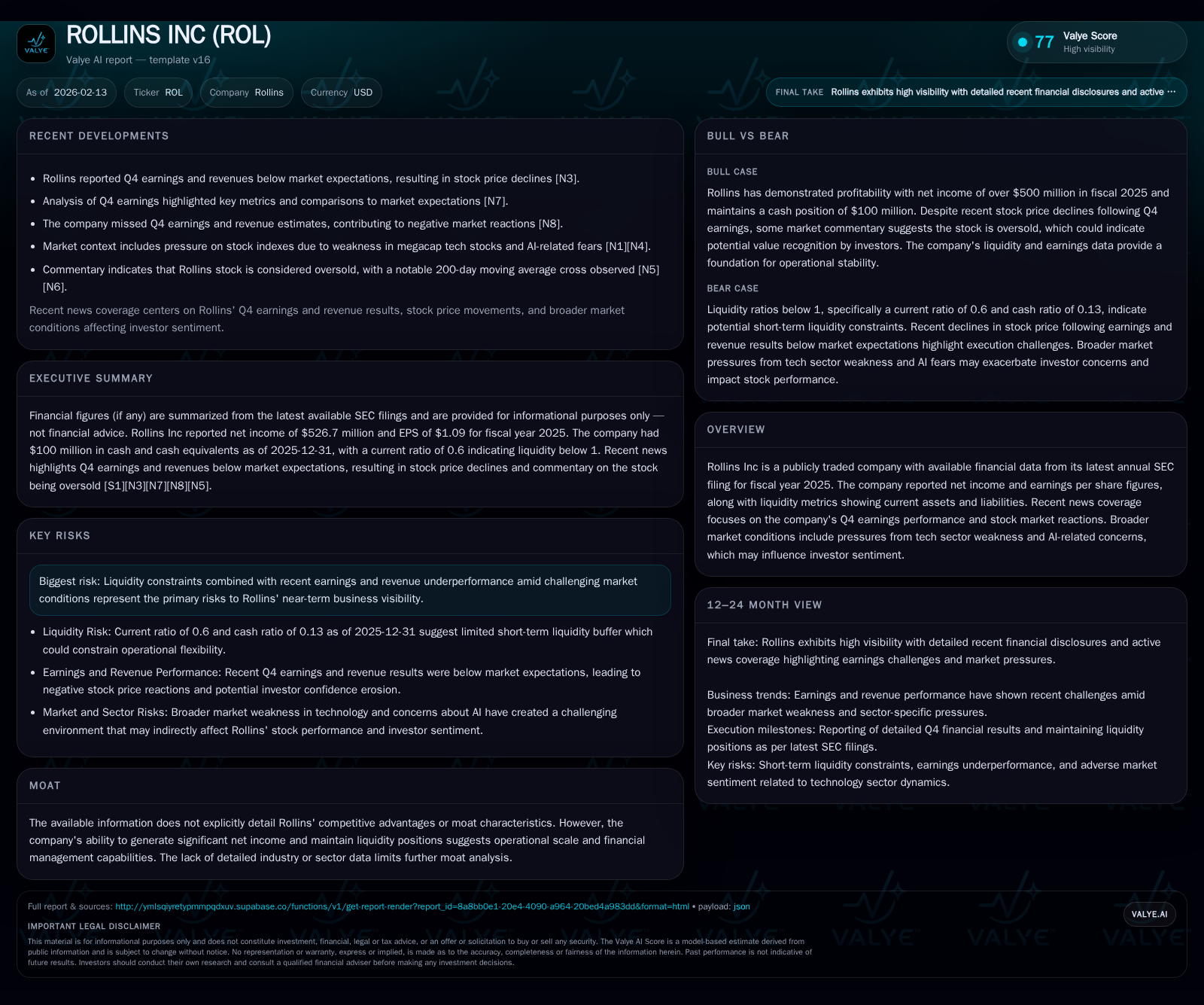
Rollins Inc reported a disappointing Q4 2025 earnings and revenue miss, which came amidst broader market turmoil fueled by declines in megacap technology shares and AI-related anxieties. The company’s liquidity profile shows a current ratio below one, signaling potential short-term financial stress. Absent clear competitive advantages in public disclosures, Rollins faces increased near-term risk visibility challenges amplified by external market pressures. Technical indicators reflect oversold conditions, adding complexity to near-term stock performance interpretations.
Rollins Q4 Earnings: A Disappointing Surprise in Numbers
Rollins Inc’s Q4 2025 financial results caught investors off guard as reported earnings per share and revenue figures fell short of consensus estimates. Multiple Nasdaq reports detail this miss, noting a decline in shares following the release [N1][N2][N3]. While net income increased year-over-year according to one source [N13], the headline operational metrics failed to meet analyst expectations, driving an immediate negative reaction. This juxtaposition highlights nuanced performance where profitability may have improved marginally but on lower revenue bases — a situation that often signals underlying demand softness or expense pressures.
Nasdaq’s after-hours coverage of Rollins’ earnings underscored the tempered outlook from management commentary, hinting at challenges extending beyond the quarter itself [N4]. The mismatch between actual outcomes versus forward-looking guidance has deepened concerns about the company’s near-term momentum.
Decoding the Liquidity Conundrum: Balancing Current Assets and Liabilities
Analysis of Rollins’ latest 10-K filing reveals a pressing liquidity issue: a current ratio calculated at roughly 0.6 (current assets around $473 million against current liabilities near $786 million) [S1][F1]. Such a ratio indicates that short-term debts substantially surpass readily available assets, raising red flags about working capital sufficiency.
While Rollins holds over $100 million in cash and equivalents, this stockpile is insufficient to offset total current claims maturing within a year, emphasizing the need for efficient cash flow management or timely refinancing strategies. This structural imbalance compounds risk especially when combined with the recent earnings setbacks that could dampen operational cash inflows.
This liquidity gap frames one of the core challenges hindering Rollins’ ability to weather market volatility without eroding financial flexibility. Creditors and stakeholders will closely monitor how management prioritizes addressing these shortfalls moving forward.
Market Turbulence and Investor Sentiment: Tech Sector Pressures Spill Over
Rollins’ stock performance cannot be fully understood without situating it within broader equity market turbulence driven by intense selling pressure on megacap technology stocks [N7][N8]. Renewed fears surrounding artificial intelligence overvaluation and sustainability have precipitated sharp rotations out of tech-oriented growth sectors into perceived safety plays.
Nasdaq commentary describes how even nontech companies like Rollins are caught in the crossfire due to sector correlations and general risk-off sentiment [N9][N12]. Weakness in benchmark indices reflects systemic investor wariness that spills over into cyclically linked industrial or service firms whose earnings reliance indirectly ties to technology-driven economic activity.
Consequently, Rollins operates under a double bind whereby internal results disappointment merges with external macro shifts causing amplified share price pressure.
Operating Without a Spotlight: Understanding Rollins’ Unclear Moat
Public disclosures lack explicit articulation of Rollins’ competitive advantages or durable moats, making concrete assessment difficult [F1]. However, its ability to generate significant net income despite challenging revenue trends indicates operational scale or efficiency gains acting as possible indirect moat proxies.
In absence of industry classification details or specific segment leadership descriptions, one can cautiously interpret strong bottom-line profitability as evidence of disciplined cost management or niche positioning within its operational scope. Nevertheless, without clearer differentiation factors outlined in filings or analyst reports, strategic defensibility remains ambiguous.
This opacity warrants attentiveness to whether future disclosures provide enhanced clarity on competitive dynamics amidst market headwinds.
Assessing Near-term Risk Factors Highlighted in SEC Filings
Rollins’ recent 10-K and preceding 10-Q risk sections candidly identify liquidity constraints alongside revenue and earnings volatility as pivotal near-term threats affecting business visibility [S1][S2]. These regulatory disclosures emphasize uncertainties stemming from market conditions exacerbating pressure on cash flows and credit capacity.
Explicit mention of these risks constrains overly optimistic interpretations of stability; instead, they underscore the importance investors place on management’s responses to evolving financial stress points. No speculative risks beyond these documented factors have been introduced, preserving analytical rigor grounded strictly in official statements.
Risks related to unresolved staff comments and cybersecurity are also noted but have not been highlighted prominently as immediate financial disruptors.
Technicals Tell a Tale: Oversold Signals and Moving Average Cross Insights
Nasdaq technical analysis highlights notable oversold conditions for Rollins' shares following the post-earnings selloff [N10]. Such technical markers suggest excessive short-term pessimism potentially setting up for price stabilization or contrarian rebounds independent from fundamental developments.
Additionally, attention has been drawn to significant two hundred day moving average crosses [N11], often associated with shifts in medium-to-long term momentum trends. While not predictive alone, these chart-based observations complement fundamental analysis by illustrating prevailing investor sentiment cycles.
Together, these technical cues provide layered context for interpreting share price action amid mixed messages emanating from financial results versus market breadth dynamics.
Strategic Outlook: Can Rollins Stabilize or Pivot Amid Challenges?
Looking ahead through lens shaped by recent analyst previews ahead of Q4 reporting [N5][N6], Rollins confronts an uncertain terrain marked by internal performance gaps compounded by external sector pressures. The balance between potential near-term stabilization efforts—such as tightening cost structures or improving working capital—and the possibility of further volatility appears finely poised.
Without explicit strategic announcements post-earnings release, scenarios range from measured recovery attempts leaning on operational resilience to necessitated pivots responding to liquidity stress. Broader market narratives suggest that any positive inflection will likely require aligned improvements both at company-specific execution levels and favorable external momentum return within technology-influenced index segments.
Decision makers will need to carefully weigh these factors while maintaining transparency with shareholders regarding progress addressing highlighted risks.
Disclaimer: This analysis is provided solely for informational purposes derived from publicly available data sources including SEC filings and news reports as of February 2026. It does not constitute investment advice or recommendations.
Disclaimer: This is research-only, informational analysis and not investment advice. It may include AI-generated interpretation and general industry context. Always verify important details using primary sources.

Comments