
Federal Realty's Disciplined Retail Strategy Navigates Growth Amid Macroeconomic Pressures
A deep dive into Federal Realty Investment Trust’s strategic portfolio management and operational execution sustaining its growth and dividend resilience in retail real estate.
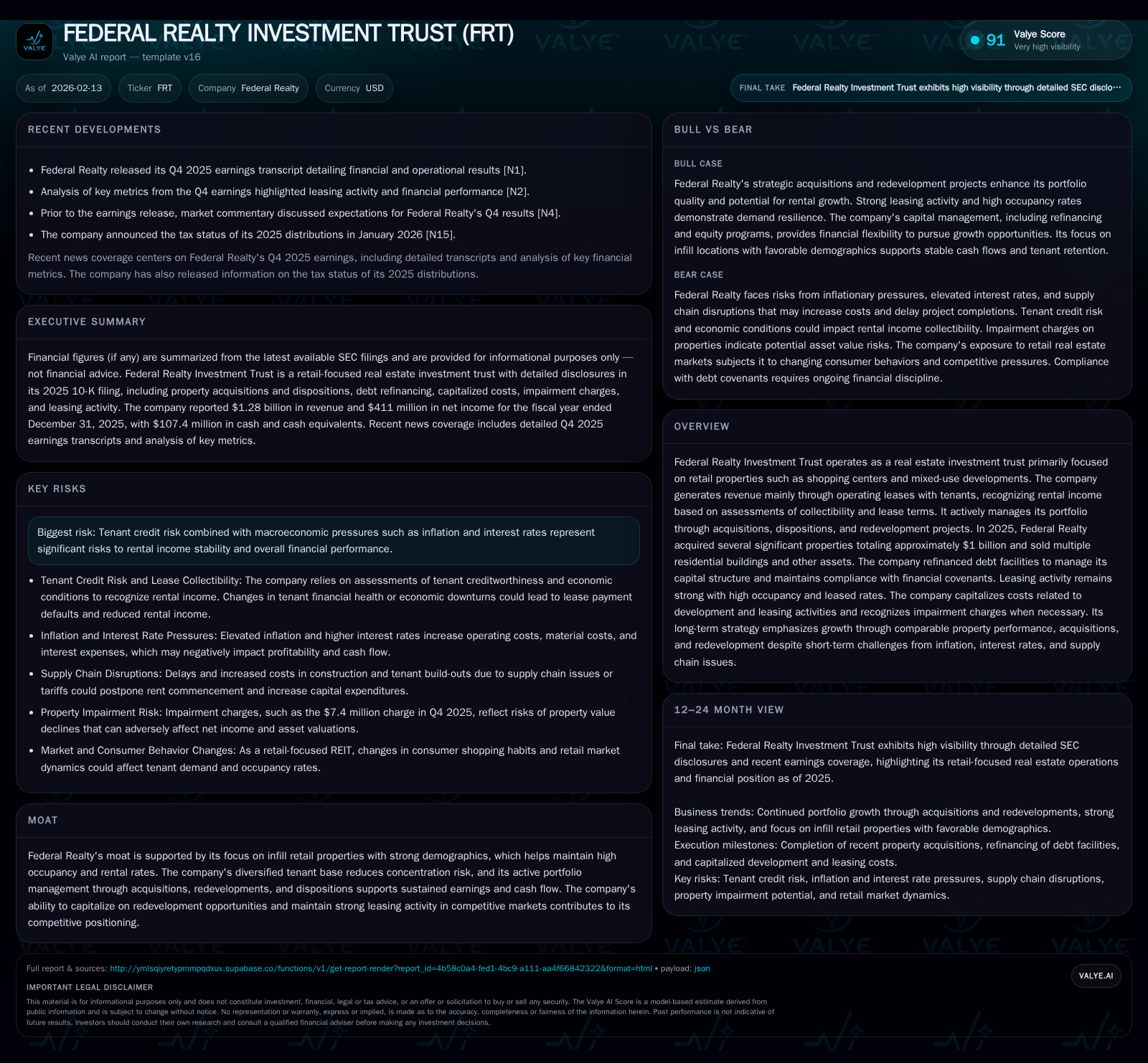
Federal Realty Investment Trust (FRT) continues to demonstrate robust portfolio management, evidenced by $1 billion of strategic property acquisitions in 2025 and active dispositions. With a legacy of 58 consecutive years of dividend increases, FRT leverages its moat of infill retail properties anchored in strong demographic markets to sustain high occupancy and rental rates. Despite pressures from rising interest rates and tenant credit risks, the company’s diversified tenant base and proactive capital structure management support ongoing leasing strength and financial stability. Key accounting judgments around lease collectibility and asset impairment remain critical for near-term earnings reliability.
A Legacy Built on Infill Retail: Federal Realty's Distinctive Market Position
Federal Realty Investment Trust’s competitive moat primarily derives from its laser focus on infill retail properties situated in densely populated urban and suburban areas marked by strong demographic profiles. This selective strategy fosters enduring demand for its shopping centers and mixed-use developments, allowing the company to sustain elevated occupancy levels and robust rental rates even as broader retail real estate faces shifting consumer behaviors. By targeting properties surrounded by affluent, growing populations, FRT effectively insulates itself from common industry headwinds like e-commerce disruptions that have disproportionately affected less strategically located malls or strip centers. Additionally, the firm’s diverse tenant roster dilutes concentration risk while active redevelopments enhance asset value and market relevance [valye_report_excerpt.moat][S1 Item 7][N1].
This market positioning differentiates Federal Realty within the competitive landscape; its ability to adapt leases based on nuanced tenant credit assessments combined with proprietary redevelopment expertise cements its role as an operator of choice among retailers seeking resilient foot traffic hubs.
2025 Strategic Moves: Acquisitions, Dispositions, and Redevelopments Driving Growth
The year 2025 reflected Federal Realty’s continued commitment to dynamic portfolio management through both expansion and pruning. The acquisition activity totaled approximately $1 billion invested primarily in accretive retail properties aligned with its infill strategy [valye_report_excerpt.overview][S1 MD&A][N1]. These additions bolster the company's footprint in key metropolitan corridors where supply constraints favor landlords. Concurrently, FRT divested select residential buildings and other non-core assets, signaling methodical capital recycling aimed at maximizing portfolio returns and liquidity.
This balanced approach—coupling targeted acquisitions with discerning dispositions—enables the firm not only to improve portfolio quality but also to enhance yield potential amid evolving capital market conditions. The redevelopments underway complement these transactions by modernizing key assets, thereby increasing appeal to tenants demanding experiential shopping environments in competitive districts.
Leasing Strength and Tenant Diversification Mitigating Risks
Leasing metrics at Federal Realty remain a pillar of strength, underscored by sustained high occupancy rates in leased spaces across the portfolio [valye_report_excerpt.moat][S1 Risk Factors - Lease Collectibility][N1][N10]. Tenant diversification minimizes dependency on any single industry segment or retailer type. Effective credit risk evaluation supports accrual accounting reliability for rental income; however, FRT exercises careful judgment given volatility within certain retail sectors.
Management assesses tenant collectibility probability considering creditworthiness, sales productivity trends at each location, macroeconomic outlooks, and peer performance data—factors that collectively guide revenue recognition prudence. This conservative posture helps stabilize income flow despite pockets of tenant distress prevalent elsewhere in retail real estate.
Navigating Debt and Capital Structure in a Rising Rate Environment
Federal Realty undertook refinancing initiatives during 2025 to extend maturities and manage interest costs effectively amidst an environment characterized by incremental rate hikes [valye_report_excerpt.overview][S1 MD&A Debt Commentary]. This proactive approach preserved flexibility to fund growth projects without compromising dividend distribution capacity.
Capital covenant compliance remains intact thereby supporting continued shareholder returns alongside investment grade credit perceptions. The firm's cash balances coupled with access to capital markets form essential buffers against tighter liquidity conditions pervasive across real estate sectors facing financing headwinds.
Analyzing Financial Performance: Revenue, Net Income, and Dividend Sustainability
For fiscal year 2025, Federal Realty reported revenues of approximately $1.28 billion alongside net income of $411 million [F1], reinforcing operational profitability amid challenging macro factors. These results underpin the trust’s historic dividend durability — notably marked by an uninterrupted streak of annual dividend increases stretching back 58 years [S1 Dividend Data][N2][N10].
Total dividends paid per share rose marginally to $4.43 in 2025 from $4.37 the prior year despite navigating mixed economic signals. This consistency reflects management's deliberate calibration of payout policies considering earnings fluctuations and capital expenditure demands.
Accounting Judgments That Matter: Lease Income Collectibility and Asset Impairment
Critical accounting estimates wield significant influence over Federal Realty's earnings portrayal [S1 Risk Factors - Accounting Estimates][S1 MD&A]. Lease income collectibility assumptions directly affect whether leasing revenue is recognized on accrual basis or limited to received cash, hinging on forward-looking evaluations of tenant viability.
Inaccuracies in these judgments could lead to material adjustments; for instance, a mere 1% adverse reclassification might reduce rental income—and ultimately net income—by approximately $12.5 million. Similarly, impairment assessments on long-lived assets incorporate discounted cash flow methodologies sensitive to changes in anticipated holding periods or market conditions.
These subjective determinations provide both risk buffers through early conservatism or potential upside via reversals if tenant prospects improve.
Risks on the Horizon: Tenant Credit and Macroeconomic Headwinds
Federal Realty acknowledges persistent risks stemming from tenant credit deterioration compounded by broader macroeconomic challenges including inflationary pressures and rising interest burdens [valye_report_excerpt.risks][S1 Item 1A Risk Factors][S1 Legal Proceedings]. Tenant defaults could disrupt rental income stability while cost escalations may compress operating margins.
Additionally, regulatory or litigation exposures although currently deemed immaterial could introduce episodic volatility. Navigating this risk landscape requires vigilant tenant vetting, adaptive lease structures, and robust contingency planning baked into financial forecasts.
Comparing FRT’s Performance Against REIT Peers in Q4 2025
In contextualizing Federal Realty’s Q4 2025 outcomes among peer retail-focused REITs like Regency Centers and Simon Property Group, FRT exhibits relative resilience despite a slight miss on funds from operations (FFO) estimates [N2][N10][N12][N14]. Whereas some peers experienced more pronounced pressures reflected through negative same-property NOI growth or occupancy softness, FRT maintained steady leasing momentum supported by disciplined portfolio choices.
This comparative steadiness enhances Federal Realty's profile as a defensive operator within retail real estate during a period of external uncertainties impacting discretionary spending patterns.
Outlook: Balancing Opportunistic Growth With Conservative Portfolio Management
Looking ahead, Federal Realty strikes a considered balance between opportunistic expansion—primarily via redevelopments targeting evolving consumer preferences—and conservative portfolio stewardship aimed at preserving capital strength [valye_report_excerpt.overview][valye_report_excerpt.risks][N4][N1].
Management commentary underscores confidence in sustaining leasing velocity bolstered by demographic tailwinds yet remains cautious regarding potential economic shocks affecting tenant viability or borrowing costs. Prioritizing investments that maximize asset-level returns while retaining prudent leverage highlights an agile but measured strategic stance shaping future earnings trajectories.
Disclaimer: This report is intended solely for informational purposes based on publicly available data as of February 13, 2026. It does not constitute investment advice or recommendations.
Disclaimer: This is research-only, informational analysis and not investment advice. It may include AI-generated interpretation and general industry context. Always verify important details using primary sources.

Comments