
Collab Z Inc.: Disrupting Property Management with Community Engagement and Emerging AI Amid Operational Headwinds
Collab Z is reshaping property management by decentralizing operations to tenants and communities, while navigating financial constraints and technology risks.
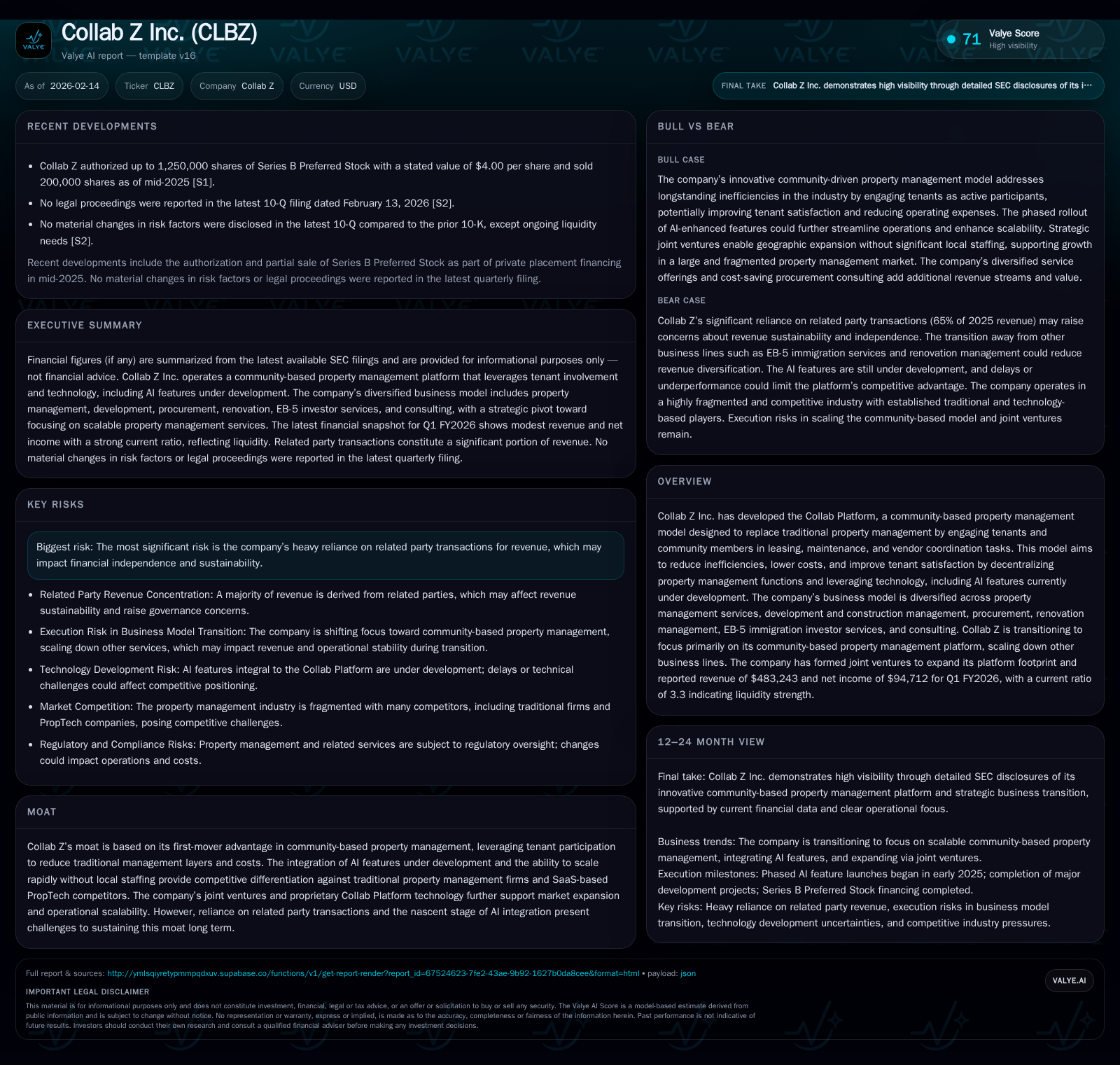
Collab Z Inc. has pioneered a community-centric property management platform that leverages tenant participation and upcoming AI capabilities to tackle inefficiencies of traditional models. The company’s Collab Platform offers scalability without local staff dependence, aiming to reduce costs and improve tenant satisfaction. However, ongoing reliance on related party transactions, nascent AI integration, and liquidity challenges underscore operational risks. Strategic joint ventures and leadership dynamics add complexity as Collab Z strives to establish a sustainable growth trajectory in a fragmented real estate sector.
Reinventing Property Management: Collab Z’s Vision and Mission
Traditional property management has long suffered from inefficiencies: multilayered oversight leads to inflated costs, slower response times, opaque processes, and a disconnect between tenants and asset managers. Against this backdrop, Collab Z Inc. emerges with an ambitious philosophy—to democratize property management through community involvement powered by technology. Their proprietary Collab Platform enables tenants themselves to take active roles in leasing coordination, maintenance reporting, and vendor interaction. This decentralization aims not only to reduce complexities but also to foster an ecosystem where all stakeholders—property owners, tenants labeled as Community Pros (CPs), and service providers—collaborate for mutual benefit [valye_report_excerpt; S1].
This vision contends with entrenched industry norms by offering a scalable model unshackled from dependence on local staff or traditional management infrastructure. By incorporating financial incentives for tenant participation and targeting enhanced transparency and responsiveness, Collab Z seeks to rewrite tenant-landlord dynamics with a mission focused on long-term sustainability rather than short-term contractual engagements.
Dissecting the Collab Platform: Community Engagement as Competitive Moat
At its core lies the Collab Platform—a technology-enabled framework designed as a first-of-its-kind community-based property management system. It capitalizes on Collab Z’s four-year market head start over similar entrants [valye_report_excerpt]. Unlike traditional firms laden with hierarchical layers or emerging PropTech SaaS solutions focused solely on software delivery without operational integration, Collab Z’s platform combines human engagement with digital tools.
Integral to this differentiate is tenant empowerment through direct involvement in property tasks previously siloed within management companies—ranging from minor repairs coordination to leasing facilitation. This approach reduces overhead expenses by shedding redundant managerial tiers while aspiring to elevate tenant satisfaction—a critical metric historically low in incumbent models.
Ahead in its evolution is the phased incorporation of AI functionalities slated over an 18-month rollout begun in early 2025. This layer promises predictive maintenance insights, automated communication workflows, and enhanced vendor matchmaking capabilities. Yet these advanced features remain embryonic; their full commercial impact hinges heavily on successful integration amidst competitive pressures and technical risks tied to reliance on third-party AI platforms [valye_report_excerpt; S1].
Financial Health Check: Revenue, Profitability, and Liquidity Analysis
Financially, Collab Z operates on a modest scale—with trailing twelve months revenue standing at approximately $483k complemented by positive net income near $95k as of year-end 2025 [F1]. Current assets significantly exceed current liabilities (ratio ~3.3), signaling reasonable short-term liquidity buffers.
However, the company acknowledges working capital constraints that raise going concern flags requiring additional financing rounds for sustained operations [S1]. This precariousness aligns with its transitional focus toward scaling the community-driven platform while winding down legacy business lines like procurement and EB-5 consulting.
Margins remain thin given operating leverage effects from initial platform investments juxtaposed against relatively low revenue base; profitability gains depend on ramping adoption alongside disciplined cost management. Moreover, revenue concentration stemming from related party contracts impairs independent earnings quality and obscures true market traction [S1].
AI and Technology Roadmap: Promise and Pitfalls in Innovation
The AI ambition embedded within the Collab Platform marks a double-edged strategic thrust. On one hand, machine learning algorithms have potential to streamline maintenance scheduling dynamically based on sensor data inputs or predict tenant churn patterns enhancing retention tactics. These innovations could solidify competitive leads if executed robustly.
Conversely, creative risks shadow these gains. Heavy dependence on external AI service providers introduces vulnerability to abrupt licensing changes or service interruptions potentially disrupting customer experiences [S1]. Further exposure emerges from leveraging open source components that may carry intellectual property litigation threats or impose unforeseen use restrictions limiting agility.
Maintaining quality control across these evolving tools requires technical rigor paired with close vendor oversight—capacity strains anticipated given relatively nascent internal R&D infrastructure documented for Collab Z [valye_report_excerpt; S1]. The path forward demands balancing feature velocity with reliable service delivery vital for user trust retention.
Navigating Risks: Related Party Transactions and Market Dependence
A striking operational risk resides in the company's significant revenue derived from related parties—a dependency that clouds financial independence narratives [S1]. Such concentration elevates scrutiny levels among investors concerned about transparency around pricing fairness or preferential contract terms which may not replicate broadly across open markets.
Moreover, property management fees—the primary revenue driver—face exposure to macroeconomic cycles including recession impacts, interest rate fluctuations affecting credit availability for real estate owners, or geopolitical factors influencing foreign currency flows [S1]. These externalities can induce volatility undermining stable cash flow projections.
Collab Z must therefore advance governance safeguards ensuring rigorous arm’s-length dealings alongside proactive diversification strategies mitigating economic sensitivity inherent in real estate services [S1; S2].
Scaling Challenges and Joint Venture Strategies
Recognizing growth limitations imposed by its existing footprint Cadcollaborative strategies have become paramount via joint ventures aimed at accelerating market penetration without commensurate capital burden [valye_report_excerpt]. Such partnerships provide access to regional networks, enable rapid onboarding of portfolio properties into the platform ecosystem, and leverage localized expertise.
However, this path surfaces complexities: aligning diverse stakeholder interests across JV entities adds managerial overhead; inconsistent operational standards risk brand equity; legal entanglements from shared liabilities amplify balance sheet risks [S1]. The company's limited track record managing multi-party collaborations compounds uncertainties around execution discipline.
Future success hinges not only on scaling metrics but also on embedding rigorous performance monitoring frameworks aligning JV partners tightly with overarching mission objectives.
Leadership Dynamics and Corporate Governance Insights
The executive team driving Collab Z is characterized by entrepreneurial zeal yet constrained by limited prior experience navigating public markets’ regulatory demands [S1]. This leadership gap amplifies risk profiles especially amid heightened scrutiny over related party dealings and compliance requirements associated with emergent AI technologies.
Notably absent is any key man life insurance coverage—a standard risk mitigation mechanism providing continuity assurance upon unexpected losses among critical personnel—intensifying vulnerability during pivotal growth phases [S1].
To sustain investor trust over time will require augmenting governance structures with seasoned independent directors proficient in complex sector dynamics alongside instituting robust risk management protocols tailored for digital transformation journeys.
The Road Ahead: Growth Prospects and Shareholder Value Creation
Collab Z stands at an inflection poised between pioneering innovation capable of redefining real estate property management ecosystems versus structural hurdles typical of young disruptors operating under capital stress [valye_report_excerpt; F1]. Its community-driven model paired with upcoming AI-powered functions presents a distinctive value proposition encouraging stakeholder alignment uncommon in fragmented industry landscapes.
Yet unlocking this potential will depend critically on successful scale execution via well-managed joint ventures balanced against prudent resource allocation controlling burn rates; maturing AI deployments free of disruptive failures; deconcentrating revenue mix away from related parties toward diversified contracts; plus strengthening corporate governance essentials supporting transparency.
In aggregate the journey ahead remains challenging yet promising — reflective of transformative ambitions reckoning both technological innovation promise and sobering operational realities common among emerging PropTech players.
Disclaimer: This analysis is provided for informational purposes only based on available public filings as of February 2026. It does not constitute investment advice or recommendations.
Disclaimer: This is research-only, informational analysis and not investment advice. It may include AI-generated interpretation and general industry context. Always verify important details using primary sources.

Comments