
Expedia Group's Technological Evolution and Risk Framework Amid Global Travel Momentum
Expedia Group emerges from Q4 with strong financial deliveries while navigating a complex technological and regulatory landscape.
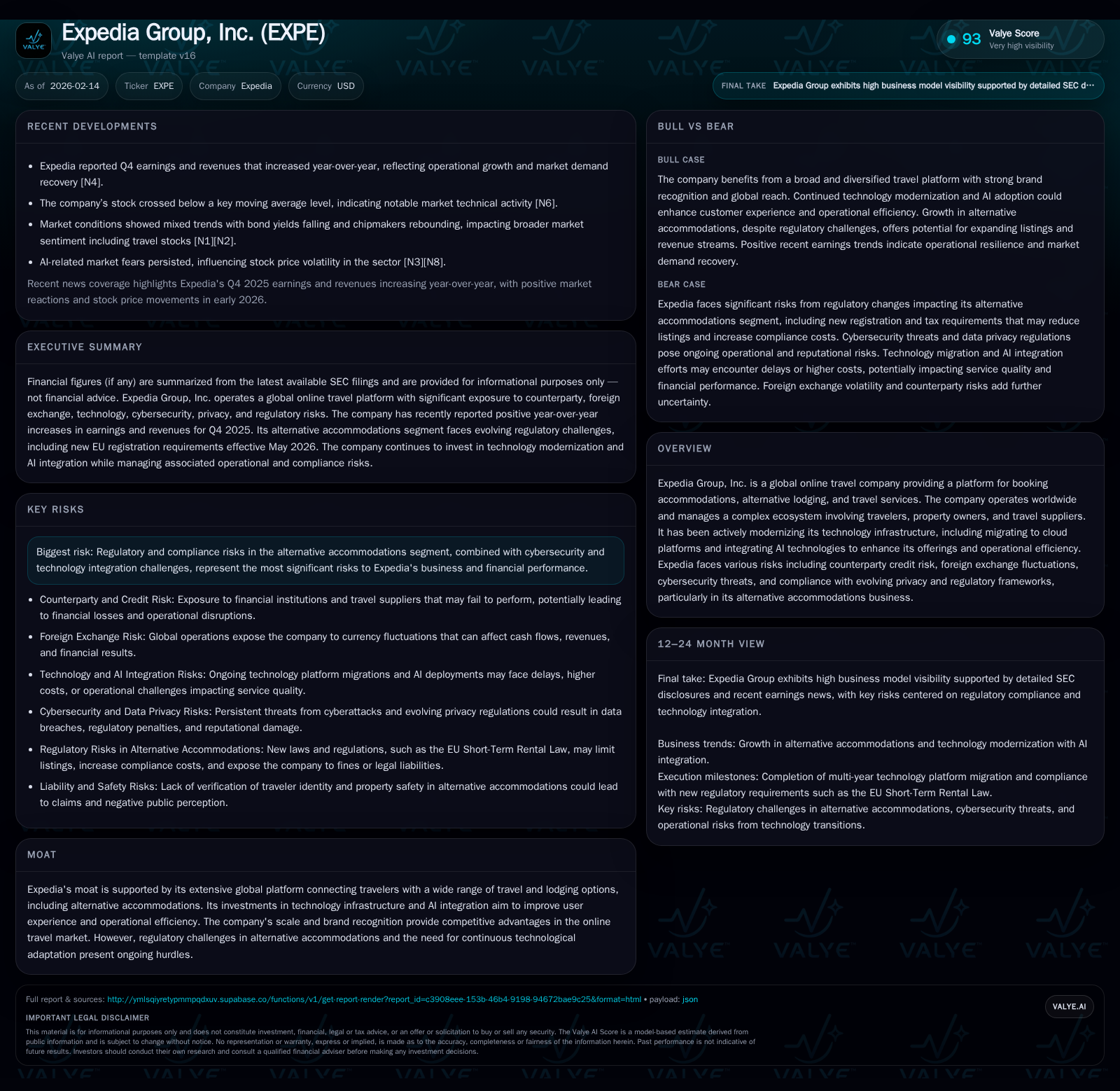
Expedia Group delivered a solid Q4 2025 earnings and revenue beat, underscoring resilient demand amidst market uncertainties. The company is actively modernizing via cloud migration and AI integration to bolster its platform’s competitive edge. Notwithstanding its scale and global reach, Expedia faces material challenges including counterparty credit exposure, foreign exchange volatility, cybersecurity risks, and tightening regulations in its alternative accommodations segment. These factors shape a narrative of cautious optimism as Expedia balances innovation with operational resilience on a global stage.
Q4 2025 Performance Highlights: Revenue and Earnings Beat Expectations
Expedia Group concluded its fiscal year with strong fourth quarter results that notably outpaced expectations. Revenues experienced healthy year-over-year growth supported by steady demand in travel booking activities [N1][N4]. Net income for the year totaled approximately $1.29 billion, a robust figure signaling operational momentum [F1]. However, the quarterly income decline highlighted in some reports suggests margin pressures possibly linked to investment in technology or one-time costs [N13]. This duality positions Expedia at an inflection point where growth is tangible but cost dynamics require careful navigation.
Technological Renaissance: Cloud Migration and AI Integration
Central to Expedia's forward strategy is its substantial commitment to modernization through migrating operations to cloud infrastructures and integrating artificial intelligence capabilities. These initiatives aim not just at cost reduction but also at enhancing the user journey—from discovery through booking—by leveraging data-driven personalization and streamlined backend processes [valye_report_excerpt][S1]. However, as noted in official disclosures, these ambitious tech transitions carry inherent execution risks including unexpected delays or increased expenses that could weigh on near-term financials [S1]. Thus, Expedia's tech renaissance is both a catalyst for competitive advantage and a source of operational complexity.
The Strategic Landscape: Expedia's Global Platform and Moat Realities
Expedia operates an expansive online travel ecosystem linking travelers with accommodations ranging from traditional hotels to burgeoning alternative lodging options. This breadth creates significant network effects reinforcing brand strength and scale advantages [valye_report_excerpt]. The platform's ability to aggregate diverse travel services globally confers a durable moat in an increasingly fragmented market. Nonetheless, this very interconnectedness exposes Expedia to regulatory scrutiny—especially around the alternative accommodations segment—which could erode some strategic benefits if not deftly managed.
Risk Under the Surface: Counterparty Exposure, FX Volatility, and Cybersecurity
Beneath the surface of revenue growth lie multifaceted risks critical to maintaining financial stability. The company's dependence on counterparty performance is nontrivial; failures by financial institutions or key partners may lead to losses relating to deposits or unsettled hedging contracts [S1]. Additionally, Expedia confronts foreign exchange risk across multiple currencies such as the Euro, British Pound, and Japanese Yen—fluctuations which can unpredictably influence accommodation revenue recognized between booking and stay dates as well as cross-border travel volumes [S1]. Cybersecurity threats compound this risk landscape; protecting consumer data integrity remains paramount given growing digital threats associated with large-scale online platforms [valye_report_excerpt][S1].
Alternative Accommodations: Regulatory Headwinds and Compliance Complexity
Alternative lodging platforms like Vrbo form an essential growth vector for Expedia but also introduce heightened regulatory exposure. Globally shifting privacy standards, rental regulations, licensing requirements, and consumer protection laws constrict operational latitude in this segment [valye_report_excerpt][S2]. Compliance demands involve navigating labyrinthine local rules that can delay product rollout or impose costly adaptations. This environment necessitates vigilant legal oversight alongside strategic agility to prevent erosion of potential upside.
Financial Health Metrics: Liquidity Constraints Amidst Growth Ambitions
Examining Expedia’s balance sheet reveals nuanced liquidity dynamics. While cash reserves stand healthy at $5.43 billion as of year-end 2025 [F1], current liabilities exceed current assets resulting in a current ratio of approximately 0.73—a tension point evidencing short-term funding pressure [F1]. This gap reflects significant obligations likely related to customer deposits pending remittance to travel suppliers or creditor contracts. Consequently, liquidity management becomes pivotal to sustaining operational fluidity while pursuing aggressive investments in technology and market expansion.
Navigating Exchange Rate Risks: Hedging Strategies and Operational Impact
Foreign exchange remains a volatile factor given Expedia’s reach across diverse geographic markets. The company's hedging program seeks to stabilize the financial impact of currency volatility on reported earnings by employing derivative instruments aligned with expected cash flows in various currencies [S1]. Nonetheless, the effectiveness of these strategies depends heavily on accurate forecasting models and robust control systems. Misestimation or process breakdowns could amplify earnings variability rather than mitigate it [S1], adding another layer of risk management complexity.
Market Sentiment and Stock Dynamics in the Context of Tech and Travel
Post-earnings share price movements reveal muted investor enthusiasm tempered by prevailing uncertainties about AI’s role within travel tech stocks broadly [N6][N7][N11]. Following reports that EXPE traded below key moving averages with volume spikes indicative of cautious selling pressure [N11], market participants are evidently wrestling with reconciling solid fundamentals against macroeconomic noise including inflationary concerns and AI hype cycles. This dynamic underscores how even companies progressing technologically must remain sensitive to investor psychology.
The Road Ahead: Balancing Innovation with Operational Resilience
Looking forward, Expedia stands at an intersection where its technological ambitions—particularly around AI enhancements—have potential to unlock richer customer experiences and operational efficiencies [valye_report_excerpt][S1][N3]. However, materialization of these benefits hinges on flawless execution amidst a backdrop of persistent headwinds spanning regulatory enforcement unpredictability, currency fluctuations, counterparty dependencies, and cybersecurity demands. Management acknowledges this tightrope walk explicitly during earnings commentary emphasizing cautious optimism balanced with practical risk vigilance [N3]. The company’s trajectory will thus be shaped by how well it calibrates innovation drives alongside fortifying its foundational controls.
This analysis aims to provide a comprehensive lens on Expedia Group’s current positioning without rendering investment recommendations. Readers are encouraged to integrate emerging data points and further disclosures when forming broader perspectives.
Disclaimer: This is research-only, informational analysis and not investment advice. It may include AI-generated interpretation and general industry context. Always verify important details using primary sources.

Comments