
Consensus Cloud Solutions: Navigating Legacy Fax Dominance Amid Healthcare Interoperability Shifts
Consensus Cloud Solutions balances its entrenched leadership in cloud fax services against emerging healthcare data exchange complexities.
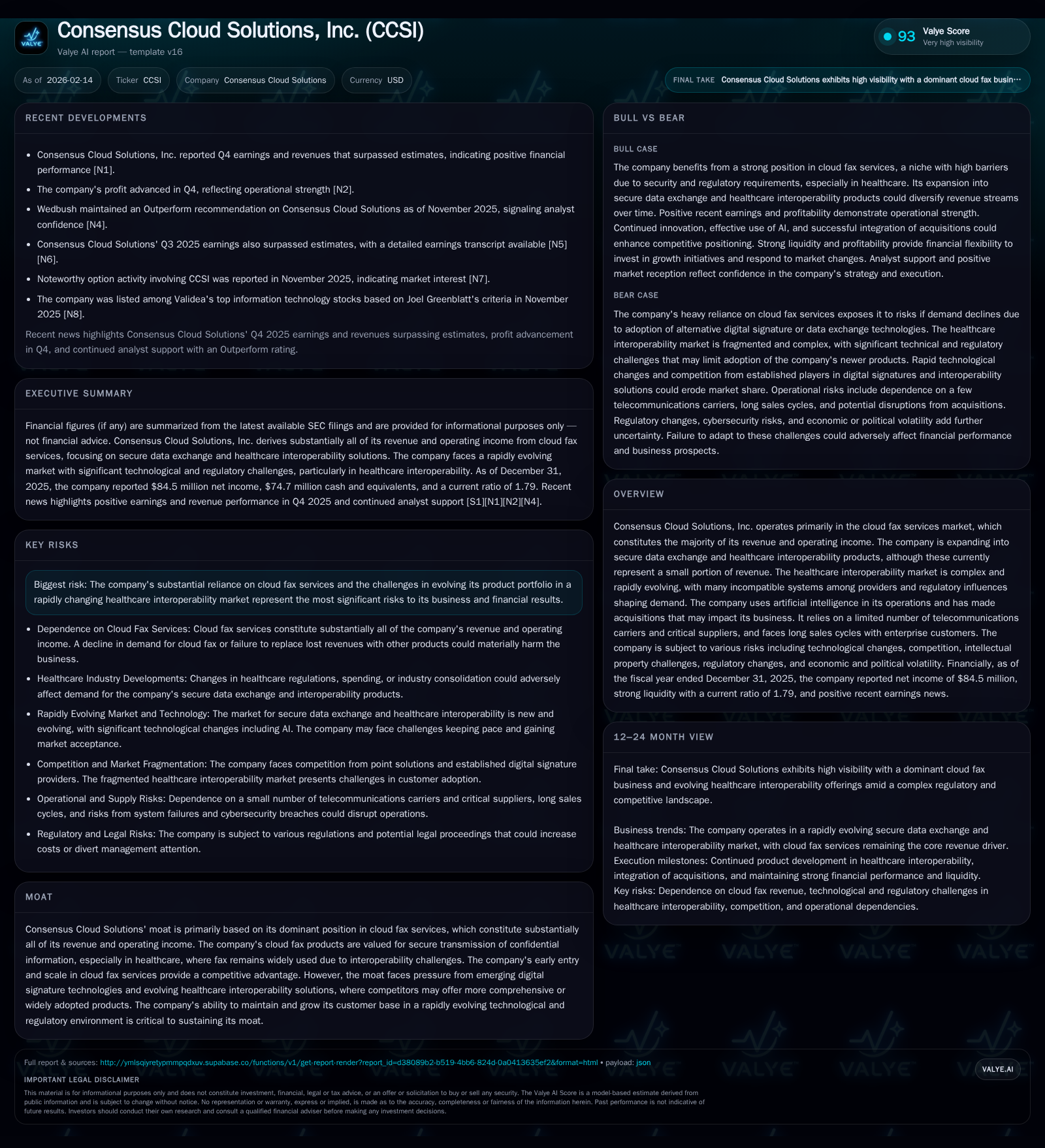
Consensus Cloud Solutions, Inc. (CCSI) anchors its business predominantly in cloud fax technology, a legacy communication tool whose secure transmission capabilities remain vital within healthcare. Despite the broader digital transformation wave, the company's recent financial quarter showcased robust results, reinforcing market confidence. However, growing its footprint in healthcare interoperability—a sector marked by fragmented systems and stringent regulations—poses formidable challenges that could redefine its strategic trajectory. Coupled with concentrated supplier relationships and regulatory headwinds, CCSI must carefully manage evolving technology adoption and competitive pressures to sustain its moat.
Legacy Leadership in a Cloud Fax Dominated Landscape
At first glance, Consensus Cloud Solutions appears tethered to an anachronism: fax technology. Yet this seeming throwback is precisely what undergirds the company’s dominant position in delivering cloud fax services—a segment that commands substantially all of its revenue and operating income. The paradox is stark: while modern enterprises aggressively pursue digital communication tools, the healthcare industry remains fixated on faxing due to entrenched interoperability dysfunctions among providers. Fax’s resilient presence stems from its unmatched security in transmitting sensitive patient information across incompatible electronic medical records systems. Early adoption and scale have fortified CCSI’s moat through client lock-in and trust accrued over years, making substitution difficult despite the lure of newer technologies [S1], [valye_report_excerpt].
However, this reliance on a legacy system inherently exposes CCSI to secular risks as healthcare interoperability initiatives gradually erode fax’s primacy. Maintaining relevance requires navigating these competing forces delicately: embracing innovation without undermining the dependable core that customers still depend on.
Takeaway: Consensus' leadership rests on an enduring legacy technology whose strategic friction with modernization frames both strength and vulnerability.
Q4 Breakouts: Earnings and Market Reactions
Consensus latest quarterly earnings defied skepticism around legacy reliance by outperforming consensus estimates on revenues and profit metrics [N1], [N3]. The $84.5 million net income recorded for fiscal year-end reflects efficient cost management alongside steady cloud fax demand. With cash equivalents nearing $75 million and a current ratio of approximately 1.79 [F1], the firm demonstrates solid liquidity cushioning near-term obligations.
Analyst sentiment has shifted positively; recent upgrades cite confidence in financial discipline paired with cautious optimism about growth vectors [N4]. This renewed endorsement underscores that consensus views are not merely anchored to historical performance but also factors in the company’s navigating capabilities amid structural transitions.
Takeaway: Financial robustness combined with favorable market perception adds credibility to Consensus' operational model during disruptive industry shifts.
Healthcare Interoperability — Opportunity or Obstacle?
CCSI’s expansion into healthcare interoperability products signals acknowledgment of shifting industry paradigms but also surfaces the complexity enveloping this ecosystem [valye_report_excerpt], [S1]. The interoperability landscape is fragmented across myriad providers deploying heterogeneous platforms lacking standardized data exchange protocols. Regulatory frameworks such as HIPAA privacy rules intensify compliance burdens, thereby constraining product deployment agility.
Despite these barriers, interoperability represents a critical growth frontier beyond cloud fax saturation. Currently contributing a minor fraction of revenue, it nonetheless holds outsized strategic importance. Success hinges on bridging technical gaps while aligning offerings with evolving regulatory requirements—a tall order given rapid changes that can alter market needs unpredictably.
Takeaway: Interoperability presents a high-stakes dilemma where opportunity coexists with operational complexity, demanding nuanced execution.
AI Integration: Strategic Asset or Operational Risk?
Artificial intelligence integration exemplifies Consensus's push toward technological evolution within core services and emerging products [S1]. AI promises enhanced automation in document processing, anomaly detection, and customer service workflows, potentially elevating efficiency significantly.
Yet this tech infusion carries reputational risks if misapplied—errors or biases in AI outcomes could undermine user trust or violate privacy mandates. Maintaining rigorous governance over AI use is paramount to avoid adverse impacts on brand value or regulatory standing.
Takeaway: AI deployment is a double-edged sword requiring balance between innovation benefits and vigilant risk management.
Supply Chain Dependencies and Carrier Concentration Risks
Operational resilience faces headwinds from reliance on a limited number of telecommunications carriers per region alongside essential suppliers providing data center services [S1]. These dependencies expose CCSI to pricing pressures, potential service interruptions, or renegotiation challenges should carrier relationships deteriorate.
Such vulnerabilities necessitate proactive supplier diversification or contingency planning as part of risk mitigation strategies—failure here could disrupt service continuity integral to client retention.
Takeaway: Concentrated supplier bases constitute critical operational fragilities demanding strategic oversight.
Regulatory & Compliance Headwinds Shaping the Future
Evolving regulatory landscapes impose multifaceted constraints on Consensus's business model via health information communication protocols, tax regimes including e-commerce considerations, and privacy legislation adjustments [S1]. For instance, tightening health data security mandates may increase infrastructure costs or delay product rollouts.
Additionally, emerging taxation interpretations around telecommunications services add financial unpredictability. Continuous monitoring of such regulatory shifts is essential to preempt compliance costs or operational restrictions that could impair profitability.
Takeaway: Regulatory dynamics remain potent forces capable of reshaping cost structures and market access paths.
Moat Sustainability in the Face of Emerging Competitors
While CCSI's dominant footprint derives from early cloud fax scale advantages, persistent threats arise from digital signature platforms and more integrated interoperability solutions offered by competitors [valye_report_excerpt]. These alternatives promise streamlined workflows transcending traditional fax limitations.
Retaining the customer base amidst these innovations demands ongoing investment in product relevance coupled with superior service reliability. The erosion risk is tangible should clients migrate toward comprehensive digital ecosystems obviating standalone fax reliance.
Takeaway: Sustaining the moat requires adaptive strategies counterbalancing disruptive competitive incursions.
Financial Resilience and Operational Efficiency Metrics
Beyond headline net income figures ($84.5 million for 2025) [F1], liquidity metrics demonstrate healthy operational footing with current assets outpacing liabilities by nearly 80%. This financial cushion enables absorption of short-term shocks or investment into new initiatives without straining balance sheet health.
Nevertheless, revenue concentration predominantly within the cloud fax segment imposes earnings volatility if market decline accelerates or competitive pressure intensifies immediately. Efficient cost control remains integral to preserving margins amid such uncertainty.
Takeaway: Financial foundations are robust but hinge on successful diversification efforts mitigating reliance risks.
Strategic Acquisitions as Growth Catalysts or Distractions?
CCSI's acquisition strategy aims at complementing its portfolio by targeting adjacent healthcare technologies linked to secure data exchanges [S1], [valye_report_excerpt]. While acquisitions can accelerate capability breadth beyond organic growth limits, they also carry risks—including integration complexity that may temporarily divert management focus or impair operating cohesiveness.
Balancing growth ambitions against operational stability is key; executed well, acquisitions bolster competitive positioning toward emerging markets; missteps could exacerbate execution risk during an already volatile transition phase.
Takeaway: Acquisition activity is a double-edged strategic lever demanding disciplined integration governance.
Looking Ahead: Navigating Sales Cycles and Market Evolution
The enterprise sales pipeline involves prolonged timelines due to complex decision-making within healthcare institutions—a challenge impacting cash flow cadence [S1], [valye_report_excerpt]. This elongated cycle pressures forecasting accuracy and requires sustained relationship management investment.
Concurrently, shifting inter-provider data exchange preferences driven by policy evolutions necessitate agile product updates to retain relevance amid fast-changing customer expectations.
Forward-looking success for Consensus will likely rest on synchronized sales execution paired with nimble responsiveness to sector dynamics translating into concrete wins beyond established cloud fax domains.
Takeaway: Mastery over protracted sales processes combined with adaptability forms the cornerstone for future growth stability.
This analysis integrates publicly disclosed filings alongside recent news reports to illuminate Consensus Cloud Solutions’ nuanced position straddling enduring legacy strengths and emergent healthcare technology challenges. While robust financials evidence operational prudence today, sustaining momentum hinges intricately on navigating systemic market shifts shaped by regulatory frameworks, competitive alternatives, technology adoption curves, and supplier ecosystems. Stakeholders should consider these intertwined factors carefully when evaluating long-term outlooks.
Disclaimer: This is research-only, informational analysis and not investment advice. It may include AI-generated interpretation and general industry context. Always verify important details using primary sources.

Comments