
TripAdvisor’s Multi-Brand Strategy and Data Edge Amid Q4 2025 Challenges
An integrative look at TripAdvisor’s platform ecosystem, competitive moat, and recent earnings setbacks shaping its path forward.
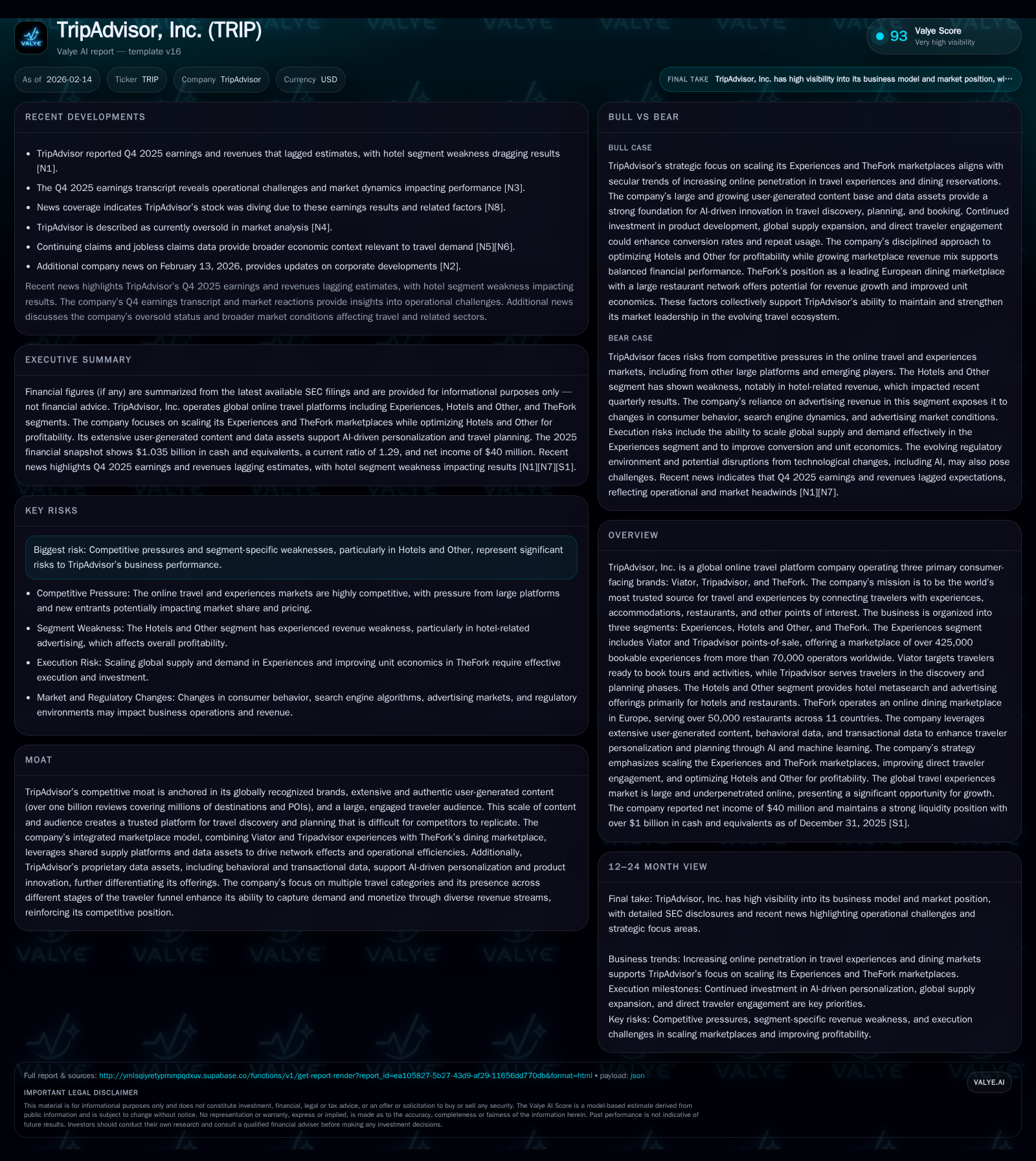
TripAdvisor, Inc. operates a multi-segment online travel marketplace anchored by its globally recognized brands: Tripadvisor, Viator, and TheFork. While its vast user-generated content and data-driven AI capabilities create a durable competitive advantage, recent Q4 2025 earnings revealed softness primarily in the Hotels segment, unsettling investor sentiment. TheFork’s expansion and experiences marketplace highlight growth avenues, but competitive pressures in hotel metasearch underscore strategic risks. Management is focusing on optimizing legacy offerings while scaling high-growth units to navigate evolving traveler demands and intensifying competition.
TripAdvisor’s Triad: Experiences, Hotels & TheFork Unpacked
TripAdvisor has clearly evolved into a tripartite platform powerhouse designed to engage travelers at multiple junctures of their journey. Its Experiences segment merges the upper-funnel inspiration role of Tripadvisor with Viator’s mid-to-lower funnel pure-play experiences OTA model. These operate on a robust shared supply foundation boasting over 425,000 bookable experiences sourced from more than 70,000 global operators [S1]. This integration allows seamless progression from discovery to booking within a singular ecosystem.
The Hotels and Other segment caters primarily to hotel metasearch functionality combined with advertising services tailored mainly for hotel and restaurant partners. Although rooted in legacy travel offerings, this segment remains critical for anchoring user intent and feeding into the broader platform’s data pool. TheFork diversifies TripAdvisor’s exposure beyond accommodations and activities by operating an established dining marketplace spanning 11 European countries with a network exceeding 50,000 restaurants [S1]. This brand adds geographic breadth and cross-category transaction volume which introduce strategic synergies.
Together these segments forge a connected marketplace model that blends discovery with direct transactional capabilities. Such integration aims to capitalize on cross-pollinating demand flows while extracting operational efficiencies through shared technological infrastructure.
Mastering the Moat: Brand Strength and AI-Driven Personalization
TripAdvisor’s moat is fundamentally built on brand equity paired with unparalleled user-generated content scale—it hosts over one billion traveler reviews covering millions of destinations and POIs worldwide [S1]. This vast authentic content repository nurtures trust among audiences while driving engagement within Tripadvisor’s planning services and Viator’s bookings funnel.
Complementing content depth is TripAdvisor's investment in behavioral data assets derived from user clickstream activity across the platform alongside transactional insights from experiences and dining marketplaces. These datasets feed proprietary AI models enabling increasingly personalized travel recommendations and curated booking pathways [S1]. Such AI integration not only improves conversion but also fortifies the classic network effect—wherein richer user profiles enhance service relevance which then attracts further usage.
This combination of an extensive global audience with deeply embedded data intelligence forms a layered defense against competition since replicating both scale of engagement and sophistication of AI personalization presents high hurdles for both traditional OTAs and emergent disruptors.
Q4 2025 Earnings Reflection: Navigating Headwinds in Hotels
Despite its strengths, TripAdvisor’s fourth-quarter results for 2025 revealed meaningful operational hurdles. The company reported revenues falling short of analyst estimates driven chiefly by underperformance in the Hotels segment [N1][N4]. Earnings per share also missed consensus, amplifying investor apprehension [N2].
Management commentary highlighted external factors such as softer hotel booking demand amidst macroeconomic uncertainties compounded by increased competitive pressure from rival meta search providers leveraging aggressive pricing strategies [N2]. Though Experiences and TheFork showed resilience, their growth could not fully counterbalance the drag from hotels.
This dynamic rattled sentiment—TripAdvisor shares dropped significantly following earnings release reflecting concern over margin sustainability in the core hotels business as well as doubts about near-term recovery cadence [N7]. Analysts pointedly scrutinized how quickly cost optimization plans would translate into tangible profit improvements given ongoing market headwinds [N4].
User-Generated Content: The Unseen Currency Powering TRIP’s Network Effect
Central to TripAdvisor's value proposition is its massive repository of traveler-generated reviews which fuel decision-making confidence for millions worldwide. This user-generated content (UGC) functions as intangible yet powerful currency fostering authenticity unmatched by algorithmic ratings alone [S1].
UGC not only enriches listings for experiences and hotels but also acts as social proof empowering travelers during planning phases which increases intent to book within affiliated marketplaces. The virtuous cycle here arises because greater engagement generates more content which further elevates platform credibility, enabling superior monetization opportunities.
In an industry vulnerable to ephemeral brand loyalties, this entrenched content asset underpins TRIP's upper funnel authority crucial for sustained traffic acquisition efforts.
Data as Differentiator: Leveraging Behavioral Insights in Travel Planning
TripAdvisor stands apart through its strategic harnessing of integrated behavioral datasets encompassing clickstream patterns, historical transaction records, and UGC metadata. These multifaceted inputs provide granular insights into traveler preferences allowing sophisticated machine learning models to personalize user journeys across device types [S1].
Amid rising unease over AI disruption risks in broader tech markets [N5], TripAdvisor positions itself as an early adopter refining domain-specific recommendation engines fine-tuned for travel nuances—such as seasonality effects or shifting experience popularity curves.
This end-to-end data-centric approach serves dual purposes: incrementally improving conversion metrics while also differentiating the platform experience in a landscape crowded with commoditized travel search tools.
TheFork Expansion & Market Synergies Across Travel Categories
TheFork emerges as an increasingly vital pillar within TripAdvisor's portfolio diversification strategy. Operating across 11 European countries with over 50,000 participating restaurants gives it a commanding presence in the online dining market segment [S1].
This geographic footprint complements Trips' accommodation-heavy focus creating broad consumer touchpoints that harvest insights transferable across categories. For instance, diner preferences can inform localized experience suggestions or even influence targeted hotel promotions nearby dining hotspots.
Additionally, integrated data sharing between TheFork’s booking engine and other segments creates operational leverage through dynamic pricing optimization algorithms ultimately designed to improve diner conversion rates while maximizing yield on restaurant partner inventory.
Competitive Pressures and Segment Risks: Hotels in the Crosshairs
Within its tripartite structure, the Hotels segment manifests pronounced vulnerability exacerbated by intensifying meta search competition from well-capitalized rivals deploying aggressive customer acquisition tactics [S1][N1]. This environment creates margin compression risks as pricing power erodes amid increased advertiser churn.
Moreover, cyclical exposure inherent to lodging demand magnifies segment volatility particularly when macroeconomic headwinds emerge [S1]. Management publicly acknowledged challenges balancing legacy business rationalization with innovation investments necessary for long-term competitiveness— a delicate strategic tradeoff elaborated during earnings calls [N2].
Such pressures underscore why TripAdvisor prioritizes scaling higher-growth marketplaces like Experiences and TheFork while pursuing operational efficiency improvements within Hotels structuring.
Investment Outlook: Valuation Perspectives Amidst Oversold Signals
Market response following Q4 results was swift—shares entered oversold territory signaling possibly exaggerated downside positioning amid growing concerns about hotels profitability trajectory [N8][N7]. However, several analysts argue that this pullback offers a nuanced valuation opportunity rooted less in fundamental deterioration than transitional repositioning toward data-led growth drivers [N11][N12][N13].
Comparative analysis versus peers reveals TRIP uniquely benefits from entrenched UGC moats unlike many broad OTAs vulnerable to commoditization. Additionally, April options markets now available provide enhanced instruments for hedging or expressing directional views on anticipated recovery paths [N10][N14].
Nonetheless, balancing optimism requires acknowledging operational execution risks combined with macro sensitivities clouding near-term visibility.
The Road Ahead: Strategic Priorities for Sustainable Long-Term Growth
Looking forward, TripAdvisor management emphasizes accelerating expansion of Experiences bookings through enriched product offerings coupled with advancing AI personalization capabilities deepening traveler engagement [S1][N2]. Prioritizing TheFork expansion remains critical given its scalable restaurant relationships across Europe contributing stable revenue streams synergistic to overall portfolio health.
Concurrently they aim to optimize Hotels operations via cost rationalizations while modernizing platform technology foundational elements sustaining legacy offering competitiveness without detracting focus from growth initiatives.
The strategic balance rests upon leveraging proprietary behavioral data assets powering differentiated innovations while managing cyclical vulnerabilities systematically—a nuanced journey requiring disciplined stewardship echoing its mission “to be the world’s most trusted source for travel and experiences.”
Disclaimer: This document is an analytical overview intended solely for informational purposes based on publicly available data as of February 2026. It is not investment advice nor a recommendation to buy or sell securities.

Comments