
GenFlat Holdings’ Collapsible Containers: Innovation Amid Financial and Market Adoption Challenges
GenFlat’s patented collapsible marine containers promise major logistics efficiencies, yet the company faces steep financial and operational hurdles.
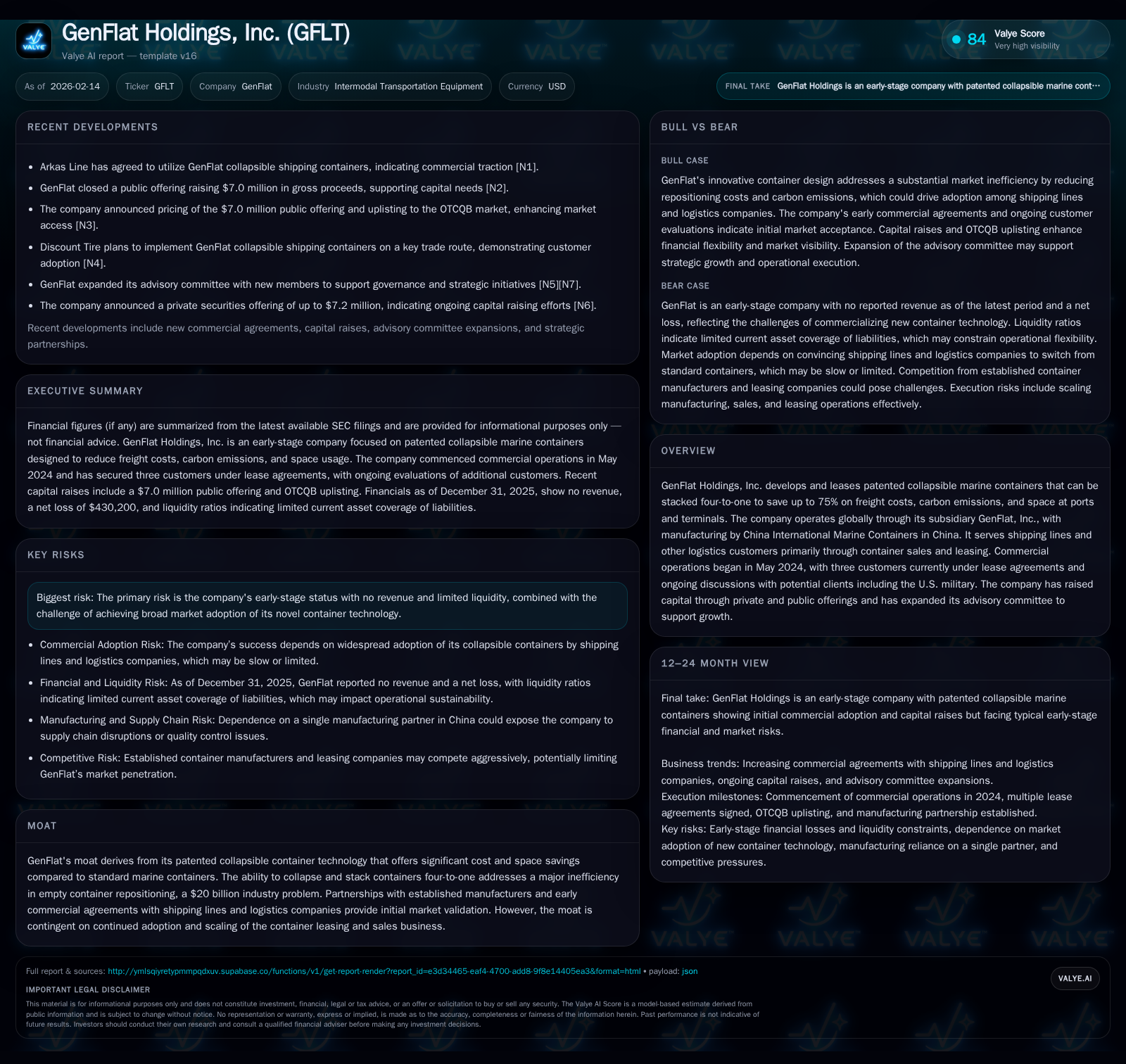
GenFlat Holdings, Inc. has developed an innovative collapsible shipping container designed to reduce freight, emissions, and port congestion by up to 75%. Although commercial operations began in mid-2024 with a handful of leasing agreements and partnerships—including CIMC manufacturing and engagements with shipping lines and government clients—revenue remains minimal. The company’s financial position is precarious with significant accumulated losses, limited liquidity, and an auditor’s going concern warning. While the patented technology offers a defensible competitive edge in addressing a large empty-container repositioning problem, scaling adoption faces challenges amid market incumbency and capital constraints.
Reimagining Container Shipping: GenFlat's Innovative Solution
Navigating the global shipping industry today means confronting a perennial inefficiency: moving vast numbers of empty containers around the world incurring unnecessary costs, space usage, and carbon emissions. Standard marine containers consume the same volume when full or empty, often requiring costly repositioning voyages that add no economic value but swell operational expenses dramatically.
GenFlat Holdings seeks to tackle this entrenched problem through its patented collapsible container technology. Their "GenFlat Container" can be collapsed to a quarter of its standard size, enabling four collapsed units to occupy the space of one traditional container. This innovation translates into potential savings of up to 75% in freight costs, terminal handling fees, transloading expenses, and related charges — a significant reduction that could reshape container logistics efficiency [S1].
The environmental implications are equally compelling: fewer transport trips translate directly into lower carbon emissions across ocean vessels, trucks, and trains — areas under increasing regulatory scrutiny globally. Port congestion relief further underscores GenFlat’s value proposition by freeing up constrained dockside storage [S1]. This confluence of cost savings and sustainability highlights why such an innovation commands interest amid the broader industry push toward greener supply chains.
Early Commercial Moves: Customers, Partners, and Market Traction
Although commercially operational since May 2024, GenFlat remains in an embryonic stage with three customers currently under formal lease or rental contracts. Initial agreements entered in August and September 2025 supplement the first rental contract executed earlier, demonstrating nascent but tangible commercial validation [S1].
Strategic partnership with China International Marine Containers (CIMC), one of the world's leading container manufacturers based in Dalian, China, affords GenFlat a crucial manufacturing backbone since production commenced in September 2023 [S1]. This collaboration positions GenFlat for scalable output aligned with demand growth.
Furthermore, recent public disclosures spotlight Arkas Line—a known player in maritime logistics—as a customer utilizing GenFlat's collapsible containers [N1]. Equally notable are ongoing discussions with strategic prospects including the U.S. military, which if realized could confer both revenue diversification and credibility enhancements indicative of sector endorsement [S1].
While current revenues remain nominal reflecting very early sales cycles and limited volumes, these customer relationships represent meaningful initial traction within a highly conservative shipping industry known for incremental technology adoption.
Financial Realities: Losses, Liquidity Challenges, and Capital Raises
An unvarnished look at GenFlat's financials unmasks stark challenges ahead. The firm reported cumulative net losses of approximately $7.8 million since inception through mid-2025 [S1]. The fiscal year ending June 30, 2025 alone saw losses exceed $4.6 million reflecting ongoing research, development expenses, sales ramp-up efforts, plus administrative overhead [S1].
Liquidity is exceptionally tight: available cash was around $13 thousand as of August 2022 with a current ratio—current assets relative to current liabilities—hovering low at approximately 0.13 at the end of calendar year 2025. This imbalance signals significant short-term financial pressures [F1], raising credible doubts about meeting near-term obligations.
Highlighting these concerns is the auditor’s going concern opinion attached to the company’s June 2025 audited statements citing substantial doubt on continuity without improved profitability or capital infusion [S1]. To address this funding gap, GenFlat recently completed a $7 million gross proceeds public offering [N2], following initial pricing announcements around early February 2026 [N3]. These funds extend operational runway but given historical burn rates underscore ongoing financing dependency.
Competitive Edge or Risky Bet? Assessing the Moat in Collapsible Tech
The crux of GenFlat's sustainable competitive advantage lies in its patented collapsible container design targeting the predominantly invisible but costly empty-container repositioning market—a sector valued at roughly $20 billion globally annually by some estimates [S1]. By enabling stacking efficiency four-to-one post-collapse while preserving standard marine container dimensions when expanded for cargo use, their product addresses a core logistical pain point.
Patents afford intellectual property protection deterring direct replication in the near term; however technological complexity alone rarely guarantees enduring dominance absent market uptake at scale. Entrenched incumbents within the traditional container framework wield considerable entrenched infrastructure and customer relationships that pose adoption headwinds for novel entrants.
Therefore, while GenFlat enjoys a defensible niche innovation today[,] long-run moat integrity depends heavily on industry-wide embrace of their leasing model alongside demonstrable total cost-of-ownership advantages over conventional containers under real-world operating conditions [N1][S1].
Scaling Questions: Manufacturing, Global Demand, and Supply Chain
With manufacturing pegged at CIMC's Dalian facility initiated since fall 2023 [S1], capacity constraints are largely bound by contractual manufacturing arrangements rather than internal production capability gaps. Leveraging CIMC’s expertise could accelerate output scale provided demand justifies ramp-up.
Global demand forecasts remain speculative due to limited historical data points; nevertheless major shipping lines engaging in pilot programs signal underlying interest contingent on trial results. Supply chain dynamics for marine containers involve multi-modal transport coordination often affected by geopolitical factors or raw material accessibility which may create bottlenecks affecting delivery timeliness or cost structures for GenFlat products.
Successfully converting pilot leases like those signed with Arkas Line and others into recurring long-term revenue streams remains pivotal for validating scalability assumptions tied to production volumes and working capital needs supporting inventory buildup [N1][S1].
Navigating Risks: Going Concern Warnings and Market Adoption Barriers
Among principal risks explicitly flagged by management is uncertainty stemming from the going concern qualification underscoring dependency on additional financing rounds or achieving profitable operations imminently [S1]. Failure to secure funds could force severe operational cutbacks or cessation.
Simultaneously customers beyond initial adopters may exhibit inertia toward switching from trusted conventional containers given pervasive industry conservatism around new hardware especially when capital investment cycles typically span years.
Market acceptance is further complicated by nascent revenue track record providing limited historical performance transparency for prospective clients considering leasing commitments at scale.
These factors collectively elevate speculative risk profiles making investor vigilance over subsequent sales growth milestones paramount.
The Road Ahead: Growth Prospects and Strategic Capital Deployment
Management underscores efforts expanding advisory committees enhancing governance input capability alongside targeted marketing strategies including direct email campaigns, presence at industry events, and business-to-business digital advertising aiming to widen institutional client penetration [S1][N2][N3].
OTCQB uplisting achieved concomitantly with recent equity raise denotes strides toward improved investor visibility possibly aiding future capital access initiatives [N3].
Capital raised will likely prioritize augmenting leased container fleets to meet demand pipeline commitments plus scaling sales infrastructure crucial for sustaining momentum beyond pilot deployments.
Yet balancing growth investments against tight cash flow realities requires measured deployment ensuring longevity while nurturing commercial acceptance curves typical for pioneering hardware-centric industrial solutions.
Investor Takeaway: Balancing Innovation Promise Against Early-Stage Uncertainties
GenFlat Holdings exemplifies an archetypal early-stage industrial technology enterprise striving to transform entrenched global supply chain inefficiencies through patented innovation offering compelling operational benefits quantifiable by cost savings and carbon footprint reductions.
However inherent financial frailties highlighted by substantial accumulated losses dwarfed modest working capital combined with auditor reservations regarding business continuity impart caution warranted toward assessing viability absent clear revenue inflection points soon.
Market receptiveness demonstrated via initial lease contracts offers hopeful yet preliminary confirmation; broader scalability contingent heavily upon navigating incumbent resistance coupled with securing further capital injections amidst volatile macro conditions dictating investor appetites for speculative industrial ventures.
Ultimately GenFlat’s journey will be shaped by execution discipline marrying innovative product design advantages with practical commercialization realities inherent to high-capital logistics equipment sectors.
This analysis is based solely on publicly available information including SEC filings and verified news sources as of February 14, 2026. It does not constitute investment advice or an endorsement of any securities.
Disclaimer: This is research-only, informational analysis and not investment advice. It may include AI-generated interpretation and general industry context. Always verify important details using primary sources.

Comments