
Newell Brands: Balancing Brand Strength with Operational and Market Challenges in 2026
A detailed analysis of Newell Brands’ strategic positioning amid core sales declines, supply chain vulnerabilities, and innovation-driven initiatives.
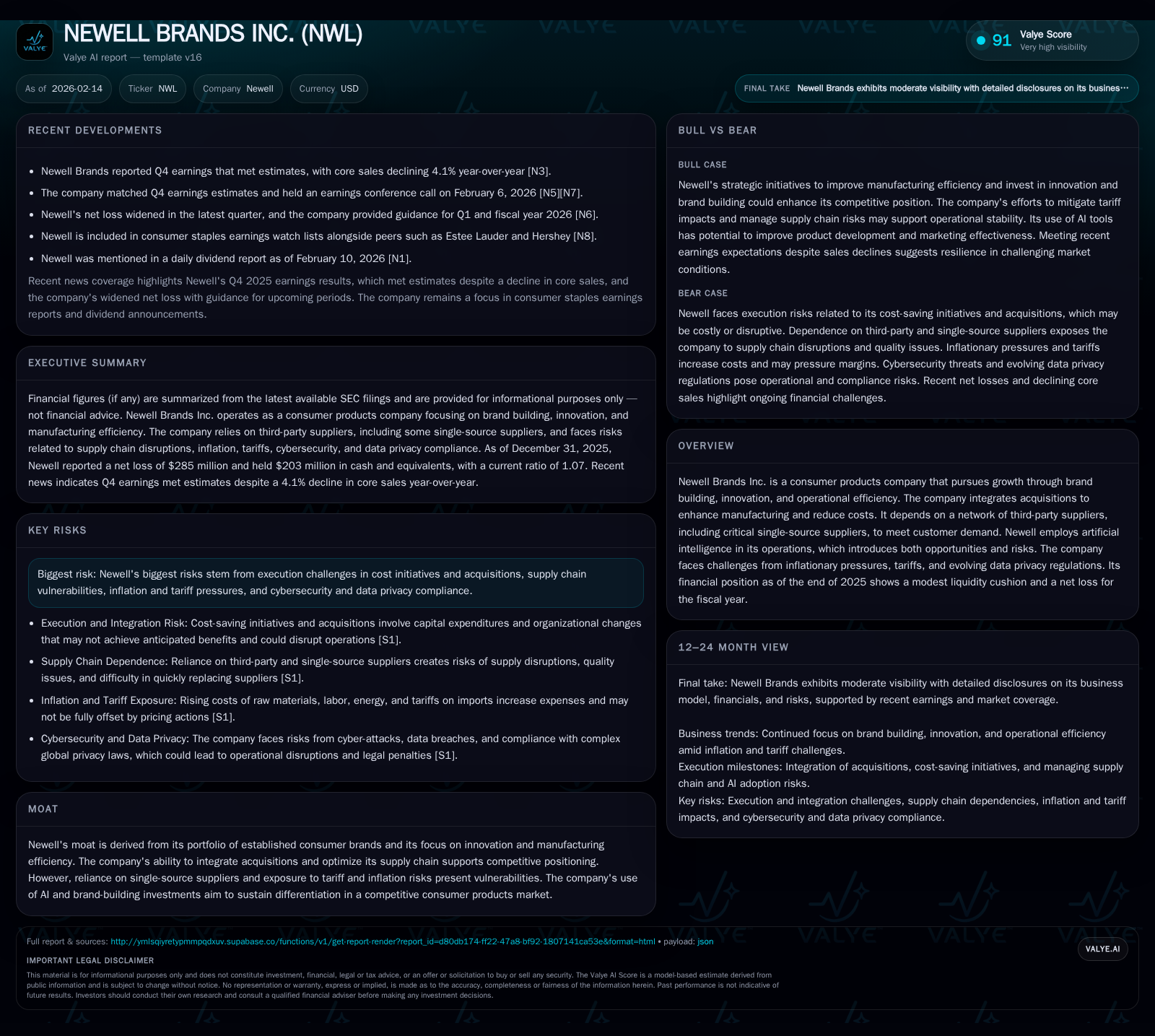
Newell Brands entered 2026 facing a complex landscape where its established brand portfolio offers competitive moats but operational and financial headwinds signal challenges ahead. Despite meeting Q4 earnings estimates, a notable 4.1% drop in core sales and widening net losses highlight revenue pressures. The company’s reliance on single-source suppliers and exposure to inflation and tariffs exacerbate risks, even as strategic use of AI and acquisitions aim to boost efficiency and growth. Leadership under CEO Christopher Peterson navigates these dynamics with focus on cost initiatives and innovation, while evolving regulatory environments add additional compliance complexity.
Newell at a Crossroads: Navigating Growth Amid Core Sales Decline
Newell Brands reported Q4 earnings that matched analyst estimates but were accompanied by a concerning 4.1% year-over-year decline in core sales [N1][N3]. This juxtaposition sets a dual narrative: while the company demonstrates some measure of stability in profits per headline metrics, the underlying softness in sales signals emerging growth challenges. Market reaction was swift—shares plunged pre-market following the release, highlighting investor skepticism about the sustainability of the company's topline momentum [N11]. This mixed picture suggests Newell is at an inflection point where brand strength is tested by intensifying competitive pressures and changing consumer behaviors.
Decoding the Numbers: Financial Health and Liquidity Under the Microscope
A closer examination of Newell's fiscal 2025 results reveals broader financial stresses beyond earnings per share parity. The company posted a net loss of $285 million for the full year, marking a notable departure from profitability [F1]. Its liquidity position is constrained; cash and equivalents stand at $203 million against current liabilities totaling approximately $2.53 billion, resulting in a current ratio around 1.07—a figure indicating limited short-term buffer [F1][S1]. This tight liquidity may restrict Newell’s ability to absorb shocks or aggressively pursue strategic investments without further leveraging its balance sheet. Nonetheless, there remains some room to fund turnaround initiatives on the operational side if executed prudently.
The Strategic Playbook: Acquisitions, Brand Building, and Innovation
Newell pursues growth through a blend of brand-building investments, innovation projects, and inorganic growth via acquisitions [S1][N13]. Integrating acquired businesses aims to enhance manufacturing capabilities and reduce costs through scale. However, such moves carry integration risks including the potential for transaction-related expenses, goodwill impairments, or dilution of focus from core operations. Innovation efforts—especially those enhancing product development or marketing—are viewed as critical levers to revive stagnant sales trends amid intensified competition. Yet innovation also demands upfront capital allocation during periods of margin pressure, making judicious prioritization imperative.
Supply Chain Tightrope: Single-Source Dependencies and Geopolitical Risks
One operational vulnerability lies in Newell’s significant reliance on third-party vendors, including critical suppliers who serve as single sources for key product categories [S1]. The Baby business unit notably depends on a sole supplier responsible for the majority of its sales volume. Such dependencies heighten exposure to external disruptions—whether from shipping delays due to port congestion, geopolitical conflicts affecting global trade routes, or inflation-driven input cost increases [S1]. These supply chain fragilities threaten timely product delivery and quality consistency fundamental to customer satisfaction.
Leveraging AI: Opportunity Meets Execution Risk
Newell has integrated artificial intelligence into various facets of its operations as part of efforts to drive efficiency gains and data-driven decision-making [valye_report_excerpt]. While AI presents promising upside—in predictive analytics for inventory management or automating routine processes—it introduces governance complexities. The company has bolstered cybersecurity frameworks in response to risks inherent in deploying advanced digital tools—including establishment of an Information Security Governance Committee comprising senior executives [S1]. Execution risk exists both in ensuring technology delivers expected benefits without security lapses or data privacy violations.
Leadership in Transition: CEO’s Vision Against Challenging Backdrop
Christopher H. Peterson’s tenure as CEO since May 2023 reflects a leadership style grounded in operational discipline informed by prior CFO and COO experience within Newell as well as leadership roles at consumer-centric firms like Revlon and Ralph Lauren [S1]. His familiarity with finance-operations interfaces positions him well to manage acquisition integrations alongside cost transformation programs underway. Navigating employee morale during restructuring efforts remains a critical challenge under his stewardship given potential distractions from day-to-day execution.
Cost Initiatives and Operational Efficiency: Execution Challenges Unpacked
Newell’s path toward margin improvement relies heavily on aggressive cost initiatives targeting manufacturing optimization and SG&A reductions [S1]. These programs entail organizational change requiring capital investment as well as cultural adaptation. The company acknowledges significant execution risk related to these efforts—they could negatively impact employee engagement or create operational disruptions if not carefully managed [S1]. Moreover, ongoing reviews of operating footprints indicate likely future restructuring charges that could further weigh on near-term earnings.
Risk Radar: Inflation, Tariffs, and Evolving Data Privacy Regulations
Inflationary pressures continue to challenge Newell’s input cost structure alongside dynamic tariff environments impacting import expenses [valye_report_excerpt][S1]. These macroeconomic factors compress margins absent passing through price increases without dampening demand. Additionally, advancing data privacy regulations impose heightened compliance burdens especially given Newell’s increased reliance on digital tools including AI platforms [valye_report_excerpt][S1]. Maintaining compliance while leveraging technology for competitive advantage requires nuanced balancing acts across legal, IT security, and operational teams.
Looking Forward: Market Sentiment and Stock Performance Reactions
The immediate market response to Newell’s Q4 earnings was unfavorable; shares plummeted pre-market due to widened losses guidance for Q1 and FY26 alongside softened revenue outlooks [N11]. Options market activity around NWL exhibits cautious positioning reflecting investor uncertainty about turnaround prospects despite enduring brand equity [N12]. Dividend announcements following earnings offer mixed signals—while continuing payouts may suggest management confidence in cash flow resilience, investors remain wary given tightened liquidity conditions [N9]. Ultimately, market sentiment underscores tension between foundational strengths versus near-term execution risks.
This analysis synthesizes publicly available data up to mid-February 2026 for informational purposes only. It does not constitute investment advice or recommendations regarding Newell Brands Inc.’s securities.
Disclaimer: This is research-only, informational analysis and not investment advice. It may include AI-generated interpretation and general industry context. Always verify important details using primary sources.

Comments